Birdlip
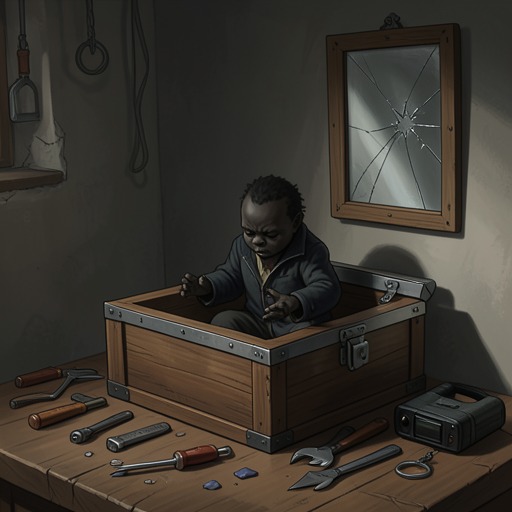
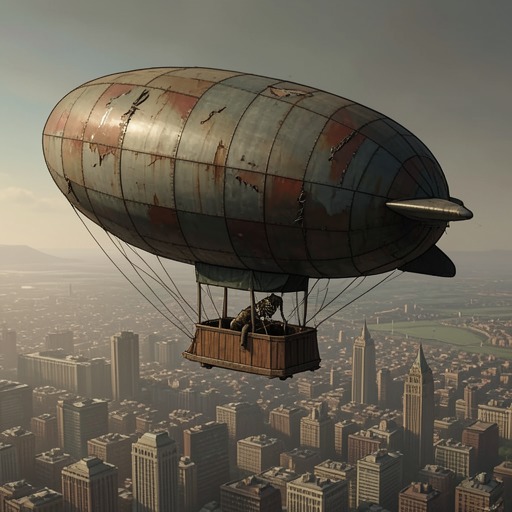
HomunculusBirdlip is the pilot and long-term keeper of a dirigible whose mysterious appearances over London draw scientific scrutiny and religious attention. His craft’s failing engine seems to be guiding it home toward Hampstead, while Birdlip himself remains difficult to classify: the Royal Academy treats him as a speculative mystic rather than a productive inventor, but Langdon St. Ives sees his journey as a genuine search for truth, one whose purpose cannot be reduced to scientific calculation.
Identity and Background
Birdlip has been aloft for fifteen years by the time his failing craft becomes a concern to Langdon St. Ives and William Keeble. Keeble recalls that the dirigible passed five years earlier, in 1865, at a low altitude and farther north than its later course. The difference suggests that its engine is declining, although Keeble suspects the design includes an unintended homing tendency that may direct it toward Hampstead, where Birdlip launched it.
Birdlip is associated with a body of speculative writing as well as with flight. The Royal Academy knows his papers, including The Myth of the Foggy London Night and Time Considered as a Succession of Semi-closed Doors. Its representatives read their subjects and style as signs of a mind given to philosophy and mystery rather than practical invention. Their judgment distinguishes Birdlip’s intellectual preoccupations from the engineering achievement of the dirigible, without explaining where that achievement originated.
The Dirigible over London
In 1870, an oval shadow travels southeast from Iceland toward Greater London. The dirigible later sails above a crowded market and passes over the Victoria Embankment on its way toward Billingsgate and Petticoat Lane. For a few seconds, the dying moon illuminates the slat-sided gondola and the rigid, cocked-hat figure at its wheel. The pilot’s wrists are manacled to the wheel, which is lashed to a strut; the craft then rights itself and continues eastward. The apparition gives the city an image of Birdlip that is at once unmistakably aerial and resistant to ordinary explanation.
The sighting acquires meanings beyond the flight itself. A missionary named Shiloh interprets the passing dirigible as an omen of doom, and the spectacle helps him attract converts. Later, the Royal Academy’s Parsons tells St. Ives that a religious cult has formed around the blimp’s intermittent appearances. He relays rumors that the craft carries a sacred device or talisman in a box, though neither the object’s identity nor the cult’s intentions are established. Birdlip’s vehicle thus becomes a contested sign: for the cult, a possible sacred presence; for the Academy, a technological and institutional problem.
Scientific Reputation and the Academy
The Royal Academy is eager to understand the dirigible and its implications, but its interest is entangled with judgments about who deserves scientific credit. Parsons presents Birdlip as a mystic and seeker after mysteries, not the genius responsible for the engine. He also presses St. Ives to persuade Keeble, a toy-maker on Jermyn Street, to share knowledge of the mechanism. The Academy’s call for rational inquiry therefore carries a practical demand: it wants access to the technology it cannot attribute to Birdlip.
Parsons frames the declining craft as a public danger. Reports from observers who tracked it over the Sandwich Islands and calculations by the Academy’s mathematicians suggest that it is steadily losing altitude and may touch down within Greater London. Parsons imagines either a destructive crash in the suburbs or the dirigible’s loss at sea, and argues that Keeble’s cooperation could clarify the engine before the craft’s return. St. Ives, however, doubts the Academy’s motives. He suspects its representatives want the engine above all, and that they would lose interest in Birdlip once they had obtained it. The conflict exposes the distance between institutional claims of disinterested science and the desire to acquire a remarkable device.
Boxes and Unresolved Mysteries
Birdlip’s long absence from ordinary life is linked to another uncertainty: the whereabouts of a box entrusted to him. After reading Sebastian Owlesby’s notebooks, St. Ives finds a final note, written in a woman’s hand, saying that the box was given to Birdlip. The note does not identify which box. St. Ives considers both the emerald box and the box associated with the homunculus, and wonders which, if either, is aboard the dirigible. He believes Birdlip has apparently cared for one of the boxes during his fifteen years aloft, but cannot establish its identity.
This uncertainty converges with the Academy’s report of a box-like talisman aboard the craft, without resolving the connection. The possibility that Birdlip carries an object sought by others makes his dirigible more than a failing machine: it is also a moving repository whose contents may matter to the conflicts unfolding below. Yet Birdlip’s own intentions toward the box remain unknown.
Mission and Significance
St. Ives regards Birdlip’s purpose as something that cannot be charted or graphed. In his view, Birdlip pursues truth along a course as irregular as the wind-driven path of his airship, and that course has nevertheless brought him home again. Keeble’s account of the engine’s homing tendency offers a mechanical possibility, but St. Ives’s interpretation preserves a larger mystery: a journey may arrive at a destination without its means or motives becoming legible to scientific observers.
Birdlip therefore stands at the boundary between invention and speculation, and between measurable achievement and a purpose that resists measurement. The Academy can track the dirigible’s altitude and predict a possible landing, but it cannot confidently explain its engine, its pilot’s mission, or the significance of the box it may carry. His flight makes those limits visible, while its threatened return turns an abstract dispute over knowledge and authority into an approaching event.