Joanna Southcote
HomunculusJoanna Southcote is Shiloh’s deceased mother, remembered through a miniature portrait, a grave in Hammersmith Cemetery, and remains repeatedly handled and displayed by others. Her hoped-for return is more than a private wish: Shiloh makes her resurrection the supreme test of his faith, while her skull becomes a prop in his public ministry. The uncertain signs of animation that gather around her remains leave the boundary between miracle and manipulation unresolved.
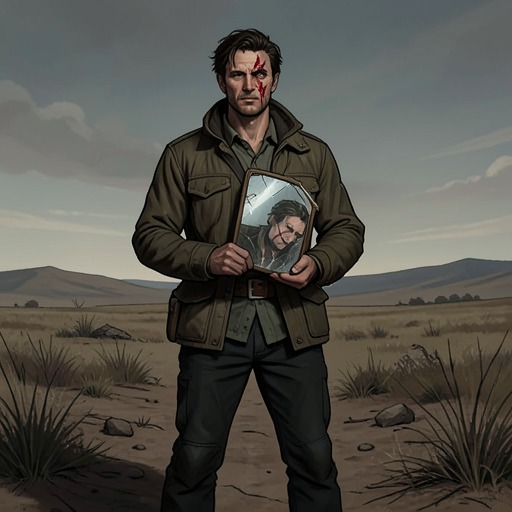
Identity and Background
The evidence presents Joanna chiefly through the people and objects that survive her. Shiloh keeps a miniature portrait of her noble face among the artifacts of a small shrine, alongside a silver crucifix and a sketch of the man he believes to be his father. His sense of family history is bound to the homunculus: he understands the creature as his father and regards its disappearance as part of the history that has kept his family’s story incomplete. The narrative also connects Joanna to the creature’s earlier passage into human hands: an Abyssinian seller had sold it to her eighty-two years before the events described.
Shiloh’s account of their last encounter gives Joanna a decisive role in that history. Twelve years before his later preparations, she confessed to him on a balcony in Kingston that the tiny creature in the box existed and disclosed its fate. She then recanted and disappeared into the Leeward Islands that night. Shiloh has spent the intervening years waiting to learn whether she deceived him. Her confession thus supplies him with a possible answer to his parentage, but her withdrawal leaves him with uncertainty rather than confirmation.
The Search for Her Return
The burial place gives that uncertainty a physical focus. Joanna lies beneath the soil of Hammersmith Cemetery, and her grave is later disturbed by Willis Pule and his companions. Its damaged headstone bears only part of a name, the number eight, and a carved skeleton. The incomplete inscription makes the grave itself a broken record of identity; Pule, by contrast, sees little distinction between one damaged set of remains and another. Shiloh sees the bones as his mother and imagines the return of the person he remembers.
For him, restoring Joanna would outweigh the results of Ignacio Narbondo’s experiments on other dead people. Shiloh privately considers such a success worth more than a thousand animated corpses. His comparison distinguishes his mother from the bodies that serve Narbondo’s work: those bodies may be useful to Shiloh’s movement, but they are not the restoration he actually longs for. The dead can be made to serve a cause, in his view, without thereby being redeemed as people.
That hope also shapes Shiloh’s relationship with Narbondo. When the doctor brings Joanna’s remains to his laboratory above Pratlow Street, he recognizes the danger of disappointing his patron. He considers staging a performance to satisfy Shiloh, even though he knows the old man expects his mother to rise. The episode places Joanna’s remains at the intersection of scientific experiment, religious expectation, and a transaction in which Narbondo hopes to retain Shiloh’s support.
The Laboratory and the Apparent Miracle
When Shiloh arrives, he finds Joanna’s remains laid out on a slab, incomplete and plainly far from the restored figure he had hoped to see. The scene sharply contrasts his expectation with the condition of what has been recovered. Narbondo’s plan to manufacture a convincing display further complicates any claim that the experiment is a straightforward act of resurrection: before the attempt, he is already thinking in terms of a show that might keep Shiloh satisfied.
The experiment nevertheless produces an alarming appearance. Narbondo brings a fresh corpse and a sluggish live carp to the work area, then proceeds with care, concentrating on the procedure. In the ensuing mist, Joanna’s corpse rises above the slab, wavering as if suspended and its jaws moving. The account records the spectacle, but does not establish that Joanna has returned as a living, restored person. Its marionette-like appearance, together with Narbondo’s earlier intention to stage a result, keeps the distinction between experimental effect and genuine resurrection unsettled.
For Shiloh, even the prospect of success carries enormous emotional and religious weight. His hope that Narbondo can revive Joanna is not equivalent to confidence in the doctor’s methods: he has seen the remains and is far from satisfied. Yet he continues to invest the possibility with meaning, because a true return would validate more than a laboratory technique. It would offer him a recovered mother, strengthen his claim to a supernatural family history, and give his followers a miracle that his ordinary handling of corpses cannot supply.
The Skull as Public Relic
Joanna’s remains later enter Shiloh’s preaching as a public exhibit. Before a crowd, he presents her skull in a glass case and works a box while exhorting the onlookers. The teeth seem to move, but the effect is slight, and the narrative expressly leaves open whether the apparent motion comes from the skull or from the attendant shaking it. The scene does not confirm a resurrection; it shows how an uncertain physical sign can be framed as evidence before an audience gathered in expectation of one.
The public display also makes Joanna’s remains vulnerable to seizure and ridicule. Theophilus Godall disrupts the performance, takes control of Shiloh’s wagon and props, and drives away with the skull among them. The head’s later appearance in the confusion of the final events is no longer a controlled religious sign: it rolls to a stop near Parsons, its jaws moving once before it lies still. Parsons later finds Joanna’s head among weeds beside a stuffed chair, while a corpse nearby has ceased responding to him. The remains persist, but the evidence offers no settled return of Joanna herself.
Narrative Significance
Joanna’s narrative importance lies in the contrast between a person Shiloh hopes to recover and the material fragments that others repeatedly put to use. Her portrait preserves an idealized image; the grave and the laboratory confront that image with remains; the glass case turns those remains into proof for a crowd. Across these settings, the object of Shiloh’s devotion is repeatedly converted into evidence, experiment, or spectacle, without the text confirming that the person he seeks has come back.
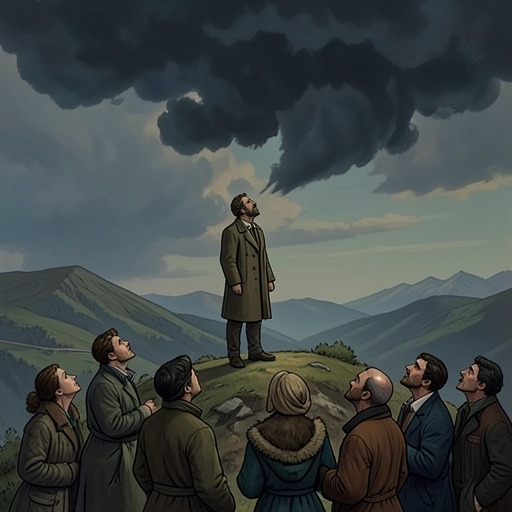
Her story also exposes the limits of Shiloh’s apocalyptic certainty. He predicts world-shaking change and treats the possibility of his mother’s return as a sign of divine significance, yet the demonstrations around her remain open to practical explanation and fail to deliver the restoration he wants. When Shiloh later names a falling light Wormwood before a crowd, the spectacle of the heavens gives his prophecy dramatic force, but Joanna’s skull remains among the abandoned props of his public campaign. Her ending is therefore not a confirmed resurrection or a recovered family life. It is the continuing presence of her remains, while the hope invested in them passes from grave to laboratory to unstable public display.