Dr. Birdlip
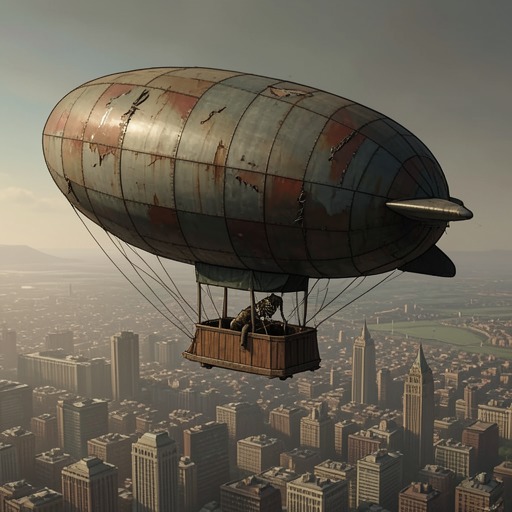
HomunculusDr. Birdlip is a philosopher, inventor, and seeker after mysteries whose returning dirigible draws the attention of scientists, religious cultists, and Langdon St. Ives. The uncertainty around the craft’s engine and purpose makes Birdlip a point of tension between knowledge that institutions can measure and a quest whose meaning, in St. Ives’s view, cannot be reduced to technical explanation.
Identity and Reputation
The Royal Academy regards Birdlip as an unusual figure: a self-described philosopher and mystic rather than the practical genius it assumes must have created his perpetually propelled craft. Its members know of his papers, including The Myth of the Foggy London Night and a speculation about spectacles that would reveal successive layers of time as doors along a corridor. These writings mark him as a thinker drawn to phenomena beyond ordinary scientific categories. The Academy’s doubts about his engineering ability do not amount to indifference; his flight is too consequential to ignore, and the institution wants an account of how the vessel works.
Birdlip’s reputation therefore rests on a productive contradiction. The Academy treats his flight as a technological achievement requiring explanation, while regarding his philosophical interests as evidence that he is not the person who could have engineered it. St. Ives, by contrast, accepts that Birdlip may not be the engine’s designer but does not take this as a reason to dismiss him. The distinction between making a machine and pursuing the purpose it serves becomes central to how the two men understand Birdlip.
The Dirigible and Its Return
Reports place Birdlip’s craft over the Sandwich Islands weeks before the Academy’s deliberations. Two men in a balloon tracked it there, and the observations suggested that it was steadily losing altitude. The Academy’s mathematicians projected that it would come down within Greater London. They feared either a destructive crash in the suburbs or a fall into the Atlantic, where storms might reduce it to wreckage. The uncertain route and condition of the vessel turn Birdlip’s return into both a public danger and a problem the Academy wants to control.
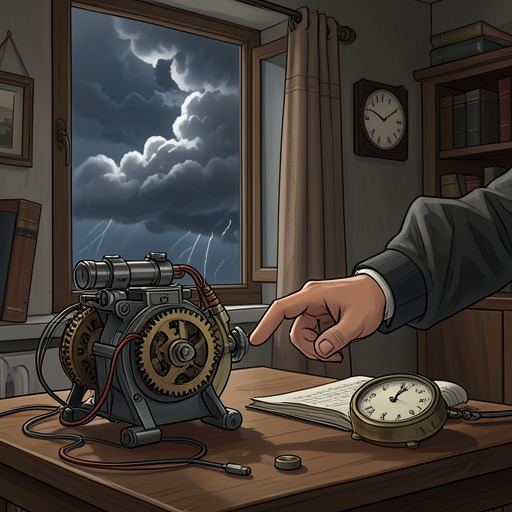
The urgency strengthens the Academy’s pressure on St. Ives. Its members want him to persuade William Keeble, a toymaker, to share knowledge of the craft’s workings. They argue that Birdlip could not have built the engine and that Keeble might explain it. Their appeal combines practical concern about the dirigible’s possible landing with a demand for access to the technology. St. Ives recognizes that, if Keeble supplied the engine’s secrets, the Academy would lose much of its interest in Birdlip himself.
Competing Interpretations
The Academy’s concern is not limited to engineering. Parsons tells St. Ives that Scotland Yard has infiltrated a dangerous cult whose members believe a sacred being, or god, resides in a curious box carried aboard Birdlip’s craft. The cultists have fixed their attention on the dirigible, though the Academy does not know whether they mean to destroy it or turn it into a temple. Parsons presents the Academy’s intervention as a defense against both possibilities. The episode places Birdlip’s flight at the intersection of institutional science and religious expectation, with neither side possessing a complete account of what the craft carries or represents.
Theophilus Godall offers another interpretation of the box’s significance. Considering the possibility that Kelso Drake wants to obtain what Sebastian Owlesby had sought, Godall speculates that Drake may believe Ignacio Narbondo can provide it. He connects that possibility to the blimp’s landing and to the hunchback’s apparent belief that the homunculus is aboard. This is Godall’s inference, not a confirmed account of Birdlip’s intentions, but it shows how the approaching craft draws competing interests toward the same uncertain object. Birdlip’s flight becomes a meeting point for scientific ambition, criminal schemes, and cult belief without resolving those motives into a single explanation.
St. Ives’s Assessment and Narrative Role
St. Ives rejects the Academy’s effort to make technical disclosure the sole measure of the episode. He believes its members want the engine and little else, and that their interest in Birdlip would recede if Keeble handed over the mechanism. In his view, Birdlip’s pursuit of truth follows a course that cannot be charted and graphed, yet has brought him home again. St. Ives contrasts this destination with the unpredictable means of the journey: the craft’s erratic course is not, to him, proof that the endeavor lacked direction.
That contrast gives Birdlip a distinctive role even when he is discussed more often than directly observed. To the Academy, he is an inadequate candidate for the technical achievement attributed to his flight; to St. Ives, he is a genuine seeker whose journey has reached a meaningful end by means the Academy cannot recognize. The dirigible’s threatened descent makes those disagreements urgent, while the rumors about its passenger and cargo widen the stakes beyond engineering. Birdlip thus embodies the novel’s uncertainty over who can claim knowledge of a marvel—and whether explaining its mechanism is the same as understanding its purpose.