Shiloh
HomunculusShiloh, also known as the New Messiah, is an age-ravaged street preacher whose apocalyptic faith binds together a returning dirigible, the Homunculus, and the hoped-for resurrection of his mother, Joanna Southcote. He gathers followers and draws crowds with warnings of the end, but his religious authority rests on claims that repeatedly meet confusion, failure, and competing explanations. His story makes prophecy both a tool for organizing a movement and a way of imposing meaning on events he cannot control.
Identity and Religious Mission
Shiloh appears among the market crowds as a tall, visibly aged missionary in sackcloth and ashes. Shivering as he preaches, he thrusts tracts at passersby, who answer with curses and occasional blows; neither their hostility nor their indifference seems to interrupt his work. He presents himself as the Son of God and turns his marginal position into a public vocation: he calls people to repentance while insisting that catastrophe is near.
His movement is called the New Church. Its promise is not merely salvation from a coming disaster: Shiloh claims that he can raise people from the grave and redeem the dead. That claim gives his preaching a practical, spectacular edge. The faithful are asked to believe not only in his authority but in visible evidence that death can be reversed. Yet the scenes surrounding his ministry leave the nature and reliability of that evidence in doubt.
Origins, the Homunculus, and the Dirigible
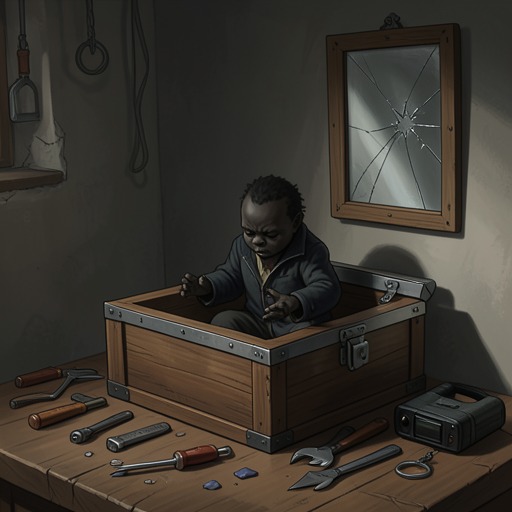
Shiloh’s account of himself depends on an extraordinary belief about his parentage. He is certain that the tiny being kept in a box by Sebastian Owlesby—the Homunculus—was his father. He treats that conviction as the explanation for his monumental birth and for the suffering and deprivation he says followed from being born as he was. In his own account, this identity was imposed on him, not chosen; his messianic mission becomes the work he must perform because of that origin.
Twelve years before the events recalled in his history, Shiloh confronted Nell Owlesby, who told him of the tiny creature in the box and its fate. She later withdrew her confession and disappeared into the Leeward Islands. Shiloh waited for years to discover whether she had deceived him. That disclosure connects his private claim of divine descent to the wider struggle over the Homunculus, while Nell’s recantation leaves the foundation of his belief uncertain rather than confirmed.
The dirigible becomes the other central sign in Shiloh’s prophetic scheme. He believes its arrival has been foretold and has fixed its coming to a particular day. More than four years before his later preparations, he saw it pass in the early morning beneath a dying moon, with an animate pilot looking down from the gondola. He reads the memory not as an isolated sighting but as a promise of the upheaval that will reveal his birth and his father’s identity. The airship’s return is therefore at once a public portent and the anticipated answer to his personal history.
Organization and Public Performance
Shiloh’s movement operates through a network of followers whom he calls his flock. Rather than employ agents to distribute his counterfeit half-crowns, he passes the coins through believers, who understand their circulation as service to his religious cause. The arrangement entwines material fraud with devotional labor: religious tracts cover the freshly worked coins, and Shiloh imagines that both the money and its distribution advance the work of God. His followers make the movement more than a solitary act of preaching, even as the evidence gives little indication of a stable formal structure.
His public methods rely on repeated signs and displays. At Kensington Gardens, a large crowd gathers behind him, while members of his flock distribute tracts. Shiloh presents a glass cube before the assembled people, and the crowd’s attention shifts from the object to the sky as a bright point descends toward Hampstead Heath. He names the falling star Wormwood, fitting the sight into his apocalyptic framework. The spectacle brings prophecy, sacred object, and a mass audience together, but it does not establish that Shiloh controls or understands what is happening.
His influence also reaches beyond the people physically gathered around him. As the dirigible’s expected arrival and the Pratlow Street corpses become newspaper news, accounts of aliens, ghouls, and Armageddon circulate together. Reports attribute to Shiloh the idea that the dead will rise in vast numbers. The resulting public fear merges distinct events into a single imagined crisis. In this atmosphere, his religious language helps shape how London interprets the approaching airship and the reanimated dead, even when the reported connection between them remains uncertain.
Joanna Southcote and Conflict with Narbondo
Shiloh’s most intimate hope is that Joanna Southcote, whose body lies in Hammersmith Cemetery, might be restored. He considers this outcome worth more than any number of Dr. Ignacio Narbondo’s animated corpses. The comparison reveals a limit to his apparent enthusiasm for reanimation: the corpses may be useful to his movement, but they are not a substitute for the return of his mother. His belief in the Homunculus as his father and his desire to recover Joanna meet in a personal hope that no public sermon can satisfy.
That hope brings him into conflict and negotiation with Dr. Ignacio Narbondo, whose experiments use carp glands in attempts to animate the dead. Shiloh confronts him while Joanna’s remains lie disassembled on a laboratory slab. Faced with the disorder of the scene, he takes a brief movement of her bones as evidence that she has spoken; her hand then falls away, and he recoils. The episode shows how readily his desire for a miracle shapes his interpretation, while the physical failure of the display undermines the certainty he brings to it.
Even so, Shiloh tries to bargain with Narbondo, offering an unnamed woman in exchange for the valuable gland. Narbondo refuses to accept the offer as stated and insists that Shiloh will pay. In a later confrontation, Shiloh asserts that Nell Owlesby is safe with his flock, while Narbondo counters that many of the same followers are his and orders that she be found. Shiloh’s religious network is thus also a contested resource, claimed by opposing men for their own purposes. He leaves one encounter with the woman and accomplices, but the supplied scenes do not resolve the bargain or establish that he secures his mother’s restoration.
Crisis and Narrative Significance
When Joanna’s animating force appears to fail after Shiloh has taken her away from Narbondo’s laboratory, he questions what has gone wrong. He wonders whether the failure should humble him, then rejects the implication: he considers himself blameless and resents the deprivation he associates with his parentage. The episode exposes the strain beneath his confidence. The promised miracle has become an unstable performance, and his response is not a clear renunciation of his mission but a renewed effort to make events fit his understanding of himself.
At the climactic gathering on Hampstead Heath, Shiloh raises the cube before the crowd as a glowing object falls from the sky. The crowd’s attention swings upward; in the confusion, a running figure seizes the cube and carries it away. Shiloh is thrown forward, and the figure later smashes the container while the assembly watches the descending object. The moment sharply reverses the authority of his staging: the crowd witnesses neither a controlled revelation nor the fulfillment of a demonstration he can command, but a spectacle overtaken by events.
Shiloh’s importance lies in the way his conviction turns uncertain phenomena into a coherent end-times narrative. His preaching attracts followers, gives public form to fears about the dead, and directs attention toward the returning dirigible. Yet the same narrative leaves him vulnerable when the promised restoration fails and the spectacle slips from his grasp. His final appearance in the supplied evidence is bound to that reversal; what becomes of him afterward is not established.