Kelso Drake
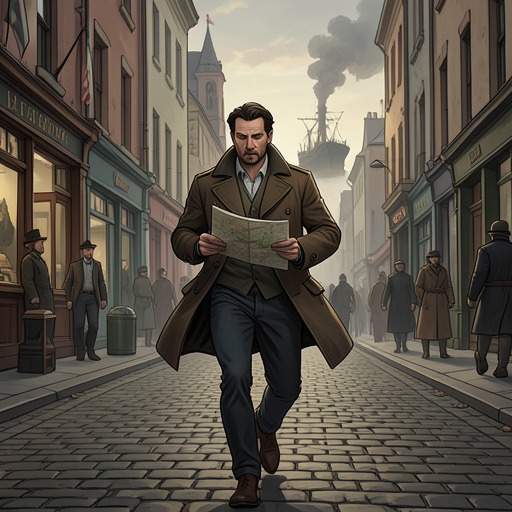
HomunculusKelso Drake is a wealthy industrialist whose pursuit of perpetual-motion technology develops into a campaign to acquire mysterious boxes and control the people connected to them. He moves between respectable commerce and covert dealings with Ignacio Narbondo, relying on money, agents, and intimidation to get what he wants. His attempts to obtain William Keeble’s engine plans and recover a box repeatedly draw him into opposition with Langdon St. Ives and the Keeble family; by the events on Hampstead Heath, his pursuit has become part of a struggle in which the boxes, rather than their would-be owners, determine what happens next.
Identity and Ambitions
Drake is introduced as a millionaire with industrial ambitions. William Keeble says Drake approached him about the patent for a perpetual-motion device, apparently imagining that such engines could power entire factories. Drake’s interest is not limited to inquiry: he wants the plans and is prepared to pay substantial sums for them. When Keeble refuses, Drake doubles his offer, but money does not overcome Keeble’s distaste for the proposed industrial use of the invention.
The contrast between the two men is presented through their encounter as well as their disagreement. Drake arrives at Keeble’s house in new, expensive clothing and carries himself with a self-satisfied superiority that makes Keeble feel diminished in his nightshirt and embroidered cap. Keeble sees in Drake’s manner the confidence of a man accustomed to treating wealth as leverage. Drake’s polished appearance and commercial purpose are set against Keeble’s eccentricity and refusal to treat scientific work as a commodity merely because it can be made useful to industry.
That conflict sharpens when Keeble admits he is unsure whether he might eventually sell Drake the plans. Jack Owlesby objects, and Theophilus Godall argues that Drake must not obtain the engine. Godall has learned that Drake is in league with Ignacio Narbondo: the two conduct business, and Godall has observed Drake visiting Narbondo more than once. He has also followed them to a discreet public house in the Borough, where they met separately rather than appearing together. Drake’s ambitions therefore reach beyond factory power; they are entangled with Narbondo’s secret work and the network of concealment around it.
The Boxes and the Scientific Pursuit
Drake’s interest in the boxes is persistent, and the novel gradually connects it to his wider dealings. Bill Kraken tells St. Ives that Drake had spoken of a machine or ship, identifying him as a source of information about the extraordinary craft at the center of the scientific mystery. Later, at St. Ives’s country house, Billy Deener exploits a diversion to enter the silo and approach the spacecraft. Deener intends to take a box for Drake and considers damaging the vehicle as an additional act against St. Ives and his associates. The episode makes clear that Drake’s agents are willing to pursue the boxes alongside the inventions themselves.
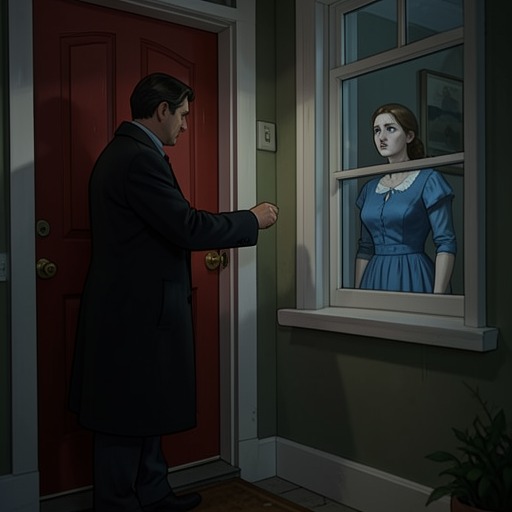
Drake’s urgency increases after he returns from Harrogate without the box. While waiting in St. James’ Square, he weighs whether to abandon his surveillance, but concludes that failure is no longer tolerable and that time is running short. He recognizes the box when Jack Owlesby carries it through the fog with Dorothy Keeble. Drake’s man attacks the pair, takes the box, and carries Dorothy away with an accomplice through a concealed way into the Kermit Street sewer. The hidden route makes the city’s underground infrastructure part of Drake’s operation: the abduction disappears from the alley into a passage that links the sewer to the house on Wardour Street.
When Dorothy wakes in Drake’s custody, she recognizes him as the cigar-smoking man who had previously argued with her father. She is feverish and disoriented, and the men attending her include Drake and a bent figure she associates with the doctor. Kraken later reports that Drake will not allow people near Dorothy except the doctor, while presenting her illness as something the doctor is meant to treat. The account establishes Drake’s control over access to her and his continued connection with Narbondo, but it does not establish that the promised treatment is genuine.
Alliances, Signals, and Conflict
Drake’s partnership with Narbondo is reinforced by his use of objects as messages. After Drake visits the Keeble household, Winnifred Keeble finds an unfamiliar novelty device he has left behind and says he had asked William to make a hundred more. Godall identifies it as the Marseilles Pinkle, a device with a history of being sent to the families of abducted young women as a warning that ransom would not secure their return. In this instance, Godall reads it as a sign of Drake’s conceit and as a possible clue to Dorothy’s whereabouts. Its presence turns an apparently absurd toy into evidence: Drake’s gifts and requests may carry meanings concealed from the people who receive them.
The object also exposes a limit to Drake’s control. Keeble has no idea what the device signifies, and Drake’s gesture does not produce the response he might expect from a wealthy family accustomed to ransom demands. Instead, Godall recognizes its history and interprets it as part of the investigation. Drake can use his wealth and access to place objects where he chooses, but those objects can be read by opponents and turned against him.
Drake’s dealings with Deener show a more openly criminal side of his power. Deener acts as his agent in pursuing the boxes and Dorothy, while Kraken’s later account places Drake at the Wardour Street house during the struggle involving Dorothy and the increasingly unstable Willis Pule. Drake’s conduct there is not presented as a straightforward alliance of equals: he exercises authority over Dorothy’s confinement and participates in a shifting arrangement with Narbondo, even as Pule’s hostility threatens to disrupt it. The criminal partnership gives Drake reach, but it also gathers volatile and competing interests around him.
Wardour Street and the Reversal of Power
The Wardour Street house gathers Drake’s schemes into one setting. During the rescue of Dorothy, Langdon St. Ives and William Keeble encounter confusion throughout the building, and Drake is found caught in his own outer garment after a struggle. Keeble strikes him while Drake is unable to defend himself; Drake then breaks free and attacks, only for Keeble to bring him down with a truncheon. The reversal is brief but consequential: the man who has used wealth and agents to dominate others is reduced to a vulnerable opponent, and Keeble answers the earlier pressure over the engine plans with direct resistance.
Afterward, St. Ives sees Drake return to the house’s great hall. Despite his bandaged head, Drake is still pursuing the boxes. He forces open a leather bag, retrieves a Keeble box from a mirrored buffet, puts it inside, and leaves. The scene shows that being thwarted in the struggle over Dorothy has not changed his objective. Nor does the rescue secure all the boxes: Drake is able to remove another from the house while St. Ives turns his attention to the strange spacecraft in the hall.
Hampstead Heath and the Unsettled Ending
At the gathering on Hampstead Heath, Drake appears after the arrival of the Captain’s wagon and then disappears from view, prompting Godall to keep watch for him. The Keebles remain in the wagon because neither Jack nor Dorothy is well enough to join the crowd; Dorothy is recovering from the effects of the drugs used during her capture. The boxes are distributed among several people, while Drake remains a threat to their recovery and safety.
Kraken eventually runs into Drake and strikes him, taking a Keeble box from his hands. Drake pursues him as the crowd surges toward Dr. Birdlip’s arriving dirigible. Later, Drake attacks Jack Owlesby and sends the box Jack is carrying toward the fire. St. Ives knocks it aside, but it lands in the lap of the enigmatic ghoul seated nearby. When Drake tries to smash another fallen box, Godall and St. Ives intervene. The box opens and releases the clockwork alligator, which snatches up the little birds before sinking back inside. The event makes the boxes active participants in the confrontation: they are not simply prizes that Drake can command or destroy at will.
Drake’s final position is one of continuing defeat rather than a clearly reported resolution. His pursuit has brought him into open conflict with Kraken, Jack, Godall, St. Ives, and the Keebles, and his attempts to seize or break the boxes are repeatedly interrupted. The novel does not establish his ultimate fate in these scenes. It does, however, complete the pattern of his ambition: the industrialist who imagines machinery as something to own, multiply, and direct encounters devices whose workings and consequences escape his control.