Willis Pule
HomunculusWillis Pule is a self-educated alchemical enthusiast and persistent accomplice to Ignacio Narbondo whose shifting schemes repeatedly redirect the struggle over the Keeble box. He enters the story presenting himself as a scholar, but his learning serves ambitions that grow increasingly personal: securing the emerald, outmaneuvering his associates, and punishing those he believes have denied him what he deserves. By the end, those practical aims have given way to a desire for destruction, and he is the one who breaks the box and releases the Homunculus.
Identity and Introduction
Pule first approaches the Trismegistus Club by claiming acquaintance with Dorothy Keeble and an interest in its scientific discussions. Jack Owlesby immediately doubts the claim: he knows Dorothy’s friends and sees no reason to count Pule among them. The visitor identifies himself as a student of alchemy and phrenology, and invokes Sebastian Owlesby’s research. His composure in the face of the club’s unfriendly reception helps make him appear deliberate, but the scene also establishes that he is prepared to use a plausible scholarly introduction to gain access.
The account of Pule’s earlier studies gives his learning a more substantial basis than his first impression at the club might suggest. He has explored old European library collections and has learned of the Homunculus through scattered references reaching back to antiquity. He connects the creature to an earlier appearance in London, to Joanna Southcote, and to accounts of powers over life, motion, energy, and the transformation of metals. Those associations make the Homunculus more than a curiosity to him: it is the center of a history that he believes has shaped major scientific work and ruined Sebastian Owlesby.
Pule’s scholarship coexists with a conspicuous concern for his appearance and public standing. He studies his reflection in a shop window and worries about the acne on his face, having tried various remedies without success. That self-regard sits beside his belief in his own intellectual distinction. He considers physical exertion beneath him, yet repeatedly accepts dangerous, humiliating work when it promises access to an object or advantage he wants. The difference between the learned identity he cultivates and the desperate tasks he undertakes becomes one of his defining contrasts.
In Narbondo’s Service
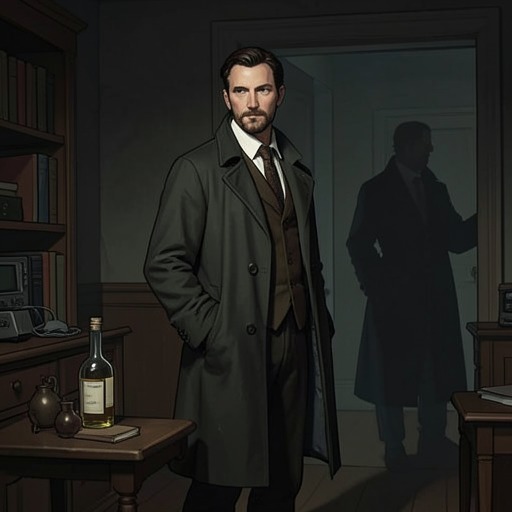
Theophilus Godall identifies Pule as a man who has recently been in Ignacio Narbondo’s company. Godall had seen the two together and followed Pule after he left the club, tracing him to Haymarket, where he met Narbondo. His observation confirms that Pule’s apparent visit to the club is not an isolated scholarly excursion: he is already connected to the doctor and has reason to approach the group under a misleading pretext.
At the oceanarium, Pule takes on the physically difficult role in Narbondo’s effort to obtain a carp. The fish is needed for the attempt to revive Joanna Southcote; without it, Narbondo’s prospective demonstration to Shiloh would fail. Pule struggles with a window, falls while entering, and eventually leaves with the carp, but the fish is badly damaged in the process. He tries to revive it in a keg of water, only to recognize that it is effectively lost. Narbondo’s dependence on the carp makes Pule’s clumsiness consequential, while the episode exposes their unequal partnership: Pule performs the dangerous labor as Narbondo waits ready to escape.
The damaged fish does not end the immediate scheme. Narbondo removes a gland from it, although the tissue is also compromised, and returns to his laboratory to find Shiloh waiting beside the unsuccessful remains of Joanna Southcote. Pule’s part in the episode is thus both necessary and disappointing: he has secured the required animal, but not in a condition that promises a reliable result. The failure leaves Narbondo to improvise a show for Shiloh, whose payment depends on seeing his mother rise.
The Box, the Emerald, and Rivalry
Pule’s goals become especially clear when he learns from Bill Kraken that the Keeble box contains Jack Owlesby’s emerald. He immediately weighs the jewel against Narbondo’s scientific interests and decides that its value, and the chance to deprive Jack of it, outweigh the doctor’s project. His resentment also extends to Dorothy Keeble, whom he believes has rejected him. He considers drawing Kraken into an alley and attacking him, while sending a boy ahead with the carp because Narbondo has paid for it. The plan is not loyalty to Narbondo so much as an attempt to keep several possibilities open while preparing to take the prize for himself.
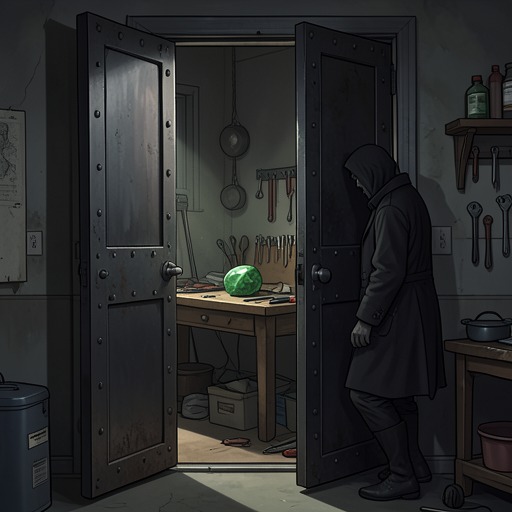
When Narbondo asks what is in the Keeble box, Pule identifies the emerald and privately settles on obtaining it regardless of what happens to his associate. He intends to wait for a better opportunity rather than force the issue at once. But Kraken is already under suspicion, and Narbondo draws a revolver to control him. Pule helps get Kraken into the wagon; the men leave with Kraken clutching the box, while Pule takes the pistol from Narbondo. Cooperation here is tactical, not trustful. Pule helps transport the box while keeping his own claim to it in view.
A later escape aboard a train brings another sudden chance. Pule discovers a sleeping passenger with a Keeble box on his lap as his pursuers close in. He strikes the passenger with a loose iron bar, takes the box, and escapes from the moving train by jumping into a pasture. The act secures his immediate flight, but does not settle the larger contest. He imagines returning to Harrogate to make another attempt, then recognizes that further heroics could cost him the advantage he has gained. The episode shows how readily he shifts between boldness and calculation: he takes a severe risk when an object he wants appears within reach, then restrains himself when the likely return no longer justifies the danger.
Breakdown and Escape
After the conflict at Kelso Drake’s house, Pule is expelled and left with a chemical treatment beneath sticking plaster. Bill Kraken later recounts seeing him with green hands and smelling strongly of chemicals; Pule had been raging against Narbondo, Drake, and the city itself. The report follows Pule’s failed pursuit of Dorothy and his sense that he has been cheated of both the emerald and his hopes. He still moves toward Narbondo’s rooms, but his fixation has begun to exceed any coherent plan.
Pule regains consciousness in a morgue, cold and in pain, and at first wonders whether Narbondo has reanimated him. He sees bodies associated with Narbondo’s activities, including people taken from the streets and a man he recognizes from Westminster Cemetery. The discovery forces him to consider how the dead came to be there and whether the passage to the laboratory has been found. His own immediate conclusion is practical: if Narbondo is arrested, Pule may be arrested too. He leaves the slab and searches for a way out.
To escape the morgue, Pule arms himself with a bone saw, then uses a paperweight when the saw breaks. He reaches the street and heads toward Wardour Street, where Narbondo is expected to be. He has been promised Dorothy as a reward for success in Harrogate, but now regards himself as swindled of the emerald and of his dreams. His declared intention to claim what is his follows directly from that perceived betrayal; it is not a renewed, stable alliance so much as another turn in his personal campaign.
The treatment on his face worsens as he walks through London. Pule imagines that the chemicals might explode and turns the possibility into a fantasy of making a dramatic entrance among his enemies. His laughter grows uncontrollable, then gives way to sobbing and despair. These abrupt changes register a marked deterioration: the clever schemer who once delayed action to improve his odds is no longer able to maintain command of either his plans or his emotions. Nevertheless, he continues to carry a bomb toward the house where Bill Kraken and Hasbro are waiting. They see him approaching with the device; Kraken attacks him, and Hasbro tries to extinguish its fuse. Pule’s arrival turns his private breakdown into an immediate danger to the people around him.
The Keeble Box and the Ending
At Hampstead Heath, Pule’s final change is made visible through the box itself. As Dr. Birdlip comes down onto the green carrying the Keeble box, Pule breaks from the group and rushes at him. The Captain tries to stop him, but Pule takes the box from Birdlip. His purpose is no longer described as obtaining the emerald or securing a share of Narbondo’s work. The narration presents him as coveting mayhem and ruin, the endpoint of the resentments and reversals that have accumulated through the plot.
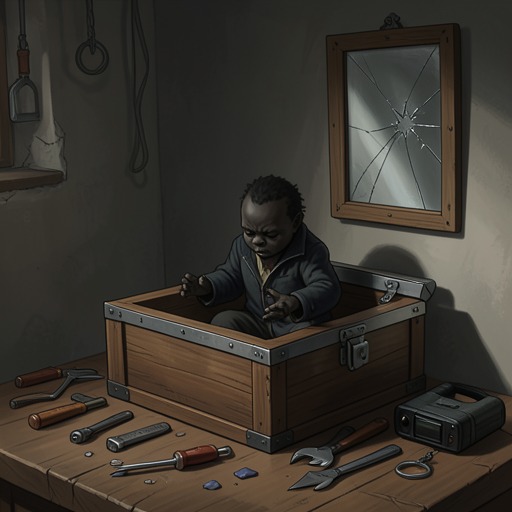
Pule smashes the box against a stone, scattering its carefully fitted parts and sending the lid into the crowd. The Homunculus tumbles free after its long confinement. Pule has therefore achieved a decisive consequence, but not in the form he once pursued: he does not keep the emerald or use the box to improve his position. Instead, he destroys the container that has been the focus of competing schemes and releases the being inside it.
Afterward, Pule clutches at his head as his destructive frenzy passes, and the narration describes him as emptied. Theophilus Godall watches him recede into the shadows and chooses not to pursue him, allowing him to wander away. The contrast with the beginning is stark. Pule first arrives at the club presenting himself as an informed student with a calculated reason to be there; at the end, the calculating accomplice has been reduced to a spent figure whose last consequential act is an act of ruin. His trajectory binds the book’s contests over knowledge, money, and possession to the destructive force of resentment when every promised reward seems to have been lost.