Langdon St. Ives
HomunculusLangdon St. Ives is a scientist, inventor, and determined investigator whose work joins experimental machinery to a restless pursuit of the unknown. He helps William Keeble complete an oxygenator for a spacecraft, pursues Willis Pule after the thefts and sabotage surrounding their work, and eventually discovers and pilots an alien craft. His importance lies not simply in building machines: again and again, he has to decide whether knowledge should be pursued through official institutions, private investigation, or direct action, while the objects he seeks prove difficult to distinguish from one another and easy for others to turn into instruments of power.
Identity and Scientific Work
St. Ives has a laboratory in Harrogate and is described as a man of science, but his interests exceed the formal demonstrations expected of scientific work. When a seller offers a gyroscope in London's West End, he refuses it: he has no need for one and would rather spend some of his money on genuine knowledge. The refusal establishes a practical distinction in his character. He values scientific instruments when they serve inquiry, not merely because they carry the prestige of scientific display.
His collaboration with William Keeble gives this principle a material form. St. Ives brings Keeble the design for an oxygenator, which Keeble believes is finished, and says that the rest of the ship is ready. They plan to launch in May if the weather clears. The work depends on shared expertise: St. Ives has designed the larger undertaking, while Keeble contributes the device and mechanical skill needed to make it function.
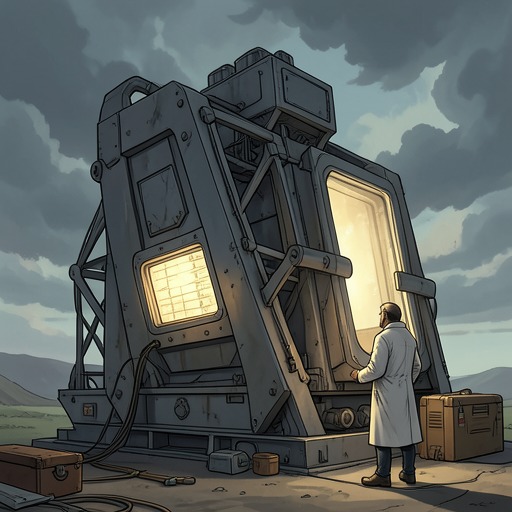
The spacecraft he prepares is a spherical iron shell, its surface crosshatched with rivets, mounted above a structure resembling an enormous rocket inside the silo at St. Ives’s manor. A system of pulleys and chains is meant to draw back the dome so the craft can emerge. Batlike arched wings hug the hull, motivator and exhaust tubes project from their bases, and heavy-glass windows ring the vessel beneath its locking hatch. St. Ives also places potted orchids and begonias inside, making the craft's interior part of the practical problem of sustaining life, rather than treating flight as an isolated mechanical feat.
Inquiry, Setbacks, and Pursuit
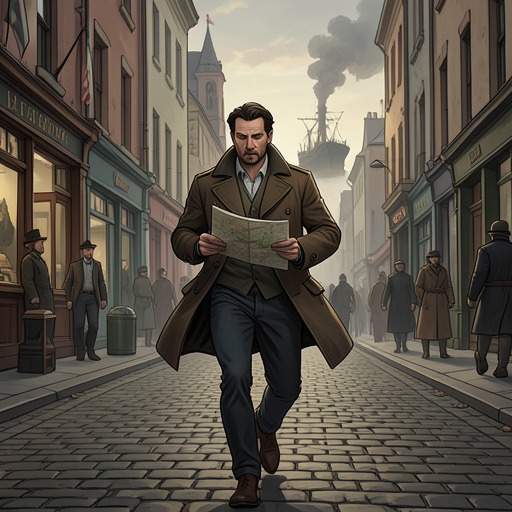
The narrative first presents St. Ives in London on April 4, 1875. In rainy Leicester Square, dressed for a dinner with the secretary of the Royal Academy of Sciences, he struggles to light his only cigar and watches Charing Cross Road for someone whose identity he does not know. The formal clothes feel alien to a man accustomed to his own laboratory. Later, when Bill Kraken is about to leave after telling a disturbing story, St. Ives stops him and produces a note from Captain Powers asking him to meet a man in Leicester Square at half past eight. The chance meeting places St. Ives inside a chain of investigations already extending beyond his scientific work.
His pursuit of Willis Pule grows from a concrete intrusion into his own affairs. After recognizing a bandaged, blond intruder as Ignacio Narbondo’s assistant, St. Ives identifies him as Pule and concludes that Narbondo sent him. He is puzzled about how Narbondo learned that St. Ives possessed the papers, but responds by arranging to search along the river and having the house secured. The scene shows his investigative habits: he connects a physical description to a known adversary, asks what information the adversary could have had, and turns immediately to the likely route of escape.
That pursuit also exposes the vulnerability of his engineering. St. Ives later sees his craft sail several hundred yards toward town, releasing small jets of smoke and fire before disappearing beyond trees; a distant crash follows. He fears that a local house may have been struck or that people may have been hurt. Anger quickly displaces fear, and he fires both rounds from his rifle at the moon while imagining Pule’s face there. The passage presents the launch as a setback and St. Ives’s suspicion as his own conclusion: he believes Pule doubled back and launched the rocket out of spite, but the account does not establish that belief as fact.
Institutions, Allies, and Objectives
The Royal Academy of Sciences takes an interest in Dr. Randal Birdlip’s flight and wants St. Ives to explain its technological implications. St. Ives understands that Birdlip is not the actual genius behind the perpetually propelled craft, and regards the doctor instead as a mystic and seeker after mysteries. The Academy’s attention is not purely scholarly: Parsons tells St. Ives that the cultists may regard a box aboard the dirigible as a sacred god, and that Scotland Yard has infiltrated the organization. The Academy intends to prevent the cultists from destroying the craft or turning it into a temple.
St. Ives does not adopt the Academy’s priorities. He finds the institutional discussion tedious and maintains that Keeble and Birdlip will choose their own courses. His own immediate purpose is to find Pule and confront him; after that, he intends to search for the spacecraft associated with the Homunculus, or find evidence that will end the legends about its existence. He agrees only to raise the matter with Keeble and see how the toymaker responds. This is not a simple rejection of scientific authority: St. Ives is willing to hear the Academy out, but he does not let its anxieties determine his aims.
His partnership with Keeble remains essential as the dangers escalate. St. Ives and Keeble enter the house on Wardour Street through London's sewers after finding the journey unpleasant but otherwise uneventful. The route makes the city’s hidden infrastructure a practical alternative to ordinary access. Earlier, St. Ives and Hasbro wait on the stairs outside a laboratory rather than rush unarmed into a room where desperate men may be waiting. They expect anyone leaving with the box to have to use the street door, since the alley door has been nailed shut. Their caution reflects an investigative method based on controlling exits as much as confronting suspects.
The Boxes and the Search for the Craft
St. Ives’s search repeatedly intersects with two boxes that look alike but have different contents and significance. One holds the Homunculus; another was built to contain a great emerald belonging to Jack Owlesby’s inheritance. When St. Ives learns that William Keeble is awake, Keeble confirms that the boxes are identical apart from their carving and painting. Nell Owlesby acknowledges that, in her agitated state, she might have mixed them up, and says Birdlip may have the emerald. She then asks whether the little man could speak. The admission changes the practical problem: the box’s appearance cannot establish which object it contains, and its possible occupant raises questions St. Ives cannot settle by inspection alone.
St. Ives’s own encounter with the spacecraft gives his long search a different kind of test. On finding the ship, he trembles so much that he can scarcely control his hands and feet. The open hatch is difficult to climb: polished metal slips underfoot, the arched edge offers no purchase, and he finally drags a nearby upholstered chair beside the craft, climbs onto it, and slides headfirst through the opening. His response registers the distance between abstract pursuit and physical discovery. The craft is no longer a legend or a research objective; it is an object he can enter and attempt to command, while the risk of being interrupted by Kelso Drake’s men remains immediate.
Landing and Narrative Significance
St. Ives eventually brings an aircraft down onto a crowded green where the Royal Academy has gathered. From above, he recognizes the Academy’s cordoned group and Parsons, but cannot pick out his own companions among the horse carts. As the ground rises, upturned faces come into view. He works the levers cautiously, easing them in different directions until the craft settles between two fires with little impact. The scene joins his mechanical skill to the public consequences of flight: the landing is not an isolated experiment in a laboratory, but a descent among witnesses and institutional observers.
The ending places the recovered people and objects beside the cost of technological pursuit. St. Ives does not regret losing the ship; he has had his voyage and believes the future promises more. Dorothy Keeble has been recovered and clutches Jack’s arm, while Captain Powers holds open a Keeble box containing a great emerald, green and immense in the firelight. The emerald’s appearance resolves the immediate question of which treasure the box holds, but the narrative leaves St. Ives’s curiosity oriented toward further journeys. His defining movement is therefore not from ignorance to mastery once and for all, but from one achieved discovery toward the next, with machines, hidden routes, and contested objects continually reshaping what the search requires.