William Keeble
HomunculusWilliam Keeble is a toymaker and engineer whose inventions connect the domestic world of his workshop to the novel’s conflicts over scientific knowledge, family, and possession. He builds toys with startling mechanical ingenuity, but his work is not merely decorative: his oxygenator helps prepare Langdon St. Ives’s spacecraft, while two nearly identical boxes he has made become objects of dangerous confusion and pursuit. Keeble’s arc joins patient craft to personal loyalty, and culminates in his taking direct action when his daughter Dorothy is in danger.
Identity and Workshop
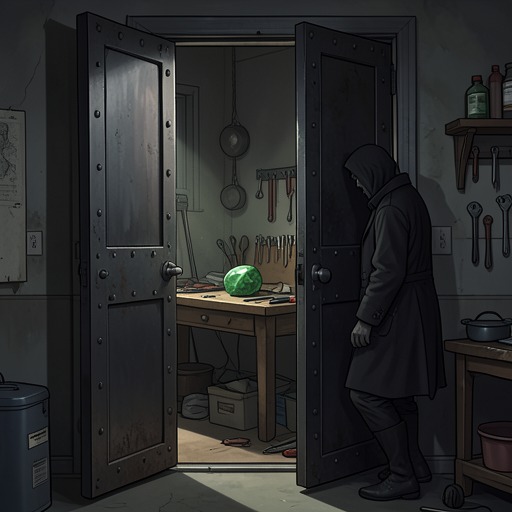
Keeble works from a cluttered toyshop whose disorder conceals a disciplined maker’s space. Rain enters through the roof and a poorly sealed window; an iron firebox warms the room, and a large fern sits close enough to the fire that rainwater dripping from its planter hisses into the flames. Above, the rafters carry carved creatures, masks, kites, rockets, and other marvels, some worn and gnawed by mice. By contrast, the red-pine floor is swept, and tools hang over two workbenches. The contrast captures Keeble’s practice: the shop is crowded with imaginative objects, but his working surfaces and tools remain ready for use.
His ingenuity appears in small, unexpected devices as well as major engineering. When Langdon St. Ives presses the nose of a horsehair brush whose handle is carved as an elongated frog, part of its head slides away to reveal a silver tube. Keeble has hidden two glasses and liquor inside it. The trick is at once playful and practical, introducing a maker who treats ordinary forms as opportunities for concealed mechanisms. St. Ives comes to the shop with the oxygenator, which he believes complete, and relies on Keeble for the remaining work on his vessel. Their exchange establishes Keeble as a trusted technical collaborator, not simply a supplier of toys.
Inventions and the Boxes
Keeble’s most elaborate toy is a mechanical alligator in a wooden box. After he turns the box, its lid opens and a miniature cayman rises, followed by four birds. The alligator swallows them in succession, withdraws, and then reappears with the birds restored, repeating the cycle. Keeble says the device took twelve years to perfect and is now as workable as Dr. Randal Birdlip’s engine. He has made it for Jack Owlesby’s approaching eighteenth birthday; Jack has been with Keeble and Winnifred Keeble for fifteen years, and Keeble regards him as unusually able to appreciate such inventions.
His work also enters the story through Sebastian Owlesby’s inheritance. Sebastian withdrew his interest in the West African Gem Company as a great emerald intended for his son Jack, then asked Keeble to make a box for it. That box was almost identical to the lead-lined cube used to contain the Homunculus. The resemblance later becomes consequential: once Keeble is roused after severe fatigue, he confirms that the emerald box and the Homunculus box are alike apart from their different carving and painting. His practical knowledge makes it possible for the group to recognize that Nell Owlesby may have confused the two, and that Dr. Randal Birdlip may have carried the emerald rather than the Homunculus.
The box’s travels give Keeble’s craftsmanship a significance beyond its original purpose. It is stolen from Captain Powers’s sea chest, appears among the dangerous objects and experiments associated with Ignacio Narbondo, and is handled by Shiloh, who knows where a box has been hidden. Keeble is not present for every theft or exchange, but the boxes he made repeatedly draw other characters into contests over what they contain and what their possession might enable. In the epilogue, Captain Powers holds open a Keeble box displaying the great emerald, now recovered and shown to Jack and Dorothy.
Scientific Work and Protection of His Designs
Keeble’s oxygenator is central to St. Ives’s preparations for flight. After collecting it from Keeble at King’s Cross Station, St. Ives installs the Keeble box in his own craft, a riveted iron vessel housed in the silo at St. Ives’s manor. A test releases green chlorophyll dust carried in helium and oxygen; the cabin’s gauge responds before the oxygen disperses. The device is thus not a speculative drawing but working equipment, tested as part of the preparations for an unmanned flight.
Keeble is nevertheless wary of losing control of his work. When a thief breaks into the toyshop, Keeble has hidden the plans, the miniature cayman, and his notes beneath the floor. On a later intrusion, he again pursues the same man into the street, though his foot has barely healed from the earlier encounter and he eventually stops rather than continue in his nightshirt. These episodes show the practical risks surrounding his designs: he has reason to protect plans and mechanisms from people seeking them, and he does so while carrying responsibility for both his work and the household.
That vulnerability also brings him into the Royal Academy’s ambitions. Parsons argues that the Academy needs Keeble to cooperate, believing that Dr. Randal Birdlip could not have built his own engine and that Keeble may be able to explain its origins. The Academy’s request comes amid alarm about the airship, the New Church, and reports of dangerous experiments. Keeble’s skill gives him leverage in a wider struggle, but the evidence presents him chiefly as a maker whose inventions others seek to interpret, obtain, or control.
Family, Crisis, and Action
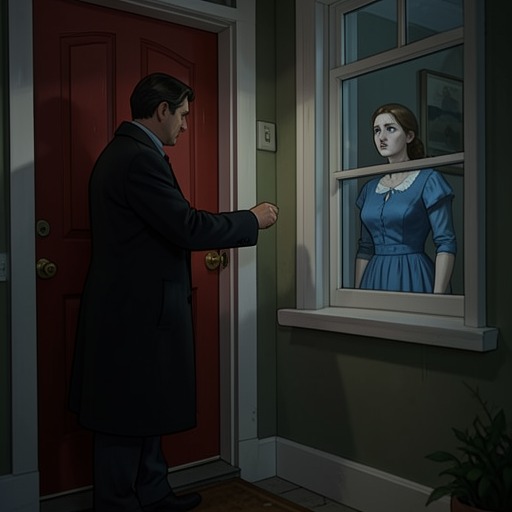
Keeble’s loyalty is most exposed when Dorothy is abducted. While she is missing, he sits with his untouched brandy and his head in his hands. Exhausted after two sleepless nights, he blames himself, imagining that if he had surrendered his engine, Dorothy might still be at home and Jack might have avoided the violence connected with the abduction. Winnifred answers his gloom by drawing the curtains open to the spring sunlight. Keeble rejects reassurance and turns instead to a small toy, repeatedly working its mechanism as he sinks into despair. The scene makes plain how the danger to his family has unsettled the usually practical inventor.
Captain Powers’s plan gives Keeble a task rather than an occasion for further speculation. The group intends to act against Kelso Drake and reach the Wardour Street house; Powers assigns Keeble and St. Ives the route through the sewer. Keeble visibly tries to gather himself, picks up his drink, and sets it down without taking it. His decision to go with St. Ives marks a return to purposeful action even while he remains distressed. During the entry, the two men find themselves inside the house without a clear route to Dorothy, and they move cautiously through a hallway as commotion spreads elsewhere in the building.
When they encounter Drake, Keeble’s restraint gives way to a burst of anger. Seeing Drake trapped in his own coat, Keeble rushes forward, strikes him, and taunts him before St. Ives tries to pull him away. Drake breaks free and attacks; Keeble then uses a leather truncheon to knock him down. Keeble asks whether he should kill him, but St. Ives immediately refuses and drags him toward the stairs. The confrontation is a sharp reversal for a character introduced through intricate, patient handiwork: in the rescue, Keeble acts with direct force, yet his question and St. Ives’s intervention prevent the encounter from becoming a killing.
Change and Narrative Role
Keeble’s change is not a conversion from passivity to heroism so much as a recovery of agency under pressure. He begins as a guarded craftsperson, protecting designs and trusting St. Ives with specialized work. Dorothy’s abduction reduces him to self-blame, but the plan against Drake draws him back into the action. His knowledge remains useful, especially when the group must distinguish the emerald box from the Homunculus box, while his physical intervention helps confront the man responsible for Dorothy’s danger.
At the end, Dorothy has been recovered and stands with Jack, while Keeble considers what became of Birdlip’s engine after the airship is destroyed and its pieces are carried away by the crowd. The loss of the craft leaves his inventions exposed to the same unstable circulation that has governed the boxes: objects made for particular purposes become prizes, evidence, or fragments in other people’s hands. Keeble’s place in the story rests on this double role. He makes mechanisms that others pursue, but his clearest personal purpose is to protect the people and relationships around which his work has been built.