Parsons
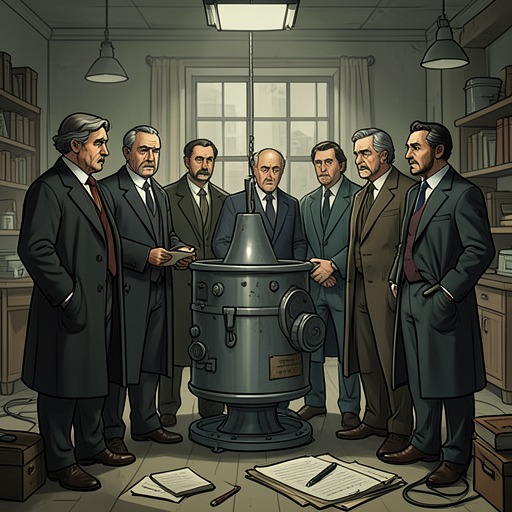
HomunculusParsons, a biologist associated with the Royal Academy, embodies the confidence and limits of institutional science in the pursuit of Dr. Birdlip’s dirigible. He wants its engine explained and its secrets made available to scientific study; at Hampstead Heath, the spectacle instead confronts him with a starship, a reanimated corpse, a head without a body, and the collapse of the distinctions on which his authority depends.
Identity and Institutional Outlook
Parsons approaches unfamiliar phenomena as problems for classification, measurement, and institutional control. In his conversation with Langdon St. Ives, he treats Dr. Birdlip as a speculative mystic rather than the productive engineer who could have built the dirigible’s perpetual-motion engine. Birdlip’s writings on the fog of London and on spectacles that might reveal successive layers of time strike Parsons as evidence of a mind turned toward theory and poetry, not practical machinery. Parsons is willing to recognize Birdlip’s genius, but only while separating that genius from the engineering achievement he wants explained.
That distinction serves the Royal Academy’s interests. Parsons says the Academy wants to understand the dirigible and its technological implications, while dismissing Birdlip’s search for mysteries as an unproductive detour. He presses St. Ives to persuade William Keeble, the Jermyn Street toymaker, to cooperate. The Academy, he implies, might reconsider its view of St. Ives’s scientific conduct if Keeble shared his knowledge. Parsons presents this appeal as dispassionate inquiry, even as he makes clear that institutional reputations and access to the engine are at stake.
His view of the religious movement around Shiloh is similarly categorical. Parsons warns St. Ives about what he regards as the dangers of religious fanaticism, and describes the cult’s interest in Birdlip’s craft and its supposed sacred object as a threat to science. When the crowd led by Shiloh appears below the club, Parsons takes its arrival as confirmation that urgent scientific intervention is needed. His concern is not merely curiosity: he fears that the dirigible may be destroyed, turned into a temple, or lost before the Academy can examine it.
The Dirigible and the Limits of Expertise
Parsons argues that Birdlip’s dirigible is losing altitude and may soon reach Greater London. He lays out the danger in practical terms: it could crash into the suburbs and ignite, or fall into the Atlantic and be broken up by storms. The Academy’s mathematicians, he says, have calculated that it will touch down within the London area. Yet the calculations cannot tell him what the arrival will mean, and the question presses him toward the very sort of uncertainty he otherwise rejects.
To Parsons, St. Ives’s hesitation about bringing Keeble into the Academy’s investigation looks irrational. He casts the scientist’s reluctance as a failure of reason, although St. Ives sees the Academy’s demand as self-interested and refuses to promise more than he can control. St. Ives agrees only to speak with Keeble and test his willingness; if Keeble declines, the matter will end there. Parsons accepts this as a reasonable arrangement, but St. Ives privately recognizes that the institution wants the engine above all. Birdlip’s pursuit of truth, by contrast, cannot be reduced to charts and graphs, even though his wandering course has brought him home.
The contrast follows Parsons to Hampstead Heath. After the failure on Pratlow Street, he arrives at Captain Powers’s shop in the early morning, pounding on the door and nearly discovering William Keeble’s whereabouts. He reports that the dirigible has been sighted over Limerick, travelling along the Irish west coast in a looping course that appears to bring it toward London. To St. Ives and his exhausted companions, this news seems less like a solution than another complication; nevertheless, the anticipated arrival of Birdlip becomes the focus around which their tangled affairs gather.
The Royal Academy on Hampstead Heath
By the time the dirigible is expected, Hampstead is crowded with people drawn by the approaching spectacle and by the carnival-like confusion around it. The Royal Academy establishes a roped-off rectangle on the green and sets out lawn chairs. Parsons, wearing a powdered wig, shouts over a sheaf of papers to his colleagues, but the crowd overwhelms his words. The gathered scientists keep their attention fixed on the stars, as if disciplined observation might hold the disorder at bay.
Parsons tries to read the atmosphere as carefully as he would a scientific instrument. He paces ten steps in each direction, comments on prevailing winds, and speculates that warm valley air might push the dirigible toward Chingford or Southgate. He compares the treachery of winds to teeth, then imagines that their habits can be deciphered like the body’s internal winds and their digestive clues. He repeatedly checks his pocketwatch. The detail makes his method both earnest and comic: faced with an immense, unpredictable arrival, he continues to seek patterns in motion and regularity in time.
He resents the spectators, their shouting, singing, and drunkenness, and blames Shiloh’s apocalyptic tracts for drawing Londoners out in such numbers. From his position, the evangelist is a charlatan whose public performance distracts from an event of scientific importance. Shiloh’s scattered references to hellfire, trumpets, angels, and creatures from the stars sound to Parsons like incoherent nonsense. Although the last subject might interest him under calmer circumstances, he cannot separate the possibility of a genuine mystery from the disorder in which it is announced.
Anomalies He Cannot Classify
When a brief shape appears against the moon and vanishes, Parsons dismisses it as a bat, explaining its presence through its nocturnal feeding and digestive efficiency. His quick assurance is characteristic: uncertainty lasts only until he can attach it to a familiar category. But the sky offers no sign of the dirigible, and Shiloh’s performance continues below. The old man raises a cube for the crowd to see, though Parsons cannot make out its contents in the dark.
The sequence then defeats the Academy’s watchful posture. Shiloh is suddenly thrown forward, and a running man in a broad-brimmed hat snatches the cube and races toward the scientists. Parsons cries out in confusion as the man reaches them with a glowing object descending from the sky. The stranger smashes the glass cube, which contains a rattling object, and leaves without being pursued: everyone’s attention has turned to the luminous spheroid vessel falling from the stars. Parsons looks from the fleeing man to the approaching starship, then watches a decayed head roll to a stop at his feet. Its jaws clack once before it lies still. His response is no longer a theory but an unfinished expression of astonishment.
Later, as the crowd gathers around the landed craft, a ghoul approaches Parsons carrying the Keeble box. Parsons steps back, regretting that he has disposed of the severed head he was given earlier; he wonders whether the creature wants it, or whether the box contains something else equally inexplicable. The ghoul passes him and takes the box toward the gondola. Even then, the incessant voice coming from it supplies no explanation Parsons can use. The box has become an object that demands attention without yielding itself to the categories he has brought to the Heath.
The Dead, and Parsons’s Ending
When Dr. Birdlip, still a skeleton lashed to the gondola, releases his grip on the wheel and frees himself from the cords, Parsons stares at the newly animate corpse. He follows it with his attention as it moves toward the Keeble box, and the biologist urges it to speak. The corpse drops dead into a chair. The failed exchange distills Parsons’s predicament: his scientific impulse persists, but the being before him cannot answer the questions that would make it legible.
After the dirigible has disappeared and its remains have been carried away, Parsons sits astride the arm of the stuffed chair beside the unresponsive corpse. He talks to it about sheep and the large quantities of methane they produce, explaining that the gas is inflammable. St. Ives gently points out that the corpse appears to have fallen asleep. Parsons begins to mention its eyes, then notices the aerator box under St. Ives’s arm and asks whether he intends to open it there. He is relieved when St. Ives says he does not. The caution is a small but telling adjustment: faced with one inexplicable object too many, Parsons recognizes that opening another may not improve his understanding.
Parsons then asks whether the night seems unusually full of dead men and severed heads. The question arrives after the evidence has accumulated around him, not before it; for once, he voices the strangeness instead of explaining it away. Shiloh appears with the Marseilles Pinkle, falls face-first, and lies still while the device sputters beneath him. Parsons watches it spin out and then walks slowly into the dark toward Hampstead, weaving like a rudderless boat. His scientific language has not vanished, but the night has left him without a framework capable of mastering what he has seen.
Narrative Role
Parsons is not presented as a simple fool: his concerns about the dirigible’s descent and the danger of its arrival are practical, and his commitment to observation is sustained rather than feigned. The comic force comes from the mismatch between that competence and the events he encounters. He can calculate wind, track time, and lecture on animal digestion, yet these forms of knowledge do not explain a dead head, a walking skeleton, or a starship.
His exchanges with St. Ives also expose the institutional boundary Parsons draws around science. He treats Birdlip’s speculative writings and Shiloh’s religious claims as unreliable, while hoping to acquire Keeble’s engine for the Academy. His standard of legitimate knowledge is therefore shaped not only by method but by what the institution wants to possess and study. At Hampstead, the boundary proves unstable: the extraordinary does not wait to be approved by the Academy, and Parsons’s final image beside the silent corpse makes his authority less a resolution than a question left open.