Captain Powers
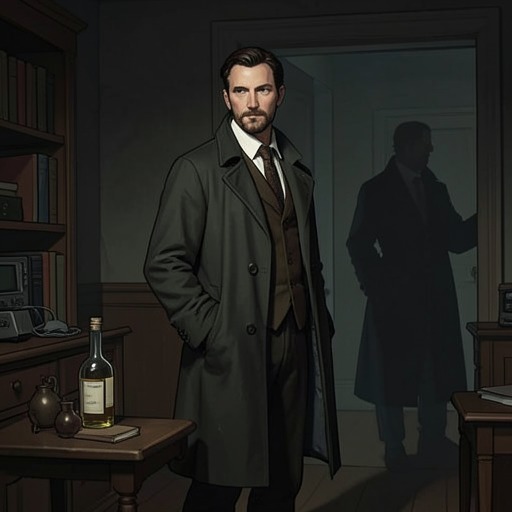
HomunculusCaptain Powers is a retired sailor and tobacco-shop keeper whose hard-won steadiness makes him a refuge to friends and a leader in moments of danger. Beneath his conservative dignity lies a taste for ingenious oddities: his carved-ivory leg conceals tobacco and liquor, and his pockets hold purported charms. He guards a secret box for years, then joins the effort to recover Jack Owlesby’s inheritance, taking his friends from private investigation toward the decisive gathering on Hampstead Heath.
Identity and Background
Powers keeps Captain Powers’ Pipe and Tobacco Shop at the corner of Jermyn and Spode. Its long windows look out along two streets, and he can watch passersby from a Morris chair behind the counter. The shop serves the genteel residents across the street, who come for tobacco or cigars, but trade alone would leave him short of money without his pension. Its familiar, unpretentious atmosphere also makes it a place where Langdon St. Ives feels at home, despite having grown up in a household governed by his father’s austere ideas about food and tobacco.
Powers has been at sea since he was twelve. He lost his right leg in a skirmish fifty miles below Alexandria, when his sloop sank after desert thieves blew it apart. He saved one valuable piece of ivory from his fortune, and, twenty years later, William Keeble made it into a prosthetic leg. Powers considered it far better than any he had worn: it fit without scraping the small remnant of his leg and had a hollow interior that could hold a pint of liquor and two ounces of tobacco. A button at the tip opened a concealed plate to expose a pipe bowl, while a tube ran up the inside of his trouser leg and coat, allowing him to smoke while walking.
He tried using the smoking mechanism in public only once. The stares it attracted made him reluctant to repeat the experiment. His response captures an important tension in his character: he appreciates Keeble’s invention and values their friendship, but he is conservative, stoic, and protective of his dignity. Rather than tell Keeble that he disliked being seen smoking a prosthetic leg, he keeps his reservation to himself.
The Shop, Its Company, and Its Oddities
Powers’ shop is both a working business and a place of friendship. Keeble’s house stands opposite, and the Captain can see the light in the attic workshop as well as the illuminated bedrooms below. His connection to the Keeble household reaches beyond the useful leg Keeble made for him: the Captain is concerned for Jack’s future and treats the young man’s inheritance as a matter requiring his own care.
His affection for curiosities is as pronounced as his practicality. Among the shop’s and his own assorted oddities are the smoking leg, a monkey-tooth necklace traded for Scotch, a pipe that produces soap bubbles as well as smoke, and a collection of supposed good-luck objects. He uses the objects as a way of taking the measure of strangers, watching how they respond to the little collection. William Keeble and Langdon St. Ives recognize the value of this habit. The Captain’s amusement in the strange does not displace his judgment; it gives his otherwise reserved manner room for play.
For Nell Owlesby, that combination of composure and eccentricity makes him a safe harbor. After years of homeless wandering in the Indies and South Carolina, she finds in him a source of security amid the suspicion and fear she associates with London. She trusts that he will protect her. The Captain’s apparent regard for frivolous, curious things also matters to her: his steadiness is not coldness, and his practical outlook leaves space for the unexpected.
Secrets and the Emerald
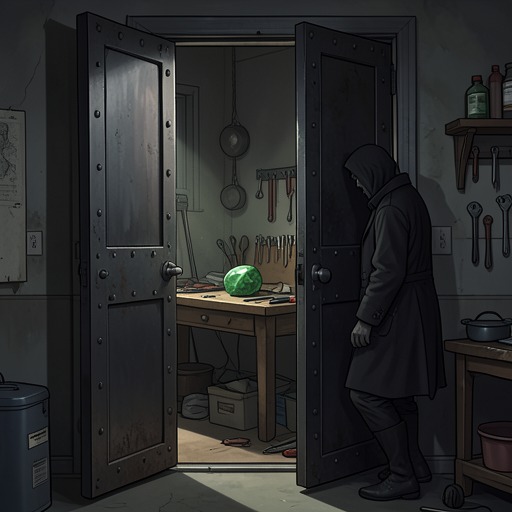
Powers has kept a wooden box concealed for years in a sea chest. When he opens the chest, the box lies beneath a false bottom made from an oak plank, hidden among objects including a brass spyglass, a sextant, sabers, and a carved idol. He assures the woman with him that no one else knows of the box’s existence, and says that in a few days or a week Jack will have it. Bill Kraken, lying nearby, overhears the disclosure, turning the Captain’s careful concealment into a vulnerability.
The Captain’s promise identifies the box with his responsibility toward Jack. Later, the emerald at the center of the dispute is described as an inheritance for Jack and Dorothy Keeble, large enough to be worth fighting over. The friends consider avoiding the police because the emerald’s concealed history could expose Nell and draw suspicion toward people they believe innocent. Powers agrees that they must act themselves. When Theophilus Godall recounts the events at Dr. Narbondo’s laboratory, including the loss of the box, Powers clenches and unclenches his fists before deciding that they will go in after it.
Leadership and Conflict
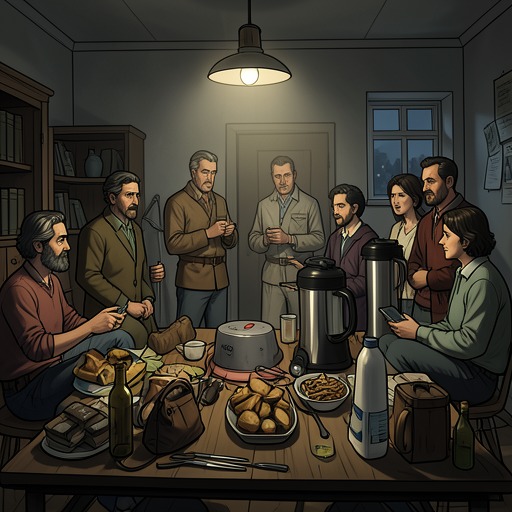
Powers’s leadership is practical rather than ceremonial. After the Pratlow Street failure, the group returns to his shop tired and with no gain to show for the night’s turmoil. He sums up his instinct as cutting and running, but this is not a refusal to act: as plans shift toward the next confrontation, he insists that time is running short and allocates work according to what the group needs to accomplish. When Jack arrives injured and offers to accompany the party to Kelso Drake’s, the others recognize the courage in the offer but know it is not feasible.
The Captain sets the plan: Langdon St. Ives and Keeble are to enter Drake’s through the sewer, while the group must be ready for the gathering expected on Hampstead Heath after sunset. He wants Dr. Narbondo dealt with immediately, with minimal further disturbance. He also directs Hasbro and Kraken to take responsibility for the doctor. His command rests on experience—he recalls forty years at sea and commanding crews across distant waters—but also on his recognition that the group has too many officers and too few people doing the necessary work.
When the plan leads into danger, Powers is not merely issuing orders from safety. Godall and the Captain appear during the Pratlow Street crisis; a bullet fired by the evangelist has only grazed Powers’s shoulder. Later, he is again part of the effort surrounding the boxes and the rescue of Dorothy. On Hampstead Heath, as the crowd rushes toward the arriving dirigible, Powers stumps toward it with Keeble and Keeble’s wife, intent on the final box aboard. In the crush, Kraken is knocked down while carrying a box, and Drake catches up with him; the Captain’s party is meanwhile pressing toward the dirigible.
Change and Narrative Role
Powers’s authority grows out of the same qualities that define his private life: discipline, loyalty, and a willingness to take responsibility without pretending that risk can be eliminated. His shop provides shelter and a base for deliberation, while the concealed box connects his domestic loyalties to the larger conflict. He is protective of Nell, attentive to Jack’s inheritance, and prepared to trust his friends with dangerous tasks, yet he also insists on a plan and a timetable.
At the Heath, the Captain follows the ghoul toward the dirigible’s gondola as the box in its hands continues to make a demanding sound. He does not stop to explain the spectacle or resolve its meaning; he remains close to the action, while the scene’s attention shifts to Dr. Birdlip and the box. Powers’s role is thus less that of a solitary adventurer than of a reliable companion and organizer. His prosthetic leg, the visible sign of an old maritime loss, becomes part of his everyday mobility and even of his humor, while his maritime habits of command carry into the tangled emergencies of London.