Ignacio Narbondo
HomunculusIgnacio Narbondo is a hunchbacked experimenter whose attempt to animate the dead depends on a substance taken from carp. His laboratory work, criminal procurement of experimental materials, and dealings over the homunculus connect a private pursuit of restored life to a wider struggle over who can control scientific knowledge and its products.
Identity and Experimental Practice
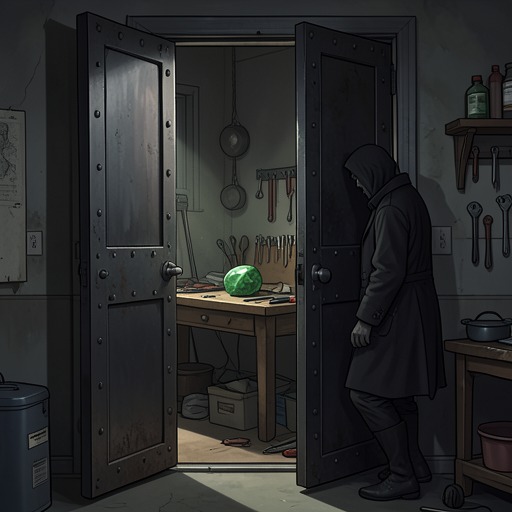
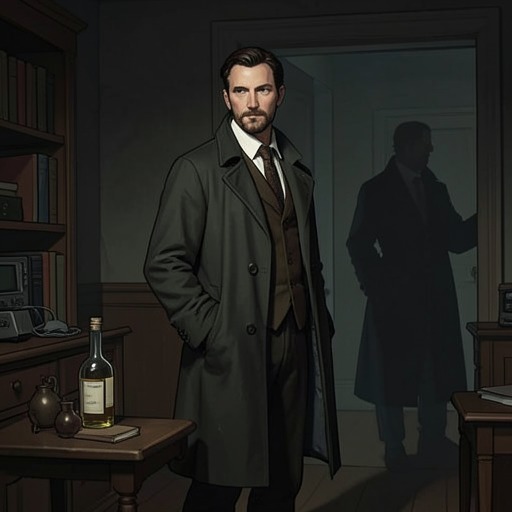
Narbondo works in Dr. Narbondo’s laboratory above Pratlow Street, where his investigations are conducted among chemical apparatus, specimen containers, aquaria, and human remains. The laboratory’s arrangement makes clear that his research crosses boundaries between chemistry, animal study, and experiments on the dead. Rather than treating the corpse before him as a person to be restored, he considers whether it can be made useful and whether animation would serve his purposes.
Carp are essential to his method. He feeds worms to the fish, watches for signs that one is failing, then removes a kidney-shaped gland and stores it in amber liquid. The gland is not a peripheral ingredient: Narbondo regards it as a valuable substance and an indispensable part of the serum needed for his work. His handling of the fish is swift and practiced, but the procedure is not presented as effortless; the difficult experiment later involving a corpse and a living carp requires concentrated work from him.
The method also makes Narbondo’s research dependent on a chain of vulnerable materials and people. Fish must be obtained and kept, the gland must remain usable, and corpses must be available for experiments. When Willis Pule brings him a damaged carp whose gland is partly ruined, Narbondo recognizes that the loss threatens his ability to satisfy Shiloh’s demand. His science is therefore both an individual obsession and a precarious system reliant on assistants, animal bodies, and access to human remains.
The History of His Work with Sebastian Owlesby
Accounts given by Bill Kraken place Narbondo among the men who stole carp from the aquarium with Sebastian Owlesby and another accomplice. They obtained roughly half a dozen fish, which were cut up on Baker Street and passed to a beggar woman on Old Pye for sale at Billingsgate Market. Kraken presents this as only a minor episode in a much larger, troubling history. He also recalls seeing Narbondo near Westminster Cemetery at night, with a dogcart and men carrying spades, suggesting that the group’s experiments depended on graveyard access as well as stolen fish.
Sebastian Owlesby’s notebooks give a more sustained account of the partnership’s consequences. Owlesby’s research concerned vivisection and corpse animation, and he recorded a progressive decline into madness. The notebooks describe Narbondo as self-seeking and as an influence urging Owlesby further into experimentation. In one account, Owlesby and an unnamed accomplice obtained the head of a sleeping indigent in St. James’ Park because their experiment required a living man’s brain. The record presents this act as a turning point in a project that had already moved far beyond the limits Owlesby could comfortably accept.
Owlesby believed that the homunculus could arrest entropy and at least superficially reverse decay. He communicated with it through a screen fitted into a specially constructed box, and his notes describe an exchange of knowledge for the possibility of its freedom. That arrangement links Narbondo’s experiments to a being whose capacities appear to exceed the doctor’s own methods. Owlesby feared that his association with the homunculus and Narbondo was contributing to his deterioration, yet he continued to pursue the possibility of eternal life. Narbondo’s influence thus belongs to a collaboration that becomes increasingly difficult for Owlesby to renounce.
Reanimation, Shiloh, and Nell Owlesby
Narbondo’s work brings him into an uneasy bargain with Shiloh the New Messiah. The doctor treats religious belief as an opportunity to sell a result: he plans a demonstration involving Joanna Southcote, Shiloh’s mother, and considers how to satisfy the evangelist even when the available remains cannot provide the restoration Shiloh wants. When Shiloh finds the experiment inadequate, Narbondo insists that the homunculus’s box might make a more complete restoration possible. The box is therefore not merely a container in his understanding; it represents access to a power his own practice cannot supply.
Their exchange over the carp gland shows how Narbondo turns experimental materials into leverage. After displaying the gland and naming its value, he faces Shiloh’s proposal to trade Nell Owlesby for it. The scene leaves the bargain unresolved, but it establishes that Narbondo is willing to treat a person as a negotiable asset in a transaction shaped by his research. His contempt for Shiloh’s public piety does not keep him from trying to profit from the evangelist’s hopes.
Narbondo also confronts Nell with the history of her brother’s death. He reveals that she shot Sebastian fifteen years earlier and claims that he pursued her, attempted to save her brother, and kept him animated for a week before deciding that the result was not worth preserving. Nell disputes part of his account, insisting that Sebastian was buried, and maintains that her mistake was not shooting Narbondo instead. Their exchange establishes a lasting enmity: he uses his knowledge of Sebastian’s death to taunt her, while she sees him as the person she should have killed.
Alliances, Institutions, and Narrative Significance
Narbondo’s assistants and observers show how his research moves beyond the laboratory. Willis Pule is unreliable in practice: his carelessness damages the gland that Narbondo needs, and his presence is a source of frustration rather than dependable support. Kraken’s recollections place Narbondo within earlier schemes involving Sebastian, while Theophilus Godall’s surveillance links him to The Blood Pudding, where Godall suspected him of eating live birds. Godall also reports seeing Narbondo revive what was almost certainly a corpse. These accounts extend the character’s work from private experiment to a network of clandestine activity and uneasy witnesses.
The Royal Academy’s interest in Dr. Randal Birdlip’s dirigible and William Keeble’s engine offers a contrasting picture of scientific authority. Its representatives disparage Birdlip’s speculative work while seeking Keeble’s technical knowledge, and they frame the arriving airship as a matter of scientific control and public risk. Narbondo is not part of that institutional debate, but his experiments belong to the same unsettled landscape in which the boundaries between legitimate science, speculation, and dangerous practice are contested. The Academy’s effort to claim useful knowledge underscores a broader contrast: institutional authority seeks to classify and manage discoveries, while Narbondo pursues results through secrecy, bodily materials, and bargains with people who want something from him.
Narbondo’s defining ambition is not simply to make a corpse move, but to obtain a means of resisting decay. The carp gland supplies a repeatable material requirement; the homunculus offers a power that may exceed his experiments; and the dead become the test cases through which he tries to turn possibility into practice. His methods make scientific aspiration inseparable from exploitation, while his dealings with Owlesby, Nell, and Shiloh reveal the human costs and conflicts embedded in that pursuit.