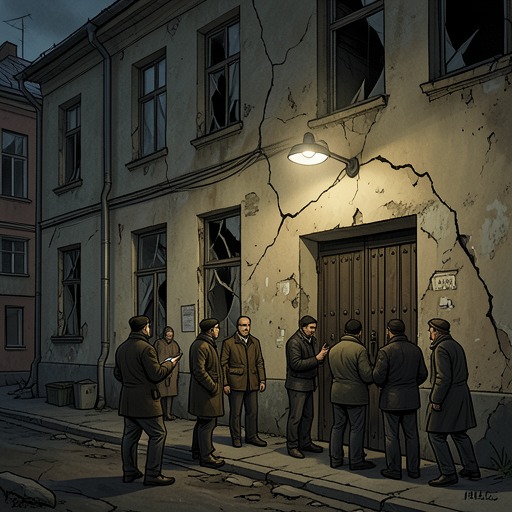
1962 publication of One Day in the Life of Ivan Denisovich
LimonovThe 1962 publication of One Day in the Life of Ivan Denisovich made a former prisoner’s account of camp life available to readers across the Soviet Union. Personally authorized by Nikita Khrushchev, the book was a rare public breach in the suppression of the country’s recent past: its meticulous attention to an ordinary inmate’s ordinary day made the camp system newly difficult to dismiss as an abstraction. The publication became both the high point of de-Stalinization and, in the account’s telling, a sign of how far that opening could go before it threatened the foundations of the system itself.
Background: Prisoners Return, Silence Persists
The book appeared after the death of Joseph Stalin, when millions of prisoners were released from the Gulag and some were rehabilitated. Their return put former prisoners face to face with the informers and officials who had helped send them away. The account describes an uneasy social encounter rather than a reckoning: people recognized what had happened, but generally looked away and resumed their lives. That embarrassed silence formed the setting in which an openly told story about camp life could have exceptional force.
The political opening had already acquired an official signal in 1956, when Khrushchev delivered a report to the Twentieth Party Congress condemning Stalin’s cult of personality. The report did not remain secret for long, and it implicitly acknowledged that the country had been governed by murderers for two decades. Yet acknowledgment from above and knowledge circulating in private were not the same as a widely read account of an inmate’s daily existence. One Day in the Life of Ivan Denisovich gave that reality a concrete, sustained form.
Publication and Reception
Khrushchev personally authorized publication in 1962. The story appeared in issue number 11 of the magazine Novy mir. Readers seized the issue across Russia, encountering a prosaic, meticulous narrative about one ordinary day experienced by one ordinary inmate in a camp described as not even particularly harsh. The restraint of that account mattered: it did not need an exceptional ordeal to make imprisonment legible. The routine itself could disclose the system.
The reception was marked by shock and disbelief as well as hope. Readers began to interpret the publication as evidence that a thaw might be underway, and that once one person had been allowed to tell the truth, the authorities might no longer be able to stop others from doing so. The response thus exceeded the fate of a single book. Its appearance suggested that publicly naming a suppressed reality might change what could be said—and what the country could know about itself.
The Opening and Its Limit
That possibility also revealed the danger the publication posed to the political order. If the truth about the camps and the recent past continued to be told, the reckoning might reach beyond Stalin. It could implicate Lenin, the system built in his name, and the lies on which that system rested. In this account, the book’s importance therefore lies partly in the boundary it exposed: de-Stalinization could condemn Stalin, but a full investigation of the past risked challenging the state’s deeper foundations.
The publication consequently marks both the height and the end of de-Stalinization. After Khrushchev lost power, a generation of Party officials shaped by the purges established what the narrative calls a form of soft Stalinism under Leonid Brezhnev. The resulting order offered stability, entrenched leadership, graft, and limited repression; its members could benefit from the system so long as they adapted to it. The public opening represented by Solzhenitsyn’s book did not develop into an unrestricted account of Soviet history.
Historical Significance
The book’s significance rests on the conjunction of its modest subject and its extraordinary reach. Rather than describing an exceptional camp or an exceptional prisoner, it recorded an ordinary day in a relatively less harsh camp. That particular scale made the larger reality harder to evade: if even this ordinary routine could be published, the experience of imprisonment could enter public discussion without being reduced to rumor or accusation.
The narrative places the book among the very few works that genuinely altered the course of history, comparing its impact only with that of The Gulag Archipelago, published a decade later. Its achievement was also inseparable from its limits. It opened a public breach in enforced silence, but the political response that followed showed why the breach could not remain open indefinitely. In this chronology, publication is at once an act of disclosure and a turning point after which the state’s retreat from de-Stalinization becomes visible.