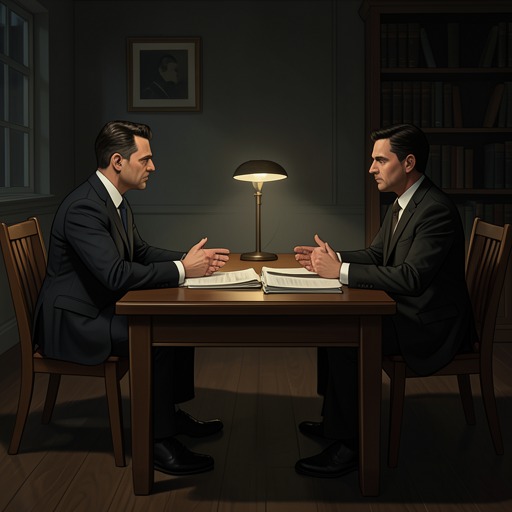
Trial of Joseph Brodsky
LimonovThe Trial of Joseph Brodsky transformed a prosecution for “social parasitism” into a dissident legend, as a journalist’s record of the hearing circulated through samizdat and reached an entire generation. The episode exposes both the state’s power to define a writer as a social offender and the difficulty of containing the meaning of his words. It also unsettles Eduard Limonov’s dismissive view of Brodsky: the young poet’s life had been far less sheltered, and his reputation far more commanding, than Limonov wanted to admit.
Brodsky Before the Trial
In Limonov’s account, Brodsky is introduced as a prodigy from Leningrad, named in the early 1960s by Anna Akhmatova as the young talent to watch. Limonov’s malicious caricature casts him as the eternal top of the class, hiding behind a teacher’s petticoat. The facts the narrative supplies resist that portrait. Like Limonov, Brodsky was the son of a junior officer; he left school early, worked on a milling machine, dissected bodies in a morgue, and served as a geological assistant in Yakutia.
His youthful adventures were not simply literary or academic. With another young companion, he went to Samarkand and hijacked a plane in an attempt to reach Afghanistan. He was later confined in a psychiatric hospital, where he received painful sulfur injections and underwent ukrutka: wrapped in a sheet, he was plunged into an icy bath and left to dry without being unwrapped. This history gives the later prosecution a context of coercion that extends beyond the courtroom. Before Brodsky was tried as a social parasite, institutions had already subjected him to confinement and treatment described as brutal.
The Hearing and Its Circulation
At twenty-three, Brodsky was arrested on the charge of “social parasitism.” The prosecution’s contemptuous description of him—as a “Jewish pygmy in corduroys” and a writer whose poems set “gibberish and pornography” against each other—reduced both his stature and his work to targets for ridicule. The narrative observes that such a hearing would ordinarily have passed unnoticed. Its importance came from a journalist who took down the proceedings in shorthand.
That record escaped the courtroom: it circulated as samizdat, carrying the exchange between Brodsky and the judge well beyond the hearing itself. Asked who had enrolled him among the poets, Brodsky answered by turning the question toward a more fundamental claim: who had enrolled him in the human race? His answer, invoking God as a possibility, refused the judge’s implied authority to decide what kind of person or writer he was. The transcript’s passage from an overlooked hearing into dissident circulation is thus part of the event’s meaning: a state proceeding intended to classify an individual became a text readers could share and interpret for themselves.
Exile and Literary Reputation
Brodsky was banished to the Far North near Arkhangelsk for five years, where he shoveled manure in a small village. The frozen landscape and his rugged friendship with the villagers fed poems that made their way circuitously back to Leningrad. In dissident circles across the Soviet Union, those poems became cult objects. The contrast is stark: the authorities sent Brodsky away from the literary public, yet the work produced in exile strengthened his standing among readers.
The narrator places this growing reputation beside Limonov’s competitive frustration. At bookstore 41, Brodsky’s name was on everyone’s lips. Limonov had already resisted the enthusiasm surrounding the publication of One Day in the Life of Ivan Denisovich, but he could separate Solzhenitsyn from himself by an older generation. Brodsky was only three years older. Limonov believed they ought to be competing in the same league, and the public’s response made clear that they were not. The trial therefore enters the book not only as a landmark in Brodsky’s biography but as a measure of the recognition Limonov felt he had not received.
Significance in Limonov’s Story
The episode complicates Limonov’s early habit of treating the dissident writers of the 1960s as just another set of important people and authorities. His pose of mocking distance groups Brodsky with figures on the other side of a social barrier; the biography it recounts makes that dismissal harder to sustain. Brodsky’s work and the record of his trial reached readers through informal routes, while Limonov watched the poet’s name become a source of collective fascination.
Akhmatova’s response to the biography being made for “our redhead” adds another layer: Brodsky’s life was already being understood as a story shaped by persecution and public attention. In the book’s portrait, the trial crystallizes that transformation. A charge meant to diminish him became the occasion for an answer that traveled farther than the hearing, while the exile that followed supplied poems to the very circles in which his name had become magnetic.