Romanian Revolution
LimonovThe Romanian Revolution overthrew the Ceaușescu regime, yet its aftermath unsettled the simple story of liberation that the fall of a dictatorship seemed to promise. In Emmanuel Carrère’s recollection, the televised trial and execution of Nicolae Ceaușescu and Elena Ceaușescu became an image of intimacy and indignity amid political violence; months later, the revelation that the reported mass graves at Timișoara had been staged for cameras exposed another rupture between the revolution’s public account and what had happened. The old order had fallen, but justice, truth, and political change did not arrive in any straightforward form.
The televised trial and execution
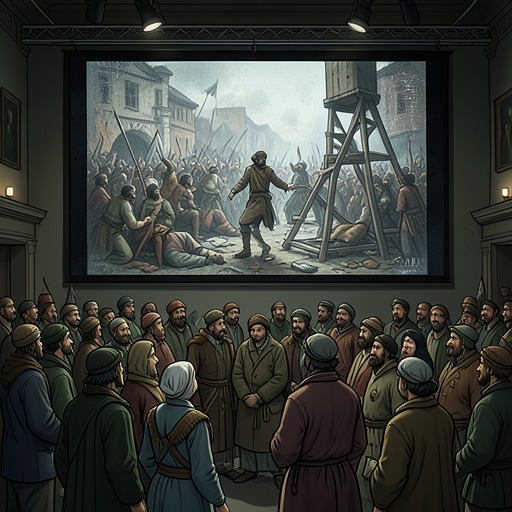
The revolution’s most disturbing image, as Carrère recounts it, was a Romanian television broadcast shown across France on December 26, 1989. In the footage, Nicolae Ceaușescu rejected the tribunal’s legitimacy while fingering his chapka. Elena sometimes lost her temper and argued; he would place a hand on hers in a familiar, calming gesture. He repeatedly checked his watch, prompting speculation that he expected troops to rescue them. No troops came. After roughly half an hour, the scene cut away; the next shot showed their bloody bodies on a pavement, with the precise location unclear.
Limonov saw the broadcast after returning from Moscow, where he had found Natasha. Carrère connects Limonov’s response to the couple’s image of facing death together, perhaps recalling his own parents and his hopes for a shared old age with Natasha. Limonov wrote that the footage, intended to justify the killing, instead bore witness to the couple’s love through a touch or a look. He did not deny that rulers were guilty of grave wrongdoing, but he described the hunted couple’s final moments as a tragic scene and placed them among the lovers of history. Carrère did not share this lyrical judgment of the Ceaușescus’ culpability; nevertheless, he too felt deeply uncomfortable at the summary execution and its supposedly exemplary staging. In his reading, dignity had fallen to the accused, whatever their crimes.
The Timișoara reports
In the months after the revolution, claims that the dying regime had massacred thousands of people in its final spasm became a focus of public emotion. The mass graves reported at Timișoara were especially powerful. The commonly cited death toll was four thousand; Libération gave the more exact figure of 4,630, and TF1 then raised it to seventy thousand. Television showed skeletal bodies in striped pajamas, dug from hurriedly made graves and covered in mud. Reports of ongoing killings by the Securitate helped prompt talk of sending international brigades to halt a genocide.
The spectacle collapsed when it emerged that the bodies shown to the cameras at Timișoara Cemetery numbered at most a few dozen. They had been exhumed from graves where people who had died natural deaths had been buried. The figures and images that had conveyed the scale of a massacre had not documented the mass killing they were taken to prove. For Carrère, this was among the bizarre signals arriving from Romania after the revolution: a supposed truth revealed as false, without making the surrounding violence or suspicion any easier to understand.
The political order after the overthrow
The reversal extended from news reporting into the institutions of the new state. Carrère relates that personnel associated with the Securitate, despite being implicated in the crimes attributed to the former regime, became officials in the National Salvation Front under the new president, Ion Iliescu. The Communist Party was formally banned and charged with every imaginable crime, yet, in Carrère’s account, it survived in practice by changing its name and leader. In the March 1990 elections, it won a substantial majority.
Carrère’s formulation—that Romanians were the only people in history to elect Communists freely—underscores the discrepancy between the revolution’s overthrow of the old regime and the electoral return of its political inheritance. The outcome did not mean that the revolution had simply failed: it did, however, show that the removal of a ruling party did not erase the institutions, loyalties, or political habits associated with it. The fall of the Ceaușescus and the survival of Communist power in altered form stood beside one another, making the new order difficult to distinguish cleanly from the one it claimed to replace.
Memory and moral uncertainty
For Carrère, the televised execution and the Timișoara deception together made postrevolutionary Romania feel uncanny: familiar political forms appeared in altered guises, and the evidence that seemed to settle events could itself prove unreliable. The broadcast brought a moment of tenderness into the public staging of a tyrant’s death; the cemetery images turned natural deaths into apparent proof of mass murder. In each case, the revolutionary story was complicated by what the camera showed, concealed, or misrepresented.
The execution also marked, for Carrère, a sour end to the year in which nonviolent revolutions had brought humanists such as Václav Havel to power. His discomfort did not absolve the former rulers; it arose from the spectacle of justice becoming summary execution, and from the way the staging failed to secure the dignity it was meant to demonstrate. The Romanian Revolution thus appears not as a single, decisive passage from tyranny to democracy, but as an overthrow followed by contested images, compromised continuities, and an unsettled moral reckoning.