Second Chechen War
LimonovThe Second Chechen War is presented chiefly through the political circumstances surrounding its launch, rather than through scenes of combat. In the account, the 1999 apartment bombings in the suburbs of Moscow—more than three hundred civilians killed—provide the pretext for a new war in Chechnya and help make Vladimir Putin, then Boris Yeltsin’s designated successor, appear as a national savior. The narrative’s emphasis falls on the gap between the official attribution of the attacks and the doubts that persisted around it, as well as on the political uses of war rhetoric.
Political Setting and the Bombings
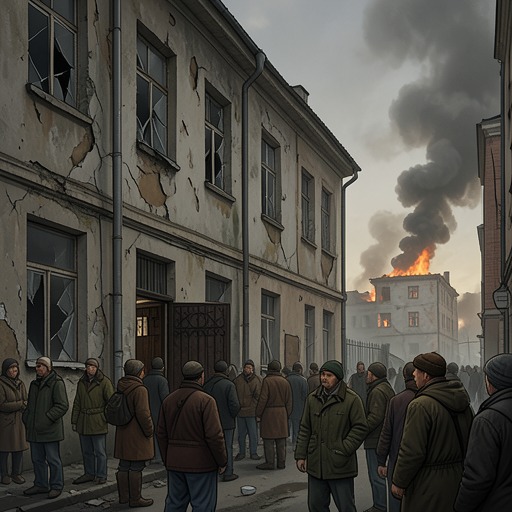
Six months before the presidential election, Yeltsin designated Vladimir Putin as his heir apparent. The election consequently seemed almost a formality, and the narrative describes a war as a means of presenting the new leader as a savior. The stated pretext was a series of bombings in Moscow’s suburbs in the fall of 1999. They killed more than three hundred civilians and were blamed on Chechen terrorists, although, as the account stresses, no proof was presented.
The passage does not recount military operations or identify particular battles. Instead, it locates the war’s significance in the sequence that brought Putin to power: succession, attacks on civilians, attribution to an enemy, and the prospect of a leader able to promise decisive retaliation. The war is thus introduced not as a battlefield chronicle but as a political event whose public meaning was bound up with the circumstances of its beginning.
The Unresolved Allegation
Against the official attribution, the narrator describes an alternative theory: that the Federal Security Service had committed the bombings. The account names four people who publicly expressed the theory: Alexander Lebed, journalist Artyom Borovik, former Federal Security Service officer Alexander Litvinenko, and Paul Klebnikov, the narrator’s cousin. Their later deaths are recounted with markedly different circumstances: Lebed and Borovik died in what the narrator calls suspicious accidents, Litvinenko was poisoned with polonium, and Klebnikov was shot with a Kalashnikov.
The passage does not establish the theory as fact. It calls it both paranoid and not entirely implausible, and notes that it remained widespread among the Russian population. Its pointed observation is that belief in the allegation did not prevent many people from voting overwhelmingly for Putin in successive elections. In the narrative’s account, suspicion and political support coexist: voters could believe, or at least consider possible, that a leader was implicated in a grave crime and still back him.
War Rhetoric and Political Consequences
A few months after his promotion, Putin’s public manner had changed. He announced his intention to waste the terrorists in their shithouses, a brutal formulation that the narrative presents as setting the tone for his presidency. Among Limonov’s National Bolshevik Party followers, the phrase became an inside joke, adapted to everyday banter over vodka. Its reuse turns a presidential threat into a private party catchphrase, without making the underlying violence disappear.
The war’s political atmosphere appears alongside the authorities’ treatment of organized opposition, though the narrative does not claim that the war caused the party’s suppression. Before the presidential election, the Ministry of Justice passed a law against extremism and fascism whose definitions it reserved the right to determine, then told the National Bolshevik Party that the measure concerned it. Limonov met the minister in a suit and tie to argue that his party was neither extremist nor fascist. After the authorization deadline passed, the party was refused permission to exist legally. At a second meeting, Limonov pointed out that his organization had seven thousand adherents, unlike the many registered parties he described as phantom organizations, and warned that driving young people underground could push them toward extremism and terrorism.
The Event in the Wider Narrative
The account’s treatment of the Second Chechen War is deliberately bounded: it gives the reader the civilian cost of the bombings, the official accusation, the contested alternative, and the rhetoric that followed, but supplies no battlefield narrative with which to resolve the allegations. That omission makes the uncertainty itself part of the event’s political afterlife. The question is not merely what the state said had happened, but how suspicion of a different explanation could become widespread without dislodging support for the leader who emerged from the crisis.
The war also marks the setting in which Limonov’s movement and the new presidency came into contact. The National Bolshevik Party’s joke about Putin’s threat, followed by the denial of its legal status, places the movement’s oppositional life beside the expanding authority of the state. The narrative therefore presents the war as both a conflict invoked in the making of a presidential image and a turning point in a political climate where forceful state language and narrowing space for opposition developed side by side.