Stalin-era Famine in Ukraine
LimonovThe Stalin-era Famine in Ukraine is presented as a catastrophe organized by Joseph Stalin and then erased from the official account of Soviet history. The book offers no detailed chronology or famine-specific death toll; instead, it places the famine within a wider system of state violence and enforced forgetting, showing how the recovery of historical truth became one of the consequential changes of the Gorbachev years.
The famine within a suppressed history
The famine appears in a list of events that Soviet society was taught to treat as though they had never happened. The same passage names collectivization and the killing or deportation of millions of kulaks, the purges of the 1930s, and deaths and deportations carried out arbitrarily. The famine is thus not narrated as an isolated disaster: it belongs to a broader history of coercion whose victims and causes were excluded from public memory.
That exclusion reached into family life. Children who were ten in 1937 knew that their fathers had been taken away and never returned, but also knew that speaking about it was dangerous, especially for children of people labeled public enemies. Families learned to behave as if the loss had not occurred; the country learned its history through the official Short Course compiled under Joseph Stalin. The book’s account connects this climate of silence to the famine’s disappearance from the accepted historical record, without supplying a separate account of how the famine unfolded.
Glasnost and the return of history
The book identifies the freedom to write history differently as the extraordinary force that transformed the Soviet Union during the six years after Mikhail Gorbachev became Communist Party general secretary. Gorbachev had imagined limited, controllable concessions, but his call to fill in history’s blank pages opened a much wider reckoning. In an address marking the seventieth anniversary of the October Revolution, he acknowledged hundreds of thousands of victims of Stalinism; the book contrasts that figure with a toll running into the tens of millions and describes the speech as a green light for further disclosures.
From 1988, books previously available only to an intellectual elite through samizdat or smuggled foreign editions began appearing publicly. Large print runs sold out, and readers queued at kiosks and read on public transport and in the street. The famine’s return to historical consciousness belongs to this larger upheaval: information that had been kept out of public circulation could now be read, discussed, and related to the lives of earlier generations.
Naming victims and contesting silence
Under Andrei Sakharov’s patronage, dissidents founded the Memorial society to name victims of repression who had been killed and then erased from memory. The effort drew on Anna Akhmatova’s wish to call the dead by name. Memorial initially hesitated to use the word millions; once it did, the book says, people seemed to have been waiting for permission to speak the number aloud. Public debate also began to make comparisons between Joseph Stalin and Hitler commonplace, while the claims of Soviet justice and official innocence were challenged by the history of arbitrary arrest and execution.
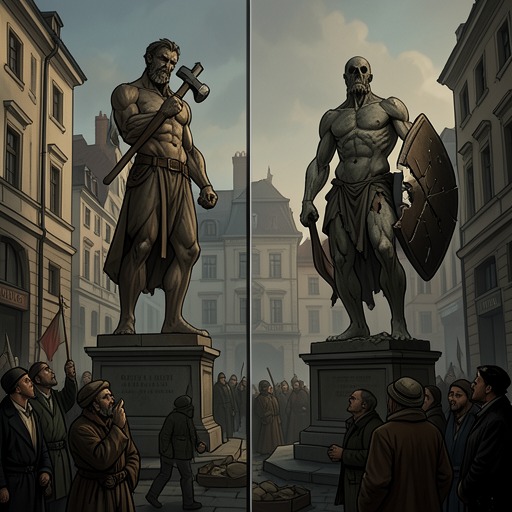
The book explains the political force of glasnost through this reversal: the state had tried not merely to conceal crimes but to compel belief that the concealed past had never existed. The famine’s significance in the account therefore includes the struggle over memory. Its recognition depends on breaking the silence that had made private loss dangerous to discuss and public history subject to political revision.
Memory after the Soviet collapse
The recovery of suppressed history did not settle how later generations would judge the Soviet past. Zakhar Prilepin’s provincial contemporaries, who were around fifteen when communism collapsed, remembered their Soviet childhood as more intelligible and dignified than their impoverished adolescence and young adulthood. Their nostalgia coexisted with a family memory of parents humiliated and stripped of pride in the post-communist period. The famine is not singled out in this account of nostalgia, but it stands within the larger history that competing memories can obscure or reclaim.
The book later describes Vladimir Putin’s appeal to a public unwilling to hear that seventy years of life, sacrifice, and belief had been worthless, and his insistence that communism was not the same as Nazism. Set beside the earlier account of glasnost, this politics of memory marks an unresolved tension: suppressed crimes had become speakable, yet the Soviet past could still be defended through memories of childhood, collective purpose, and national dignity. The famine remains consequential in that tension—as a historical reality recovered from silence, and as part of a past whose meaning continues to be contested.