1993 Russian Constitutional Crisis
LimonovThe 1993 Russian Constitutional Crisis turned a constitutional confrontation between Boris Yeltsin and his opponents into a siege, street battle, and bloody defeat for the insurgents. In the account, Eduard Limonov’s participation makes the crisis more than a contest over institutions: he enters the White House’s orbit as a committed patriot, misses much of the siege after leaving, and then is wounded in the assault on Ostankino. Its aftermath leaves both the political balance and the moral meaning of the conflict unsettled.
Background and Competing Claims
The crisis took shape amid rapid economic and political change. Yeltsin’s government had liberalized prices, provoking inflation of 2,600 percent. A voucher scheme intended to turn citizens into investors had been undermined by the loss of the vouchers’ value; many beneficiaries sold them for little more than the equivalent of a bottle of vodka. Meanwhile, the new political order did not command settled public allegiance. The confrontation would be presented as a defense of democracy by Yeltsin’s supporters and as resistance to executive seizure of power by his opponents.
In September 1993, Yeltsin announced that he was dissolving the Duma and calling new elections. The narrator treats dissolution as a familiar political gamble, but stresses the uncertainty over whether Yeltsin would accept the result if elections failed to produce a more compliant parliament. Viktor Alksnis, known as the Black Colonel, called Limonov to say that the situation was heating up and that patriots were gathering at the White House. Limonov finished his bowl of broth, left his lodging, and went there.
The building had changed meaning since the confrontation two years earlier: it had once stood internationally as a symbol of Yeltsin’s victory and the democrats’ cause. Now several thousand patriots gathered outside it. The narrator does not present this camp as politically uniform: some of its members were fascists, but others could not be reduced to that label. Their claim to be defending constitutional order against democrats prepared to impose a dictatorship was confused and compromised, yet the account refuses to dismiss it as wholly baseless.
The two central parliamentary opponents had themselves recently stood on Yeltsin’s side. Ruslan Khasbulatov, president of the Duma, and General Alexander Rutskoy, vice president of the Russian Republic, now led the rebellion against him. Rutskoy had also turned against Yegor Gaidar, mocking the prime minister over a photograph of him playing golf in pink shorts. The reversal of former allies sharpened the crisis: the dispute was not a simple division between people who had always belonged to opposing camps.
The White House Occupied
That evening, an extraordinary session of the dissolved parliament declared its dissolution unconstitutional, deposed Yeltsin, named Rutskoy president in his place, and occupied the White House. The assembly claimed to act in the people’s name and said it would leave only if forced out at bayonet point. Limonov joined the supporters inside. Through the night he moved from meeting to meeting amid cigarette smoke while the occupants argued, shouted, drank, drafted communiqués, and discussed forming a government. Limonov was impatient with the talk of distributing ministries; he wanted preparations made for the siege he expected.
The following day, Limonov left to shower and change at a friend’s home and visit Alexander Dugin, whom he urged to join the patriots. Dugin stayed behind to watch events on television. When Limonov returned, Yeltsin had cut electricity and telephone service to the White House and deployed OMON riot police. The siege had begun, and Limonov could not get back inside. All night he tried to slip between military trucks and soldiers carrying machine guns, comparing his position to that of a French partisan during the Nazi occupation. Government loudspeakers called on the insurgents to surrender; from outside, the building’s candlelit windows showed flickering lights and moving shadows.
The siege lasted ten days. Those trapped inside had no electricity, telephones, water, or heat; the cafeteria’s food and drink ran out. They burned office furniture for warmth and sang Orthodox hymns and songs of the Great Patriotic War. The people crowded into the building included Cossacks, old Stalinists, young neo-Nazis, parliamentary legalists, and priests. Offices became makeshift confessionals and baptisteries, and the little water left was blessed. Icons and images of the Virgin stood alongside portraits of Lenin and Nicholas II; red flags appeared beside swastika armbands. The scene’s clashing symbols and factions made the occupied building a miniature of the crisis’s political disorder.
Contact with the outside depended on an English journalist’s bulky radio telephone; mobile phones did not yet exist. Rumors ranged from the fantastic claim that the American Congress had arrested Bill Clinton to the increasingly credible fear that the army would attack. The occupants expected a bloodbath if they did not capitulate, but rejected capitulation as tension mounted. Rutskoy and Khasbulatov spoke of mass suicide, and nobody slept. Limonov, meanwhile, was outside and distraught at missing the siege, certain that the people inside would pay dearly for their resistance. The television coverage presented the insurgents as fascists and madmen and showed Yeltsin’s supporters, including a concert by Mstislav Rostropovich, while offering no images from inside the White House.
Street Fighting at Ostankino
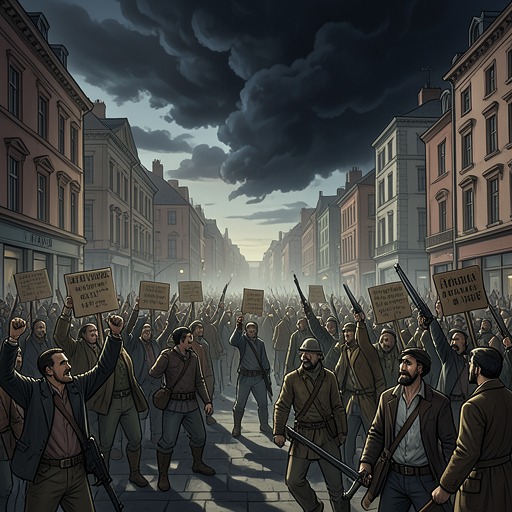
On October 3, Limonov did take part in a huge demonstration outside the White House. Several hundred thousand people waved red flags in support of the insurgents. He had come with Taras Rabko, a Ukrainian student and, after Limonov and Dugin, the third member of the National Bolshevik Party. The crowd shouted support for the Soviet Union and accused Yeltsin of fascism. Some also shouted antisemitic and racist slogans. Limonov disapproved, judging them both stupid and likely to be the only element Western media would report.
The demonstrators provoked OMON, whose forces opened fire, seized people, and beat them. Young people who recognized Limonov surrounded him and shielded him with their bodies. Rutskoy appeared on a White House balcony and urged the crowd to march on the Kremlin, arrest Yeltsin, and take Ostankino, the television tower whose control could, the account notes, change the struggle for the news. Armed men boarded buses and cars for the tower. Limonov and Rabko joined them; as they crossed an otherwise deserted city, occasional bystanders raised a V sign. On the bus, Limonov told an Irish journalist that the struggle was not over and that his side was beginning to hold its head high.
At Ostankino, several hundred insurgents had grown to several thousand, but only about one in ten carried a weapon, and OMON was waiting. The police opened fire and charged with batons. Limonov was slightly to one side when the assault began and threw himself to the ground. A body fell on top of him: the Irish journalist, who was dead, blood at his mouth. Limonov checked him and briefly wondered whether anyone would one day see the footage the journalist had just filmed.
Gunfire continued around them. Limonov got up, felt a bullet strike his shoulder, and was led by Rabko to trees in the park. Rabko tore his shirt to dress the wound. It bled heavily but was not deep. The fighting carried on nearby before the area quieted. When OMON searched the park and forced demonstrators into vans, Limonov and Rabko escaped capture. With the exits watched, they spent the night freezing in bushes. Limonov told himself that next time he would lead, rather than leave events to the generals who had dismissed him as an intellectual.
Defeat and Its Immediate Aftermath
At dawn, Limonov and Rabko left the park and reached a metro station, where they learned that tanks surrounded the White House. Only hours earlier, they had thought victory possible; now it was clear that the insurgents had lost. The attack on the building brought renewed patriotic songs and Orthodox litanies. Rutskoy again spoke of suicide, invoking Hitler in his bunker, but surrendered in the afternoon. The narrator says that the delay cost 150 lives. OMON entered the White House and pursued those inside through corridors, offices, and toilets, beating them and, in some cases, killing them.
The official register recorded hundreds dead and thousands injured, including not only insurgents but passersby, older people, and children who had gathered to watch. Fearing arrests in nationalist refuges, Limonov and Rabko went into hiding. They took a train to Tver, where Rabko’s mother lived, and spent two weeks shut up in her small apartment watching television.
The imposed account of the crisis began to crack. The narrator describes a reversal in which the comparison with the Paris Commune placed the fascists in the role of the Communards and the democrats in the role of the Versaillais. Political labels no longer seemed to settle who was progressive or reactionary, or who was right. Andrei Sinyavsky, a dissident and committed democrat, expressed the disorientation in an interview: “The terrible thing now,” he said, “is that the truth seems to be on the side of people I’ve always thought of as my enemies.” The crisis had not merely defeated one side; it had made the customary moral alignment harder to sustain.
Political Legacy
The crisis became a point of reference in Limonov’s later political organizing. At a National Bolshevik Party convention, he recalled his futile attempt to persuade Rutskoy during the siege and argued that the moment for taking power had not yet arrived. The party had grown to seven thousand members, with several hundred delegates attending the convention, but Limonov told them not to mistake enthusiasm for readiness to rule. The experience of 1993 thus remained a lesson in timing as well as a memory of defeat.
He redirected the party’s ambitions toward Russians living in former Soviet republics, whom he described as abandoned after the Soviet Union’s collapse. He named the Baltic states and Central Asia as targets for organizing and advocated encouraging insurgencies and separatist republics. This later strategy does not erase the White House’s defeat; it shows how Limonov converted the crisis into a continuing opposition project. Years afterward, the Ministry of Justice denied the National Bolshevik Party authorization to exist, forcing it toward clandestine organization. The crisis’s aftermath, in the book’s broader political arc, therefore extends from the collapse of the 1993 insurgency to the state’s later suppression of the movement that Limonov built.