Secret Speech at the 20th Congress of the CPSU
LimonovThe Secret Speech at the 20th Congress of the CPSU was Nikita Khrushchev’s 1956 denunciation of Stalin’s cult of personality, delivered at a moment when former prisoners and those who had helped send them away were once again sharing the same society. Though designated secret, the report soon circulated beyond the congress. Its significance lay not only in its criticism of Stalin but in the larger question it raised: what might happen if the Soviet Union continued telling the truth about its past?
Background: A past returning to view
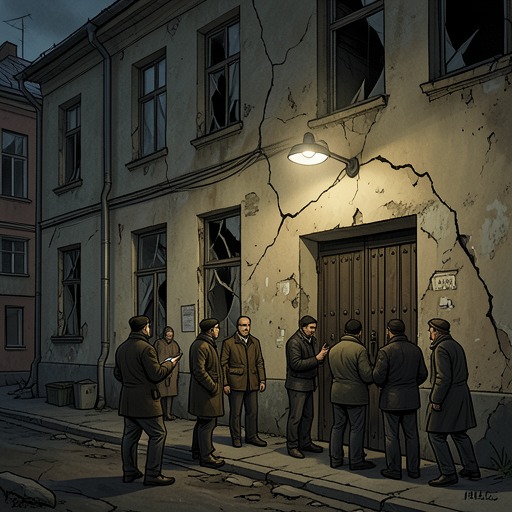
After Stalin’s death, millions of former prisoners were released, and some were rehabilitated. Their return brought survivors into contact with bureaucrats, informers, and others who had expected never to see them again. The encounter did not become the bloodbath it might have been; often, people recognized one another, looked away, and carried on, leaving the history between them unspoken. The Secret Speech belonged to a brief period in which that silence could be broken.
The report and its implications
In 1956, at the Twentieth Party Congress, Khrushchev delivered a report that deplored Stalin’s cult of personality. It implicitly acknowledged that the country had been governed by murderers for twenty years. Although the report was called secret, it did not stay that way for long. The account presents its effect as more than a change in official language: once the past could be discussed, the truth about the camps and the regime’s violence threatened to unsettle the legitimacy of the whole political order.
The thaw and the limits of disclosure
The report’s challenge to Stalin was followed by a more public act of disclosure in 1962, when Khrushchev personally authorized publication of Aleksandr Solzhenitsyn’s One Day in the Life of Ivan Denisovich. The story’s meticulous account of an ordinary day in a camp shocked readers, and the issue of Novy mir carrying it was snapped up across Russia. The book gave renewed force to the possibility that one person’s truthful account could not simply be suppressed. In the narrative’s chronology, the Secret Speech and the publication together mark the rising arc of de-Stalinization, while the later book makes visible just how far that opening could reach.
Political aftermath and historical significance
The authorities understood that continued truth-telling might sweep away not just Stalin but Vladimir Lenin, the system itself, and the lies on which it depended. The publication of Solzhenitsyn’s book thus marked both the height and the end of de-Stalinization. After Khrushchev lost power, a generation of apparatchiks that had emerged from the purges established a softer form of Stalinism under Leonid Brezhnev. The report’s historical importance, as presented here, is therefore double: it made a public breach in the official silence, and it exposed the political limits that would soon close around that breach.