Battle of Vukovar
LimonovThe Battle of Vukovar is presented through Eduard Limonov’s journey to the city after Serbian troops had taken it, not through an account of the fighting itself. The visit brings him face to face with the destruction left by the battle and with the conflict’s competing claims about victimhood. He recognizes that civilians and fighters have suffered on both sides, yet refuses neutrality and chooses the Serbian side—a decision that exposes how readily the reality of war becomes entangled with his own longing for danger and military brotherhood.
Background and invitation
In November 1991, Limonov was in Belgrade for the launch of one of his books when uniformed men approached him at a signing. They asked what he knew about the Serbian Republic of Slavonia, described to him as an enclave of Serbs in the easternmost part of Croatia. Opposed to Croatia’s secession, its Serbs had declared a secession of their own; the Croats objected, and the dispute had become a war. Vukovar, a key city in that conflict, had just fallen. The men invited Limonov to see it for himself.
He initially had other plans. Events in his own country interested him more than what he considered disputes between Balkan peasants. But he thought he would soon be fifty and had never experienced war, an experience he believed a man ought to have sooner or later. He accepted the invitation and was so excited that he did not sleep that night. The trip therefore began not with a political commitment to the conflict but with an appetite for the experience of war itself.
At dawn, two officers collected him from his hotel and drove him along the highway between Belgrade and Zagreb. Since hostilities began, the road had seen no private vehicles, and checkpoints and roadblocks interrupted the journey. Soldiers checked travelers’ identification while others kept rifles trained on them. Limonov’s identity complicated the assumptions made about him: as a Russian, he was presumed Orthodox and pro-Serbian, but his French passport suggested to the officers that he might be Catholic and pro-Croatian. He eased their suspicion with pointed remarks against Franjo Tuđman and Hans-Dietrich Genscher, whom the officers associated with European recognition of Croatian independence. After a drink, they continued toward Vukovar.
The fall and its aftermath
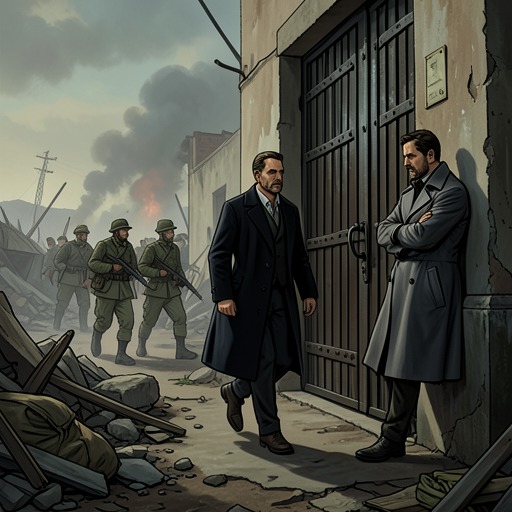
A contradiction in the officers’ account complicates the journey. The soldiers supporting the Serbian cause wore the uniform of the Yugoslav People’s Army, an institution that in theory could not take part in the conflict. In practice, because it was majority Serb, it had shelled Vukovar and Croatian positions around it. The officer accompanying Limonov nevertheless developed a comparison between the Serbs’ situation and the Jews’ fate during the Second World War. The comparison faltered against the evidence of the army’s role, but Limonov was not interested in testing it. Tanks, rifles, sandbags, gray-green uniforms against snow, distant mortar fire, and villages still smoking held his attention instead.
Vukovar had been taken two days before his arrival. Those around Limonov called the capture a liberation, without irony; the word did not make him question what had happened. The once-pretty Habsburg city looked to him like a smaller Berlin after the Red Army’s advance: devastated rather than restored. On his return to Belgrade, a writer would ask what hotel he had stayed in. Limonov did not explain that there were no hotels left in Vukovar. Few houses still stood, none was habitable, and the city had become a wasteland of rubble, twisted metal, and glass that bulldozers were beginning to clear.
The destruction shaped even the smallest movements through the city. Mines made it dangerous to step off the path, and there were no birds in the sky. Most corpses had already been removed, but Limonov was taken to a body-identification center. There he saw tortured, purple and charred bodies, slit throats, and bags of human remains unloaded from trucks. When he asked who the dead men were, the officer guiding him answered that they were Serbs. To the officer, the victims of war were Serbs by definition and Croats their torturers. The narrative sets that certainty against the location: the center stood on the outskirts of a Croatian city annihilated by Serbian, or more precisely federal, artillery, with a quarter of its population missing. It does not establish the identity of the bodies Limonov saw; the guide’s answer is itself part of the competing account of the battle.
Allegiance and the experience of war
Limonov did not conclude that one side held a monopoly on suffering or courage. He believed there were innocent victims, valorous warriors, and unjustly displaced people on both sides. But for him, refusing to choose was not an acceptable response: he regarded neutrality as cowardice and felt that fate had placed him with the Serbs. His allegiance thus coexisted with an awareness that the Serbian account could not explain away the devastation surrounding him.
The visit fulfilled the desire that had taken him onto the road. Around the evening fires and in the crowded camp, he felt at home among unshaven men warming swollen, black-fingernailed hands. The camp’s charcoal stoves, prune schnapps, and the smell of feet made war into a physical world of hardship and belonging. As a child, he had dreamed of this kind of military encampment and brotherhood; now he felt that what fate had denied him had suddenly been placed within reach. He judged that two hours of war taught more about life and people than four decades of peace. Although he called war dirty and senseless, he also believed that its intense appeal explained why people returned to it. Vukovar’s destruction and Limonov’s exhilaration occupy the same episode, an uneasy contrast the account refuses to resolve.
Later political significance
The battle also supplied an analogy in Limonov’s later political rhetoric. Addressing his National Bolshevik Party, he compared Serbs in the former Yugoslavia with Russians living in former Soviet republics: peoples who had once exercised power, he argued, but who now faced victimization, ostracism, or toleration in territories they believed they had helped build. He pointed to Russian communities in Latvia, Ukraine, and Kazakhstan and advocated stirring insurgency and creating separatist republics. The analogy does not erase the differences between those situations; it shows how the experience of Vukovar could be carried forward as a political frame for interpreting abandonment and lost power. The episode’s lasting significance lies in this double vision: Limonov encountered a city whose destruction challenged a simple story of Serbian victimhood, yet he emerged with a Serbian allegiance and a model of war that would inform his later political imagination.