Croatian War
LimonovThe Croatian War is presented not as a conflict with an immediately clear division between right and wrong, but as a struggle in which national self-determination, the memory of fascist violence, and the fears of minorities collide. Its fall into the narrative is marked by Vukovar: the city’s destruction ends the narrator’s distant, unsettled observation and draws Eduard Limonov toward the front, where the visible machinery of war fascinates him more than the political contradictions surrounding it.
Competing claims and inherited violence
The narrator first encounters the conflict from afar, while writing a biography of Philip K. Dick and following events in the Former Yugoslavia without taking a firm position. In the earliest framing, when Serbs and Croats are the principal parties, their fighting can seem like an ancient feud: villagers reach for rifles after drinking and kill one another over histories and grievances difficult for outsiders to comprehend. One such dispute concerns a field regarded by Serbs as sacred because it was the site of their bitterest historical defeat. From a distance, the war also appears to signal that the exhilaration of 1989 has faded.
Many of the narrator’s friends support Croatian independence on the principle of national self-determination: a people that wants to leave should not be forcibly kept within a state. Those who oppose this argument raise two objections. If the principle applies without qualification, they argue, it must also apply to Corsicans, Basques, Flemish separatists, and supporters of Italy’s Northern League, potentially making separation endless. They also invoke the history of the Second World War: France had traditionally been a friend to the Serbs, who resisted Nazi Germany, while the Croats had supported the Nazis with particular zeal. The account of Ante Pavelić in Malaparte’s Kaputt gives this history its most grisly emblem. Asked whether a basket contained Dalmatian oysters, Pavelić reportedly said it held forty pounds of Serbs’ eyes, sent by his Ustaše loyalists; the Serbian side, in turn, was associated with the Chetniks.
The argument that seems most persuasive to the narrator concerns the Serbs living within Croatia. A population long dominant in the Former Yugoslavia would become a minority in an independent Croatia, and its fears were sharpened by the first actions of the government under Franjo Tuđman. The government banned signs in Cyrillic, dismissed Serbs from the civil service, and replaced the Yugoslav federation’s red-starred flag with a red-and-white checkerboard. The new flag had been created in 1941 by the Germans, and for people who had lived through the Second World War it carried associations comparable to those of the swastika. In those first months, the account insists, the conflict could not simply be sorted into good and bad camps. Propaganda was present, but it was not irrational to imagine the Serbs of Croatia as a people exposed to persecution. The spectacular destruction of Vukovar begins to alter that uncertain picture.
Limonov is drawn toward Vukovar
In November 1991, Limonov is invited to Belgrade for the launch of one of his books. During a signing, uniformed men ask what he knows about the Serbian Republic of Slavonia. He knows little. They explain that it is a Serbian enclave at the eastern edge of Croatia: unwilling to accept Croatian secession, its inhabitants have seceded themselves, provoking Croatian opposition and war. Vukovar, a key city in the fighting, has just fallen. The men ask whether he wants to see it.
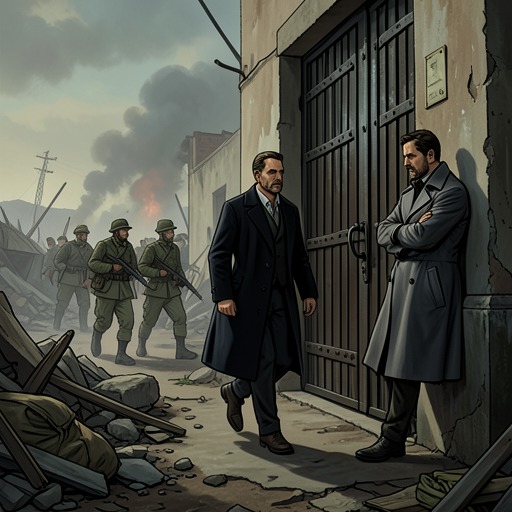
Limonov has other plans and is more interested in events in his own country than in disputes between Balkan peasants. Yet he thinks he will soon be fifty and has never been to war, an experience he believes a man must have sooner or later. He accepts. His excitement is so great that he does not sleep that night. At dawn, two officers collect him from his hotel and take him along the highway linking Belgrade with Zagreb. Since hostilities began, the road has seen no private vehicles, and the journey proceeds through roadblocks and checkpoints. Soldiers inspect identification papers while others keep rifles trained on travelers. The route to Vukovar is therefore not a clean passage from civilian life into war: armed scrutiny and suspicion are already part of the journey.
A divided identity at the checkpoints
Limonov’s identity complicates the officers’ assumptions. As a Russian, he is presumed to be Orthodox and pro-Serbian; his French passport, however, suggests that he is Catholic and perhaps pro-Croatian. The passport makes him legible to the soldiers through a competing national and religious alignment, despite the simplicity of their initial expectation. The tension eases after he makes forceful criticisms of Tuđman and Hans-Dietrich Genscher, the German foreign minister who encouraged European colleagues to recognize Croatia’s independence. In Belgrade, Genscher is regarded as a theorist of a Fourth Reich. The officers and Limonov exchange threats about hanging one with the other’s intestines, drink together to seal the understanding, and continue on their way.
The episode offers a small, concrete instance of how the conflict’s political divisions are enforced and negotiated. Limonov is questioned not only about what he knows, but about what his passport appears to say he believes. His verbal attack on figures regarded as hostile to Serbia reassures his escorts sufficiently for the journey to resume. Yet that accommodation does not resolve the larger issue of who is actually conducting the war.
The army behind the Serbian cause
One detail in the account the officers give Limonov undermines their comparison between the Serbs of Croatia and Jews facing persecution during the Second World War. The soldiers supporting the Serbian cause wear the uniform of the Yugoslav People’s Army, an institution that still exists and is theoretically unable to participate in the conflict. In practice, because the army is majority Serb, it has conscientiously shelled Vukovar and Croatian positions around it. The officers’ account of Serbian vulnerability thus sits beside evidence of an organized military force actively attacking the city. The analogy with Jews who had no Wehrmacht to defend them cannot withstand that contrast.
Limonov is indifferent to the contradiction. What attracts him are the soldiers, tanks, sandbags, gray-green uniforms against the snow, and the mortar fire. The narrative’s emphasis shifts accordingly: it has moved from the narrator’s careful weighing of historical claims to Limonov’s appetite for the physical presence of war. His trip does not settle the political argument or turn him into a reliable judge of its factions. Instead, Vukovar draws him into a scene where the discrepancy between an explanatory story and the forces on the ground is unmistakable, yet less compelling to him than the spectacle of armed conflict itself.