First Chechen War
LimonovThe First Chechen War emerges as both a military catastrophe and a political gamble: a campaign whose leaders hoped it would strengthen Boris Yeltsin, but whose destruction and human cost made the promise of a swift victory ring hollow. The account places the war amid a crisis of democratic legitimacy and offers a second, explicitly attributed explanation for why influential military figures may have wanted the conflict: a major war could conceal the scale of corruption in the armed forces.
Background and political stakes
By the time the war entered the presidential-election crisis of 1996, the disastrous effects of shock therapy and the first wave of privatizations had plunged Russia into chaos. Many people regarded the changes since 1989 as a historic calamity. Yeltsin, once the bearer of great hopes, appeared to have lost control; isolated in the Kremlin with his family and security chief, Alexander Korzhakov, he endured serious depressive episodes and drank heavily. His public drunkenness embarrassed Russians at international gatherings. The account presents these swings between despair and drunken euphoria as a political circumstance in which military hard-liners could find an opening.
Chechnya had been independent since 1991 and was governed by a former Soviet apparatchik who had converted to Islam. The account describes it as a haven for organized crime, drug trafficking, and counterfeiting, but also notes that Russia continued to benefit from the situation and had little obvious economic reason to intervene. That distinction matters: the campaign is not explained simply as an effort to suppress crime. The military high command had another interest in a major conflict, according to a theory advanced by Paul Klebnikov before his murder.
Klebnikov, whom the narrator describes as no believer in conspiracy theories, suspected that generals needed a war to hide extensive corruption. They had allegedly sold large quantities of weapons and ammunition, especially tanks, on the black market. A major conflict, in his account, would allow that matériel to be recorded officially as destroyed. The book does not establish this as the decisive cause; it preserves it as Klebnikov’s explanation and explicitly leaves open how much weight it should carry.
The assault and its scale
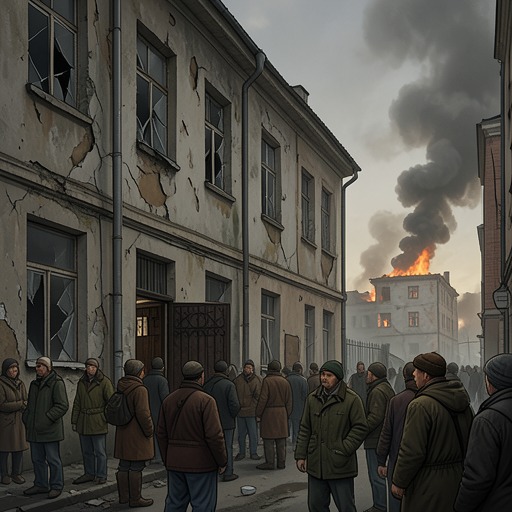
Whatever the generals’ motives, the Russian army did not spare the city. At the height of the siege of Sarajevo, the account gives a figure of 3,500 detonations a day. At the beginning of the siege of Grozny in December 1994, it gives 4,000 an hour. The comparison compresses the difference into a brutal measure of intensity: the bombardment of Grozny surpassed even the already staggering pace described for Sarajevo. The city was laid waste as completely as Vukovar had been.
The account sets that destruction against the Chechens’ resistance. They fought a merciless guerrilla war, attacking Russian soldiers in their tanks and carrying out bloody terrorist actions on Russian territory. The campaign therefore did not remain the victorious lightning strike its young conscripts had been promised. Instead, the army became bogged down in a conflict compared to the Soviet war in Afghanistan, a comparison that makes the war’s failure of expectation central to its human cost.
Conscripts and the legacy of dirty wars
Forty thousand young conscripts were drawn into the conflict. Among them was Zakhar Prilepin, who would later become a writer. They had been promised a rapid victory and a triumphant return; many instead found themselves trapped in a war as horrible as Afghanistan had been for their fathers and older brothers. The book’s account refuses to treat the conscripts as an abstract military number: it emphasizes that they returned, if they returned at all, crippled, humiliated, and suffering from hallucinations.
The chronology sharpens the sense of repetition. Mikhail Gorbachev withdrew Soviet troops from Afghanistan in 1988; only six years of peace separated that war from the Chechen conflict. The two wars are presented as dirty wars that sent young Russians home bearing lasting physical and psychological damage. The interval is short enough to make the second campaign feel less like a new beginning than a renewed exposure of a generation to violence.
Electoral calculation and political consequence
The conflict was also bound up with Yeltsin’s deteriorating political position. With the 1996 election approaching, Korzhakov and the military hawks persuaded him that a small, decisive war against Chechnya could undermine the nationalists and revive his waning popularity. The plan depended on a sharp contrast between the promised quick victory and the campaign that followed: Grozny was devastated, guerrilla resistance continued, and conscripts became bogged down in another prolonged war.
As the election approached, Yeltsin was more hated than his predecessor, and he seriously considered canceling the vote. The account thus places the war beside a broader crisis in which the democratic experiment had lost public support and the Communist Party appeared capable of winning massive backing. It does not present the war as the sole cause of that crisis, nor does it settle the outcome of Klebnikov’s theory about military corruption. Instead, it shows the campaign at the intersection of presidential insecurity, electoral calculation, military interests, and the lives of young soldiers. Its decisive significance lies in that collision: a war intended to produce political advantage became an immense act of destruction and another source of the crippled, humiliated survivors whom the book associates with Russia’s dirty wars.