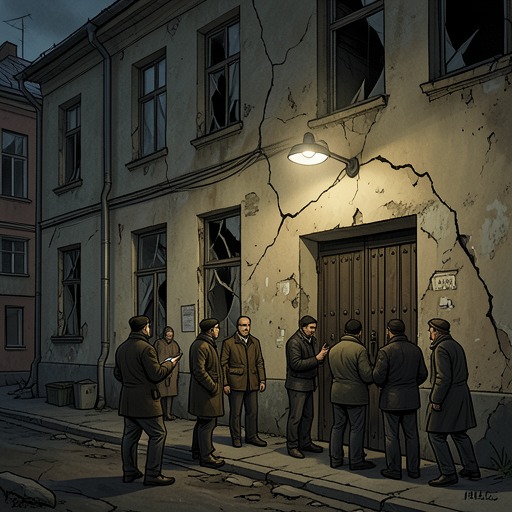
Collapse of Communism in Europe
LimonovThe Collapse of Communism in Europe is the decisive rupture in the book’s account of Eduard Limonov: an event that first seems to separate him from the friends who had admired his irreverence, then places him inside new struggles over Russian power and political legitimacy. The end of the old order does not settle what it meant. Instead, it reveals how nostalgia, nationalism, democratic opposition, and the memory of Soviet life can combine in ways that unsettle the narrator’s assumptions about who belongs on which side.
From liberation to rupture
Before the collapse, Limonov spoke of the Soviet Union under Leonid Brezhnev with wry nostalgia, presenting it as a vanished world in which resourceful hooligans could thrive. His Paris acquaintances took his praise of Joseph Stalin as provocation, and admired the Red Army officer’s jacket, the arguments, and the adventurous past. They regarded him as their barbarian: an unruly figure whose difference from bourgeois life was part of his appeal.
The collapse changes the tone of that performance. The narrator recalls that Limonov was unhappy while everyone around him celebrated, and that his call for Mikhail Gorbachev to face a firing squad no longer seemed like a joke. The apparent political provocation had become a position with consequences. What had once been safely legible to his friends as theatrical defiance now looked like a real break with their shared expectations of what the end of communism should mean.
War and a new political identity
After the collapse, Limonov began making long trips to the Balkans. His acquaintances were horrified to learn that he fought on the Serbian side, and a BBC documentary showed him bombarding besieged Sarajevo under the eye of Radovan Karadžić, the Bosnian Serb leader and a known war criminal. In the narrator’s account, this was no longer the picturesque unruliness that had made Limonov attractive in Paris: his politics had entered an actual war.
After returning to Russia, Limonov founded the National Bolshevik Party. Its public image made the rupture visible. Reports showed young members with shaved heads, dressed in black, marching in Moscow with a raised-arm gesture associated with Nazism and a clenched-fist gesture associated with communism. Their flags replaced the swastika in a Third Reich imitation with the hammer and sickle, while their slogans invoked Stalin, Beria, and the Gulag. The figure leading them with a megaphone was, for the narrator, almost impossibly the same amusing, seductive friend he remembered from Paris. The change prompted him to look back over their friendship and wonder what chain of circumstances had led Limonov so far from the people who had once admired him.
A contested place in opposition politics
The narrator’s first judgment seemed straightforward: Limonov was a fascist leading a militia of skinheads. Reading Anna Politkovskaya’s account of the trial of forty National Bolshevik militants complicated that conclusion. The activists had occupied and vandalized the presidential administration’s offices while demanding Vladimir Putin’s departure. Politkovskaya defended them as courageous young people of integrity and among the few who offered hope for Russia’s moral future. Yelena Bonner, widow of Andrei Sakharov, likewise supported the party’s members, while acknowledging that its name carried troubling associations.
This unexpected support did not erase the movement’s symbols or Limonov’s past; it altered the political position from which those things had to be understood. Several months later, Limonov joined a coalition called The Other Russia with Garry Kasparov and Mikhail Kasyanov, figures whose political histories seemed incompatible with his own. The narrator saw a change not necessarily in Limonov himself, but in the place he occupied in Russia. That change prompted him to propose Limonov as the subject of a magazine feature, despite his colleague Patrick de Saint-Exupéry’s dismissive description of him as a petty thug.
The contradiction also appears in the 1993 confrontation at the White House. Limonov joined patriots supporting the rebel parliament against Boris Yeltsin. Some among the crowd were fascists, yet they presented themselves as defenders of the constitutional order and accused the democrats of using dictatorship to preserve democracy. Limonov argued to General Rutskoy that the conflict was not a coup but an elected parliament resisting dictatorship, and insisted that the decisive struggle would take place inside the White House. The scene gives political labels no easy stability: people who had recently stood with Yeltsin were now leading a rebellion against him, while Limonov framed his side as the constitutional one.
Rebuilding a movement after the Soviet Union
Limonov’s party turned its Soviet inheritance into a political constituency. At a convention, several hundred delegates gathered from across Russia, although the party counted seven thousand members in the country. The meeting had been difficult to arrange: venues repeatedly withdrew, and organizers feared a bomb scare, police harassment, or an outright ban. For Limonov, the gathering showed that years spent distributing the party newspaper beyond Moscow had brought real followers together. Many were provincial adolescents whom the narrative depicts as poor and socially exposed; the movement gave them a shared identity, style, and ideal.
Limonov told the delegates that the party was not yet ready to take power. Instead, he proposed turning its attention to Russians living beyond the borders of the former Soviet Union, whom he described as abandoned and dispossessed after its dissolution. He named Latvia, Ukraine, and Kazakhstan, citing the large Russian populations there, and called for insurgency and separatist republics in the Baltic states and Central Asia. A planned canvassing trip to Central Asia drew a surge of volunteers. In this vision, the collapse was not only the end of a state: it was also a grievance and a mandate to contest the new borders it had left behind.
The party’s mass politics developed alongside a widening internal division. Alexander Dugin’s followers looked down on Limonov’s recruits, whom they regarded as a common crowd of rock fans and fighters rather than the disciplined, historically minded paramilitaries they admired. Zakhar Prilepin disliked the movement’s fascist references. Dugin eventually left to establish a geostrategic studies center, leaving Limonov’s followers to themselves. The split showed that a shared opposition to the post-Soviet order did not produce a shared account of what should replace it.
Aftermath: opposition and the struggle over memory
The post-Soviet political landscape also brought a renewed appetite for the Communist Party. Five years after Yeltsin had declared it illegal, polls showed widespread readiness to vote for it, amid anger at democracy, market reforms, and the injustice associated with them. Gennady Zyuganov offered a cautious program focused on corruption, national pride, and Russian Orthodoxy rather than a promise to restore the Gulag or the Berlin Wall. At the same time, oligarchs feared that a Communist victory might undo the loans-for-shares arrangement through which they expected to acquire major state assets. The book presents this electoral contest as a consequence of the collapse that is economic as well as ideological: the new order had not secured popular loyalty simply by displacing the old one.
Later, Limonov opposed Putin in pamphlets, calling him a tyrant, while the narrator judged that description inadequate. Putin’s appeal, as the narrator understands it, rested partly on a refusal to treat decades of Soviet belief and sacrifice as worthless or equivalent to Nazism. Limonov, the narrator suggests, could have pursued a similarly authoritarian course had he reached power; instead, he occupied the incongruous role of opposition defender of democracy and human rights alongside people whose values he had long despised. The collapse therefore ends neither Soviet memory nor the political conflicts built around it. It leaves Limonov in a position shaped by the new order he rejects, while making the narrator reconsider the line between a fascist provocation and a movement that can also be defended as opposition.