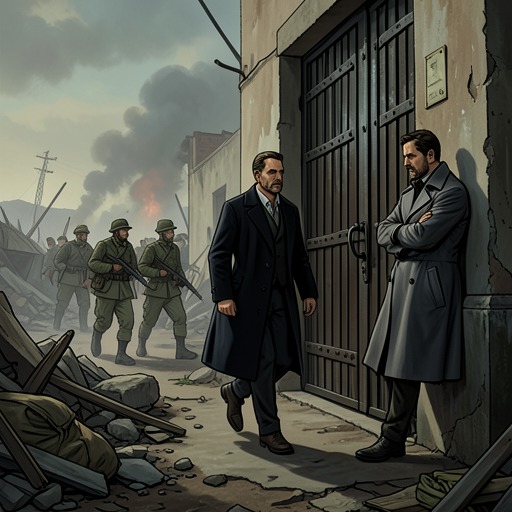
Sarajevo’s wartime siege and bombardment
LimonovThe Siege of Sarajevo is presented as both a prolonged assault on a besieged city and a test of how observers choose their side. In Emmanuel Carrère’s retrospective account, its significance lies not only in the bombardment but in the changing judgments it provokes: visitors drawn by solidarity and danger, witnesses willing to correct their first impressions, and images that make Eduard Limonov look at once less culpable than rumor suggested and more ridiculous than his admirers might have wished.
A siege and its observers
When fighting between Serbs and Croats came to a provisional halt and shifted to Bosnia in the spring of 1992, the political picture seemed clear to the circles Carrère knew. Slobodan Milošević and Radovan Karadžić appeared to embody the aggressor’s side; Alija Izetbegović and the Bosnian Muslims appeared to be suffering a heinous attack. In France, Sarajevo became a symbol of the multiethnic Europe people wanted to defend. Its Bosnian Muslim residents were often idealized as the embodiment of that cause.
That idealizing view helped propel people Carrère knew into regular trips to the besieged city. They slept in bombarded buildings without the possibility of bathing, crossed shattered streets under sniper fire, and lived with the possibility that any day might be their last. The danger could lend itself to exhilaration and romance; some visitors fell in love. Carrère acknowledges that he declined the opportunity partly out of fear. He had also learned that Jean Hatzfeld had just lost a leg after being hit by Kalashnikov fire, and he distrusted the pull of supposedly sacred political missions, especially when they appealed to his own social circle.
Choosing where to stand
Carrère’s hesitation develops into a wider question about political certainty. He considers how easily a person might be drawn, in another time or circumstance, toward terrible causes, and whether values regarded as universal might later look grotesque or wrong. He does not treat those doubts as proof that the besieged and besiegers were morally equivalent. Instead, he examines the danger of explanations that make every conflict so complicated that no one has to choose a side.
Hatzfeld’s reporting becomes a test of that distinction. His first instinct was to believe Serbian snipers had ambushed him because they meant to kill a journalist. After spending a year in hospital, he returned to Sarajevo to investigate and concluded that, by chance, the shots that cost him his leg had come from Bosnian militiamen. The correction matters: Hatzfeld puts a fact against his own initial understanding rather than concealing it. Yet it does not make the choice of where to observe the siege meaningless. Carrère’s account argues that when one side is weaker and the other stronger, a witness can acknowledge that the weaker side is not angelic and the stronger side not demonic while still going where the shells fall, rather than where they are fired from.
That position requires continual adjustment. Carrère notes that Jean Rolin could feel satisfaction when Serbs, for once, were the ones under attack; the feeling did not last as the balance shifted again. The sequence leads to a broader warning about the reversal of victim and perpetrator: those who suffer may become perpetrators, and perpetrators may later become victims. The challenge is not to claim permanent innocence for one camp, but to keep moving one’s attention toward those who are suffering now.
The film from the heights
Paweł Pawlikowski, a Polish-born British filmmaker, approached the war from the other side of the dominant rhetoric in London and Paris, which portrayed the Serbs as heirs to the Nazis. In 1992 he went to see what people there thought and filmed the material that became Serbian Epics. The documentary follows Serbian nationalist imagery into everyday settings: musicians play hurdy-gurdies outside soldiers’ tents, songs celebrate defeat on earth and victory in heaven, and children sing while carrying Kalashnikovs. The names of heroic ancestors give way to contemporary figures, including Karadžić and Ratko Mladić.
Pawlikowski also filmed a council of war in which Karadžić and Mladić lean over maps, marking borders and populations and weighing what could be conceded. The scene gives the leaders’ decisions a physical form: lines on a map stand for people and territory being bargained over. At Pale, the ski resort that served as the capital of the Bosnian Serb Republic, Pawlikowski noticed Limonov among officers and Chetniks. Limonov’s People’s Army overcoat, leather jacket, crew cut, glasses, and 7.65 pistol made him seem like an outsider adopting a disguise. Pawlikowski asked him to interview Karadžić for the film.
The resulting scene takes place on the heights from which Serb batteries bombard Sarajevo. The city lies below in a basin, and the rumble of mortar fire is nearly constant. Karadžić, tall and imposing in a large overcoat, explains that his people are not aggressors but seek to reclaim territory they regard as theirs. Limonov nods respectfully and praises the Serbs’ resistance to the countries aligned against them. When Karadžić recites an ode about Sarajevo in flames, a pause gives the exchange an ominous quality. A telephone call from Karadžić’s wife interrupts it.
While soldiers remain nearby, one plays with a small dog and another greases a machine gun. The soldier offers Limonov a turn. Limonov takes his position behind the weapon, follows the instructions, and fires a magazine toward the besieged city. The filmed gesture is startling partly because the soldier’s encouragement and the laughter around him make Limonov look like a child eager to perform for adults. The camera records a real act, but the act alone cannot establish that he hit anyone.
What the images prove—and cannot prove
The film’s reception sharpened the scene into a more definite accusation. In France, a rumor spread that Limonov had been shown shooting people in Sarajevo’s streets. When asked about it fifteen years later, he denied aiming at people: he had fired in the city’s direction, he said, but at nothing in particular or at the sky. A wide shot supports part of that distinction. The machine-gun scene occurs on heights some distance from the city, where mortars were firing, not down among the positions from which snipers picked people off in the streets.
But the edit complicates the viewer’s judgment. The footage of Limonov with the machine gun is followed by a much closer view of the city, presented like a reverse angle. That change in perspective can make the shots appear more directly connected to the streets below than the opening wide shot warrants. The images cannot settle whether Limonov would have been troubled by shooting at people, or whether he did so in other circumstances. They establish that he fired toward the besieged city; they do not establish that he shot its inhabitants.
The uncertainty did not prevent the footage from changing his public image. People Limonov knew in Paris stopped seeing him as a charming adventurer and began to regard him as something like a war criminal. Carrère, who had not seen the film when French television broadcast it, eventually obtained a DVD from Pawlikowski. Serbian Epics so disturbed him that he stopped work on the book for more than a year. His strongest reaction was not that the documentary proved Limonov had committed a crime; Carrère explicitly distinguishes the filmed evidence from that claim. It was that Limonov looked absurd: a little boy playing at toughness.
The siege as a problem of judgment
The episode’s force comes from the gap between the reality of bombardment and the instability of the stories told about it. Sarajevo’s position in a basin, the near-constant mortar fire, and the danger faced by people crossing its streets are concrete conditions; the film’s edited sequence, by contrast, can invite a viewer to infer more than its images demonstrate. Carrère makes that gap visible rather than closing it with a verdict.
The siege therefore becomes a setting in which sympathy, evidence, and political allegiance remain in tension. Hatzfeld’s investigation corrects his own assumption about who fired the shots that wounded him without erasing the difference between besieging and besieged. Limonov’s filmed burst of gunfire reveals his proximity to the Serbian position and his willingness to participate in its performance, but it does not show him killing anyone. In Carrère’s account, the essential act of witnessing is neither to hide inconvenient facts nor to use complexity as an excuse for indifference.