Eduard Limonov's arrest and trial
LimonovEduard Limonov’s arrest and trial expose the gulf between the modest reality of his group’s encampment in the Altai and the state’s portrayal of it as a grave security threat. The raid leads from a snowbound cabin to Lefortovo’s isolation, a high-profile trial in Saratov, and a four-year sentence served in part at Penal Colony 13 at Engels. Across those settings, the case becomes both a struggle over political legitimacy and a close account of how Limonov meets confinement through discipline, observation, and adaptation.
Political Context and the Raid
The arrest came against a background in which political identities and claims to democratic legitimacy had become fiercely contested. During the earlier confrontation at the White House, Limonov had joined the patriots assembled in support of rebel legislators. He argued that the conflict was not a coup but an elected parliament resisting dictatorship, and presented Western support for Boris Yeltsin as evidence that Russia’s opponents abroad wanted the country weakened. The episode illustrates how language about democracy, patriotism, and constitutional order could be claimed by opposing sides.
The later prosecution would likewise turn on how the state defined Limonov and his movement. The account describes a camp in the Altai where a special-forces unit arrived at dawn. Around thirty masked men, armed and accompanied by barking German shepherds, pulled the sleepers from their bags and made them kneel in the lingering snow. Limonov had lost his glasses and was barefoot in wool underwear; as the group’s leader, he was allowed to dress first. One of the soldiers told him that he admired his books and was proud to be arresting him, then the questioning began with the demand, “Where are the weapons?”
The search was meticulous, using dogs and metal detectors. It found two hunting rifles but no other weapons. The arresting force’s scale and theatrical efficiency stood in stark contrast to the sparse evidence described at the camp. Six other National Bolsheviks were loaded roughly into an army truck, while Limonov travelled with Colonel Kuznetsov in a sedan stocked with vodka and snacks. Their drive to the Federal Security Service base at Gorno-Altaysk took eight hours, and a special plane awaited the prisoners there. Kuznetsov called the journey “VIP treatment” and drank to the operation’s success. During the drive he disclosed that he had worked on the movement’s file for years, had acted against its members at a filmmaker’s request, and had arranged the arrest of activists travelling to Riga two months earlier. Limonov challenged the earlier arrest as a setup, saying those activists had carried no drugs.
Lefortovo: Isolation and Self-Discipline
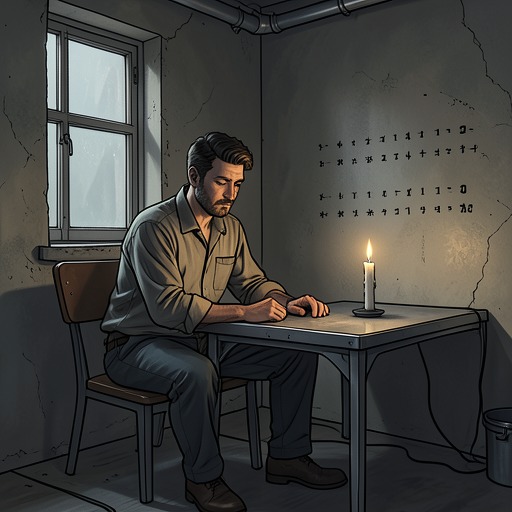
Limonov was detained at Lefortovo, a prison associated with the Soviet and Russian state’s most prominent political prisoners and high-level security suspects. At first he did not know precisely what he and his companions were accused of. He had not seen a lawyer, could receive no visitors, and had no way to learn when the trial would begin or whether people outside knew where he was. The uncertainty extended beyond the charges to the possibility that his arrest might pass without public notice.
The prison’s conditions differed from those of many Russian institutions: the cells were clean, white, and not overcrowded, and inmates were not subjected to the beatings or sexual violence described elsewhere. Its pressure came instead through strict isolation and control of time. Prisoners could watch television for much of the day, a routine that the narrative describes as leading from fuzzy-headed dependence into apathy and depression. Exercise took place in tiny fenced-off spaces on the roof, where loud music made conversation impossible. It was optional, and many inmates chose to remain in bed rather than go outside.
Limonov insisted on exercising every day. Even in winter, when it was dark and temperatures reached minus twenty-five, he demanded his allotted time outdoors. For half an hour he ran on his small patch of concrete, doing push-ups and sit-ups and boxing the icy air. The guards resented having to leave their warm room for a single prisoner, but they were also impressed by his persistence. His politeness and education earned him the nickname “Professor.” The contrast is central to the account of his imprisonment: the institution sought to narrow movement and contact, while he made a repeated physical routine into a form of resistance to passivity.
Charges and Trial in Saratov
After fifteen months in Lefortovo, Limonov was transferred under police escort in a government Antonov aircraft to Saratov, on the Volga. The jurisdiction was chosen because it was the Russian region closest to Kazakhstan, where prosecutors said the alleged crimes had been committed. In Saratov, prisoners had to state not only their names and patronymics but also the criminal-code articles under which they were held. Limonov learned to recite his identifying details and four charges: terrorism, organizing or participating in an illegal armed group, unlawful firearms dealings, and incitement to extremist activity.
At the first hearing, the investigating judge recited the charges and the severe sentences they carried. Limonov faced a double bind: he took a certain pride in being accused of major crimes, yet needed to defeat the case if he was to avoid a long term as a terrorist. The account emphasizes the disparity between the prosecution’s claim and the circumstances it describes: half a dozen men in a log cabin, roughing it about sixty miles from the Kazakh border, with no arms beyond a couple of hunting rifles. In the author’s framing, the group had little apparent capacity to destabilize Kazakhstan, much less to initiate a nuclear war. But the judge appeared unwilling to engage with Limonov’s arguments and adhered to the Federal Security Service’s account, which portrayed him and his six associates as a serious threat to national security.
The case was also shaped by television. As Limonov arrived in Saratov, Channel One Russia broadcast a film called The Ghost Hunt. It presented the National Bolshevik Party as an Al-Qaeda branch and the Altai hut as a secret training camp for hundreds of fanatical fighters. The narrative distinguishes this sensational image from the camp that had actually been raided, while noting that Limonov had himself dreamed of building a force on that scale. Prisoners had all seen the broadcast; they called him “bin Laden,” a nickname that flattered him but also made the prosecution’s portrayal harder to dismiss as harmless spectacle.
Conviction and Penal Colony 13
Saratov brought a different hardship from Lefortovo. Its cells, designed for four, could hold seven or eight inmates. When Limonov entered his cell, every bed was taken, so he rolled out his mattress on the floor without complaint. That response helped unsettle expectations formed by his reputation as an intellectual, political prisoner, and celebrity. He shared food from packages, did chores without fuss, and learned the unwritten rules of the cell. He refused cards and chess because he considered them a waste of time, choosing instead to read and write, but he also helped fellow prisoners with letters and crosswords. Within a week, the other inmates had concluded that he was a good man to live with.
The sentence was less severe than the prosecution had sought. After the prosecutor Verbin called for fourteen years, the judge imposed four; Limonov had already served half, leaving two years. The account calls the reduction a remarkable reprieve, particularly because he had been preparing for twelve years. It did not remove the threat of arbitrary punishment. At Penal Colony 13 at Engels, an officer could reportedly send an inmate to solitary for a week on a pretext; one story circulated there concerned a prisoner whose release was delayed by a year after a drunken junior officer objected to his shave. Limonov therefore tried to make himself inconspicuous and avoid provoking staff who might resent his fame.
Engels was presented to human-rights advocates as evidence of improving Russian prison conditions, with brightly coloured walls, rosebushes, and designer-style sinks. Yet it had a reputation so poor among Russian prisoners that some injured themselves to avoid being sent there. Limonov’s response was not to mistake the appearance of the colony for freedom. At sixty, he was exempt from forced labour, but barred during the day from returning to his books and notepads. Instead, he cleaned toilets, a task allotted an hour that he deliberately stretched across four by doing it thoroughly and refusing to daydream. The arrest and trial thus end not with release from state control but with a changed arena: after isolation and overcrowded cells, the work camp imposes its own repetitive schedule, and Limonov meets it by turning even compulsory cleaning into a test of attention and self-command.