Parliamentary Reform
MiddlemarchParliamentary Reform is the national movement for political change that reshapes Middlemarch’s public life and tests the ambitions of Mr. Brooke and Will Ladislaw. The debate is not merely a distant parliamentary question: it prompts local organizing, electoral maneuvering, and arguments over representation, while revealing how reform can be weakened when its advocates evade the consequences of their own principles. The novel sets this political struggle beside private and professional conflicts, showing a town in which national change enters through meetings, newspapers, party alignments, and the reputations of its inhabitants.
National Debate and Local Consequences
While Tertius Lydgate is struggling to advance medical reform through the New Fever Hospital, Middlemarch becomes increasingly alert to the national contest over Parliamentary Reform. When Lord John Russell’s measure is debated in the House of Commons, local political animation grows, and residents begin to reconsider the balance of parties in anticipation of another election. Some predict that the Bill will not pass in the existing Parliament. Will Ladislaw treats that possibility as a reason to congratulate Mr. Brooke on not having tested himself at the hustings earlier: the town’s political mood is changing, and the coming contest may offer different prospects.
Will urges Mr. Brooke to concentrate on the Pioneer and political meetings. He describes a rising public temper and argues that the country needs a House of Commons less weighted toward nominees of the landed class and more representative of other interests. In his view, a reform movement cannot preserve its purpose by demanding only the parts of change that suit its supporters. Seeking a smaller, safer alteration while a larger transformation is already gathering force is, he argues, like asking for only a fragment of an avalanche. Political reform therefore raises a question of principle as well as procedure: whether representatives will answer to a wider range of interests, or whether the existing political balance will remain protected.
Will Ladislaw and the Meaning of Reform
The arguments between Will and his associates distinguish support for reform from the belief that reform alone can cure society. Lydgate warns against presenting a measure as a universal remedy, or treating political change as a kind of cure-all. Will answers that reform must begin somewhere and argues that many forms of social degradation cannot be addressed without the particular reform under discussion. He invokes the imbalance of a political system in which seats have effectively been sold wholesale, while public attention is directed toward smaller instances of bribery. In his account, political action should respond to the claims of an injured class rather than wait for public agents of immaculate character.
Will’s position does not amount to the claim that legislation can resolve every social problem. Instead, he challenges the idea that imperfect allies make action impossible. He asks whether Lydgate would refuse to work with a person whose motives or judgment were inferior if that person could help achieve medical reform. Lydgate concedes that refusing to work with those available could produce a deadlock. Their exchange links national politics with the practical compromises involved in local reform: principled aims must be pursued through imperfect institutions and alliances, but those alliances can also expose reformers to criticism and suspicion.
Mr. Brooke’s Candidacy and Political Compromise
Mr. Brooke wants to identify himself with reform while retaining considerable independence from its demands. He invokes the example of Wilberforce and Romilly and expresses interest in causes such as emancipation and criminal-law reform, while also saying that he would support Grey. Will presses him to accept the wider implications of the reform principle rather than take up only the positions that seem congenial. Mr. Brooke readily praises Will’s formulations and asks him to put them into writing, but his agreement does not prevent him from returning to tactics of conciliation and moderation.
As the election approaches, Mr. Brooke worries that drawing a definite line on representation may alienate voters. He asks why the franchise should be limited to ten-pound householders if some boundary must be drawn at all. Will replies that a candidate who waits for a perfectly logical Bill risks presenting himself as a revolutionary, while Middlemarch is unlikely to elect him on that basis; but he rejects trimming as the appropriate course at this moment. Mr. Brooke repeatedly agrees, then drifts back toward his own methods. His political difficulty lies not simply in deciding what he believes, but in trying to keep the benefits of reform rhetoric while avoiding the sharper choices reform entails.
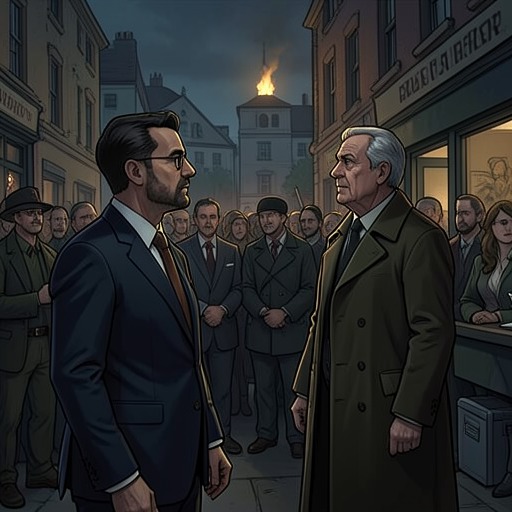
The election campaign also shows how political claims are judged in public. At a meeting, a heckler demands the Bill, and a mocking echo turns Mr. Brooke’s attempt to respond with a promise of freedom of opinion and press into a joke at his expense. He tries to become concrete by producing a paper, but the crowd’s ridicule exposes the gap between his accommodating manner and the audience’s demand for a definite measure. The episode makes public opinion an active force in the reform contest: a candidate’s language can be repeated back to him, transformed into mockery, and used to measure the credibility of his promises.
Reform amid the Town’s Other Conflicts
The novel places political reform alongside competing systems of change rather than treating it as the town’s only public concern. Lydgate’s new hospital has been funded and shaped by Nicholas Bulstrode, who gives a small group of directors influence according to their contributions and excludes small contributors from governance. The institution is intended to treat fevers and give Lydgate authority over medical decisions, yet every other doctor in town refuses to serve as a visitor. Lydgate nevertheless believes the hospital can prosper and bring other practitioners into the work later. Its conflict over authority, access, and professional cooperation echoes the political debate about who should hold power and whose interests count.
The political campaign also occupies Will while personal tensions make his position in Middlemarch more precarious. He has not yet heard gossip about Edward Casaubon’s will, as the town’s attention is absorbed by the dissolution of Parliament and the coming election. Although Dorothea’s widowhood remains in his thoughts, he resents being drawn into discussion of the Lowick living and insists that he does not visit her at Freshitt. He suspects that Mr. Brooke is arranging to keep him away from the Grange after Sir James Chettam’s remonstrance. Thus public political labor coincides with a private separation: Will is active in the reform campaign even as the social circumstances surrounding Dorothea restrict his access to her.
Parliamentary Reform matters in Middlemarch because it turns abstract national questions into local tests of judgment, alliance, and representation. Will’s arguments insist that reform must address the distribution of political power rather than settle for gestures that leave the underlying balance intact. Mr. Brooke’s wavering campaign, by contrast, shows how readily the language of change can be moderated by electoral calculation and personal habit. Through their contrast, the novel presents reform as necessary but not self-executing: its meaning depends on who acts for it, what compromises they accept, and whether public claims survive contact with local power and public opinion.