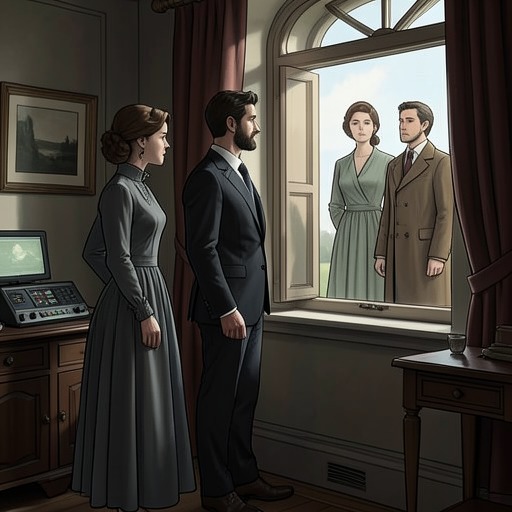
Class identity and social advancement
MiddlemarchClass identity and social advancement in Middlemarch are neither fixed inheritances nor simple rewards for merit. They emerge from a changing mesh of kinship, money, work, education, taste, and reputation: the town and surrounding parishes grow more closely connected, and that proximity makes social boundaries both more negotiable and more conspicuous. Rosamond Vincy’s hopes of rising through marriage, the Garth family’s hard-won respectability, and the status-conscious networks surrounding the Vincys all show how aspiration operates within limits imposed by birth and local judgment.
A Changing Provincial Society
The narrator describes old provincial society as a field of gradual movement. Some people lose standing while others gain it; political and religious currents rearrange associations, and families that appear firmly established acquire new meanings as they change and are seen differently. Municipal life and rural parishes develop fresh connections as older habits of money and exchange give way to new ones. Even squires and baronets, once able to remain remote from the civic world, become more exposed to the judgments of closer acquaintance.
The Vincy family illustrates how such boundaries are made through relationships as much as formal rank. They are old manufacturers who have kept a substantial household for three generations, and intermarriage has connected them to neighbors of varying degrees of gentility. Mr. Vincy’s sister married the wealthy Nicholas Bulstrode, whose uncertain local origins make his alliance with an established Middlemarch family socially consequential. Mr. Vincy, by contrast, married the daughter of an innkeeper, a connection that carries its own reminder of status. Money, pedigree, and local belonging do not align neatly: each can strengthen or complicate the others.
Rosamond’s Aspirations and Lydgate’s Arrival
Rosamond’s education at Mrs. Lemon’s School gives her accomplishments and a polished command of manners, but it does not erase her unease about her family’s position. She believes that being of good family makes a difference and regrets being the daughter of a Middlemarch manufacturer. She is particularly sensitive to the memory that her maternal grandfather kept an inn. Her sense of status is therefore not just a wish for wealth; it is an effort to escape associations that she considers socially limiting.
The arrival of Tertius Lydgate seems to offer a route beyond those limits. Rosamond is attracted not only to his appearance and intelligence but to his connections and the distinction of his family. She imagines a husband who is a stranger to Middlemarch and whose relations may bring her closer to county society. When she meets him, she interprets their exchanged attention as the beginning of the romance she has long pictured. Her expectations quickly develop into detailed imaginings of married life: a home in Middlemarch and visits to well-bred relatives elsewhere. The narrator emphasizes that her imagined elevation concerns refinement and social association rather than a conscious calculation of money.
The difference between Rosamond’s reading of the encounter and Lydgate’s intentions shows how status-seeking can shape the meaning of intimacy. Lydgate has not understood that he has become the object of her sustained attention; his own ardor is directed chiefly toward medical work and the hope of contributing to human progress. Rosamond, however, treats his looks and words as episodes in an anticipated romantic plot. His birth and connections make him especially desirable because they promise a social world unavailable through her existing circle. Her ambitions are entangled with affection, rather than cleanly separable from it.
Marriage, Rank, and Unequal Expectations
The narrator makes this entanglement explicit: passions do not remain in separate compartments but bring their associated notions together. Rosamond’s feeling for Lydgate is joined to her idea of what his family connections might make possible. She has envied the social position of Dorothea Brooke and Celia Brooke when she saw them among the aristocracy at the county assizes, despite their plain dress. Their visible access to a higher social setting gives Rosamond a concrete image of the distinction she wants.
Marriage is also a vehicle through which men pursue their own security and domestic ideals. Edward Casaubon believes that a man of good position should choose a young, virtuous, religious wife of equal rank, make financial arrangements for her, and receive in return domestic happiness. In Dorothea he thinks he has found a helpmate who can assist with his scholarship, even allowing him to avoid hiring a secretary. His understanding of the marriage is shaped by conventional assumptions about a woman’s role and by his own need for companionship. The narrative sets his expectations beside the unasked question of whether he can make Dorothea happy, exposing the unequal distribution of attention and obligation concealed within respectable marital arrangements.
Lydgate, too, imagines marriage through a classed and gendered ideal. When he becomes engaged to Rosamond, he believes she will honor his intellectual work, manage the household, and make domestic life harmonious. His expectation that marriage will further his ambitions overlooks the practical costs of the home and standard of living they establish. Rosamond’s preference for ordering the best of everything and Lydgate’s belief that things must be done properly contribute to spending that exceeds his income. His professional earnings fall short of what he expected, while household expenses, horses, rent, and furnishing accumulate. Their marriage demonstrates that the social performance of gentility has material costs, even when neither spouse treats expenditure as a deliberate route to wealth.
Work, Respectability, and Local Judgment
The Garths provide a contrast to advancement through genteel marriage. Fred Vincy and Rosamond have known the family since childhood, and Fred’s affection for them persists despite the decline in their circumstances. Caleb Garth’s building business failed; he worked for his assignees and lived narrowly while trying to repay his creditors in full. By the time he succeeds, his honorable effort has earned esteem, but not an equal place in genteel visiting. In Middlemarch, respectability gained through labor does not automatically overcome distinctions marked by furniture, a complete dinner service, and established social habits.
The history of Fred’s visits also shows how status can strain kinship and friendship. When the Garths were better off, the families’ connection through Peter Featherstone’s marriages brought the children together; Fred and Mary played side by side, and Fred once made Mary his wife with a brass ring cut from an umbrella. As adults, the Vincys’ greater social confidence and the Garths’ reduced means shape their relations. Mrs. Vincy regards Mrs. Garth’s former work as a teacher as a mark of lower status, and she fears that Fred may attach himself to Mary because her parents live modestly. The old closeness survives, but it sits within a society that measures suitability by more than affection.
Social position also travels through information and association. In the Vincy household, visitors repeat reports about Lydgate, while Mr. Wrench’s doubts about his professional discretion contribute to local discussion. Later, gossip about Bulstrode spreads through Middlemarch, and an inference about Caleb Garth’s knowledge is repeated until it is mistaken for confirmed information from him. In this provincial world, reputation is not an ornament added to status; it can alter how a person is received and what others believe about his standing.
The Limits of Advancement
The novel’s social world allows movement, but not escape from consequence. A family alliance can lend standing to a newcomer such as Bulstrode, yet uncertainty about his origins remains part of how the town understands him. Rosamond can imagine a life among county connections, but her marriage to Lydgate also ties that aspiration to domestic expectations and expenses that press upon his professional resources. The Garths can achieve moral and financial respectability through painstaking work, yet genteel customs continue to register their reduced means. Across these distinct cases, social advancement depends on more than individual desire: it is negotiated through inherited connections, practical resources, and the judgments that pass from household to household.
Middlemarch’s recurring irony lies in the way private hopes are formed inside this larger social web. Rosamond’s romantic ideal carries a wish for rank; Casaubon’s marriage plans turn a wife into anticipated domestic and scholarly support; and the Garths’ honorable labor wins esteem without dissolving class distinctions. The novel thus treats social mobility not as a simple ascent but as a change of position within relationships that remain unequal. Ambition may alter how people imagine their future, while money, family history, work, and public opinion continue to determine what that future can sustain.