Scientific medicine and medical reform
MiddlemarchScientific medicine and medical reform in Middlemarch take shape through Tertius Lydgate’s attempt to join new knowledge to honest clinical practice. His ambition is not simply to discover more about disease: he seeks to reform how doctors treat patients, how they earn their living, and how a provincial institution can serve both medical care and education. The resulting conflicts reveal how scientific work depends on more than individual insight; it must contend with uncertain diagnoses, professional custom, public misunderstanding, and the governance of the New Hospital.
Principles and ambitions
Lydgate regards medical practice as a field in which scientific inquiry and professional conduct should reinforce one another. He intends to prescribe without dispensing medicines or taking a percentage from druggists, a choice that challenges the established habits of general practitioners in a country town. He sees the reform as a practical safeguard: removing a systematic financial temptation makes it easier to practise according to his convictions.
His wider ambition is to enlarge the rational and scientific basis of medicine. In 1829, he thinks of pathology as a territory still open to discovery, and is drawn to questions about the nature of fever and the structure of the living body. The account of Bichat’s work on tissues gives this ambition a foundation: organs cannot be understood adequately by treating each as an isolated unit, but must be considered as structures made from underlying materials. That change of perspective makes the study of tissue relevant to symptoms and the action of medicines, while leaving further questions open for later inquiry.
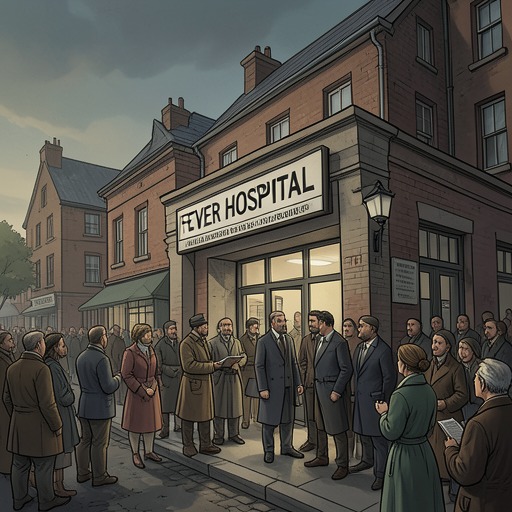
The New Hospital appears to Lydgate as an opportunity to connect care with education. He argues that a fever hospital alongside the old infirmary could become the nucleus of a provincial medical school. A town outside London, he believes, can provide a freer field for professional aims and resist the tendency for better opportunities to gather in the capital. Scientific medicine, in this vision, is not confined to research: it also requires institutions where knowledge can be developed and put to public use.
Clinical practice and uncertain knowledge
Lydgate’s casework shows both the force and the limits of his approach. When he takes over Fred Vincy’s illness, he recognizes the symptoms as typhoid fever and judges that the earlier medicines have been wrong. He requires immediate bed rest, a regular nurse, and careful precautions. Mrs. Vincy is distressed by the change in care and focuses on the implications for her long-standing doctor, Mr. Wrench. Lydgate nevertheless puts the seriousness of Fred’s condition ahead of professional etiquette, while acknowledging that early symptoms of fever can be equivocal.
The case of Nancy Nash exposes a different difficulty: diagnoses can become public stories that survive correction. Dr. Minchin describes Nancy’s complaint as a tumor and recommends her to the infirmary. Lydgate examines her there and determines that it is cramp, not a tumor; he prescribes a blister and a steel mixture and sends a note asking her employer, Mrs. Larcher, to provide good food. When Nancy worsens, Lydgate continues attending her at home for a fortnight, until she recovers and returns to work.
The neighborhood, however, continues to discuss a supposedly wandering tumor and to credit Lydgate with a remarkable cure for it. Dr. Minchin avoids admitting that his initial diagnosis was mistaken, recasting the case as surgical; he and Mr. Wrench instead object that Lydgate has violated professional etiquette by contradicting a physician openly. Lydgate does not use the episode to claim superiority, but public report turns a correction of error into a misleading legend of miraculous skill. The episode makes clear that clinical improvement alone cannot ensure accurate public understanding of what a doctor has done.
In the treatment of Borthrop Trumbull’s pneumonia, Lydgate uses the illness as an occasion for expectant treatment: close observation, with the disease allowed to run its course as far as possible, rather than routine reliance on drugs. He explains that Trumbull may provide a useful example for medical science, and Trumbull willingly embraces the idea that his illness could benefit society. The case demonstrates the appeal of observation as a method, but it also shows how the patient’s consent and self-understanding become part of the procedure: Trumbull takes pride in being treated as a participant in an inquiry, supported by temperature measurements and technical explanations.
Professional custom and public opinion
Lydgate’s reforms meet resistance not only in clinical disagreement but in the social rules of the profession. His refusal to dispense medicines challenges local practice, while his open correction of Minchin is treated as discourtesy. The town’s judgments also attach themselves to outcomes without understanding the methods behind them. Patients recovering under Lydgate’s care generate a reputation for success, yet this apparent good fortune irritates him because it can resemble the sort of publicity sought by an unscrupulous practitioner. He recognizes that the public may credit the wrong qualities, and that arguing against every mistaken interpretation would be futile.
The tension persists as he works at the New Hospital. Mr. Farebrother reports that Lydgate is giving the institution much of his time and preparing a ward in case cholera reaches the town. Mr. Toller turns this preparation into a suspicion that Lydgate is devising theories to test on patients. Farebrother counters that a bold, fresh mind has value and that, with cholera, established practitioners are not certain what treatment is best. His defense captures the uncertainty surrounding medical innovation: a new method may go too far, but the risk of error is not confined to reformers when existing knowledge is itself unsettled.
Hospital governance and the limits of reform
The institutional future of Lydgate’s work becomes precarious when Nicholas Bulstrode proposes withdrawing from the management of the New Hospital and changing his residence. With Bulstrode’s support in doubt, he suggests amalgamating the new institution with the old infirmary under a shared directing board and combined medical management. The proposal promises to resolve the question of maintenance and reunite the town’s charitable interests, but it would also end the New Hospital’s independent organization.
Lydgate can recognize the proposal’s financial logic without welcoming its professional consequences. He fears that the other medical men will interrupt his methods simply because they are his, and therefore resist a merger that could subject the new institution to established practice. Bulstrode presents his own renunciation of the original plan as submission to providential indications; Lydgate hears the language as a justification for surrendering an independent experiment. Their exchange exposes a central vulnerability of reform: an institution may be judged by its ability to secure support and public agreement, even when those conditions threaten the very independence that made it scientifically promising.
The novel also links this institutional conflict to the broader pressure on Lydgate’s work and life. Farebrother notices that Lydgate’s expenses seem too great for his practice and that his usual clarity of inquiry has given way to diffuse argument. Later, when Lydgate seeks help from Bulstrode, his clinical attention remains engaged with the treatment of John Raffles, especially with the disputed use of alcohol and large doses of opium in cases of alcoholic poisoning. He recalls evidence from Dr. Ware’s American experience and acts on his conviction against the prevailing practice. At the same time, he reflects on the apparent contrast between Bulstrode’s harshness toward some people and the time and money he has devoted to benevolent objects. Medical judgment, financial need, and moral uncertainty thus converge without making the clinical question disappear.
Significance
Scientific medicine in the novel is neither a simple triumph of new knowledge nor a contest between a wise reformer and uniformly foolish opponents. Lydgate’s principles are serious: he seeks to limit conflicts of interest, base treatment on observation, and create an institution that can advance medical education. Yet the treatment of fever and other illnesses remains uncertain, and the public often turns that uncertainty into rumor or simplified narratives of success and failure.
The repeated gap between what happens clinically and what the town says happened is especially consequential. Nancy’s mistaken tumor diagnosis becomes a tale of a wandering growth; Trumbull’s cooperation makes a method of observation socially acceptable; and Lydgate’s plans for a fever hospital become objects of suspicion and institutional negotiation. The novel presents reform as dependent not only on scientific reasoning but on trust, professional cooperation, and governance. Its promise is real, but so is its exposure to the very customs and pressures it aims to change.