Moral uncertainty and the limits of judgment
MiddlemarchMoral uncertainty and the limits of judgment name a central ethical pressure in the scandal surrounding Tertius Lydgate and Nicholas Bulstrode. The available facts do not resolve every suspicion: Lydgate recognizes his own compromised judgment, yet the town’s accusation exceeds what can be proved. The concept turns on the uneasy gap between evidence, character, motive, and public belief—and on the danger of mistaking uncertainty either for exoneration or for guilt.
Suspicion and the limits of proof
As Lydgate’s situation becomes clear to him, he reconstructs the likely chain of events. Bulstrode had feared that John Raffles would disclose damaging facts; Lydgate therefore suspects that Bulstrode’s abrupt generosity was intended to bind him through obligation. He also fears that Bulstrode may have interfered with the treatment against his orders. But Lydgate cannot establish that this happened, and he recognizes another possibility: Bulstrode’s change of manner may have been genuine remorse. A plausible explanation is not proof, and the explanation that comes most readily to mind may be false.
That uncertainty does not protect Lydgate from suspicion. The town connects his receipt of Bulstrode’s money to Bulstrode’s apparent motive and to the death of the patient, concluding that Lydgate accepted a bribe to keep silent or took part in some undefined wrongdoing. The suspicion is powerful precisely because it lacks a precise charge that could be disproved. Public belief can settle on a story through motive and association even when the crucial act remains unknown.
Lydgate sees why a public defense would not straightforwardly clear him. His own testimony would be weighed against circumstances that appear stronger, and a full account would also draw further attention to Bulstrode’s conduct. In explaining that he had sought financial help before he knew of Raffles, Lydgate would have to disclose the later convergence of the loan, his medical attendance, and Bulstrode’s interest in the case. Yet even suspicion of Bulstrode might be unjust. The more completely Lydgate explains himself, the more material he supplies for judgments he cannot control.
Character, conduct, and competing interpretations
Mr. Farebrother refuses to treat Lydgate’s honorable reputation as decisive evidence. He can imagine an honorable man yielding to an indirect bribe if pressed by hardship, and believes that Lydgate has been under severe financial strain. This is not an accusation of a proven crime; it is a recognition that virtue can be tested and that circumstances may alter conduct. Farebrother’s caution also reflects a practical difficulty: there is no solid basis for a public inquiry, while asking Lydgate directly could be received as an insult. He advises waiting for an opportunity rather than claiming knowledge that the evidence does not provide.
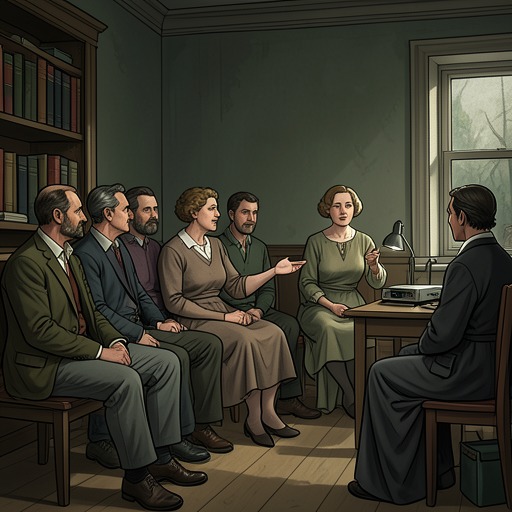
Dorothea initially resists this caution. She believes Lydgate has acted honorably and argues that friends should want to defend a person against calumny. Her confidence comes not from new proof but from her view of human beings and from her gratitude to the doctor who advised her during her own trouble and attended her in illness. She wants friendship to act before certainty is available. Sir James Chettam, now her brother-in-law and a close friend, warns that she cannot manage another man’s life for him; Lydgate must act for himself. Their disagreement frames two ethical risks: withholding help until proof arrives, and assuming that sympathy licenses intervention.
Farebrother’s warning that character is living and changeable further complicates Dorothea’s faith. A good reputation matters, but it cannot function as an unalterable guarantee against error. At the same time, the possibility of failure does not establish that failure occurred. The concept therefore resists both a fixed judgment of virtue and the contrary assumption that an honorable person must be guilty once circumstances look compromising.
Lydgate’s inward reckoning
Lydgate’s own review is more exacting than the town’s undefined charge. He asks whether he would have acted differently had he not received Bulstrode’s money. If he had suspected that Bulstrode disobeyed his medical orders while the patient could still be treated, he believes he would have investigated and, if his suspicion were confirmed, abandoned the case despite his financial obligation. But after the patient’s death, he is unsure whether he would have investigated with the same firmness without the loan. The question does not prove that he took a bribe; it reveals that dependence may have altered his willingness to challenge a powerful benefactor.
This is where Lydgate’s professional ideal and his compromised independence meet. He had believed that a doctor’s duty was to do, or see done, what seemed best for the life entrusted to him, and that scientific doubt should keep the conscience alert to error. Under financial pressure, however, he had let the disputed treatment seem merely a matter of professional etiquette: his orders might have been wrong, and their disobedience might not amount to crime. His retrospective unease is not the same as evidence of intentional misconduct, but it identifies a moral lapse in how he weighed his responsibilities.
When he later speaks openly to Dorothea, he tells her of his first reluctant request for money, his treatment of the patient against dominant practice, his doubts at the end, and his awareness that accepting the loan affected his private inclination and professional behavior. He also reports that the housekeeper at Stone Court said she gave the patient all the opium remaining in the phial Lydgate had left, along with substantial brandy. That account does not settle who was responsible for the disobedience or establish Bulstrode’s criminal intent. Lydgate acknowledges that Bulstrode may have been innocent of criminal purpose and may not have caused the orders to be disregarded. The factual uncertainty remains even after the fuller confession.
Public judgment and sympathy
Lydgate believes that the public accusation will persist because people already have a motive-based story: Bulstrode wanted the patient to die, gave Lydgate money, and thereby secured his silence. In that account, Lydgate’s connection to Bulstrode’s character becomes evidence against Lydgate himself. He feels blighted by a judgment that treats association and circumstance as sufficient, though the circumstances do not disclose exactly what happened. The scandal thus distinguishes the social force of an accusation from its evidentiary certainty.
Dorothea’s sympathy offers a different response without pretending to solve the case. Once she understands why self-defense would be difficult, she listens while Lydgate explains the facts and, more painfully, his doubts about himself. He accepts her support with less of his usual reserve and gives a fuller account than a simple denial could provide. Her compassion neither supplies missing proof nor erases his compromised judgment; it makes room for the difference between being publicly condemned and honestly examining one’s own conduct.
The concept’s significance lies in that refusal of an easy verdict. Lydgate may be unable to prove himself innocent of every suspicion, and he cannot dismiss the ways obligation weakened his professional independence. Yet the unknown facts cannot simply be replaced by the town’s certainty. The novel holds open the distinction between what might have happened, what Lydgate fears he would have done differently, and what others are prepared to believe—while showing how money, reputation, and the limits of knowledge make those distinctions consequential.