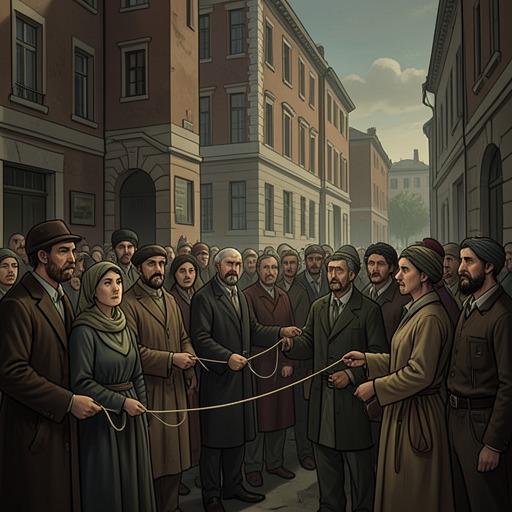
The web of social life
MiddlemarchThe web of social life is Middlemarch’s pervasive structure of interdependence: characters are linked not only by formal kinship or friendship, but also by work, medical practice, courtship, inheritance, household obligations, and circulating opinion. It gives private choices their reach and their limits. A town’s relationships can offer loyalty and practical help, yet the same connections expose people to scrutiny and transmit rumors that alter reputations. In this network, a letter, a visit, or a change in professional allegiance may become consequential because it passes through people who are already connected in several different ways.
A Town Made of Overlapping Ties
The Vincy family exemplifies how local position is built from intersecting relations rather than from a single measure of rank. As established manufacturers who have kept a substantial household for three generations, they are connected to many of the town’s more genteel families. Mr. Vincy’s sister has married Nicholas Bulstrode, while Mrs. Vincy’s sister was the second wife of Peter Featherstone. Their kinship places the Vincys near wealth and influence, even as the family’s own marriages and social standing remain matters of local distinction. When Tertius Lydgate arrives, he enters a medical and social world in which the Vincys’ connections matter: Bulstrode and Featherstone, both important patients of Lydgate’s predecessor, welcome the new doctor, while Mr. Wrench’s doubts about Lydgate’s professional judgment are retailed among the family’s frequent visitors.
These connections do not dissolve hierarchy. The Garths’ long friendship with Fred Vincy began when the families were better acquainted and the children played together, but their later circumstances sharpen the difference in status. Caleb Garth has endured business failure and worked to repay his creditors in full; the Vincys nevertheless retain a sense of social superiority, and Mrs. Vincy is uneasy about Mary Garth as a possible match for Fred. Fred’s continuing affection for the Garth household survives this distance. When financial trouble makes him seek help, he turns to Caleb, the poorest and kindest friend he has, revealing how an old personal bond can remain available even when the families’ adult relations have cooled.
Connection as Care and Obligation
The network also carries ethical weight. Lydgate’s growing friendship with Camden Farebrother affects a decision that would otherwise have been merely convenient. Lydgate’s vote in the dispute over a hospital chaplain would have been easy to give to Walter Tyke; his regard for Farebrother makes the choice matter personally. Farebrother has shown delicacy by warning Lydgate away from his own interest rather than recruiting him, and Lydgate recognizes in that restraint a generosity unusual in a newcomer’s contested professional world. Their acquaintance turns an institutional question into a test of loyalty and judgment.
Dorothea’s early married life shows the converse: a life crowded with provision can still lack meaningful connection. In the isolated comfort of Lowick, others do things for her, but no one asks for her help. Marriage has not yet given her the active, necessary work she hoped would bind her to another life; instead, she experiences what the narrative calls the “gentlewoman’s oppressive liberty.” Her yearning for connection is therefore not satisfied by social position or domestic arrangements. The contrast makes the web more than a count of acquaintances: its value depends on whether relationships create genuine claims, shared work, and mutual understanding.
The bond between Dorothea and Lydgate briefly becomes a direct meeting of people who recognize one another’s distress. In the aftermath of Casaubon’s illness, she appeals to Lydgate for advice about a husband absorbed in his labor and asks him to think what she can do. Lydgate later remembers the moment as a cry from one soul to another, made in a shared, troubled life. The encounter does not erase their different circumstances, but it gives their connection a lasting significance: sympathy can arise across social and professional distance without becoming a formal alliance.
Courtship, Household, and Local Scrutiny
The Vincy drawing room shows how private attachment becomes public knowledge. Lydgate and Rosamond’s courtship develops through small signs and unfinished exchanges, but their growing intimacy is observed by others. Their engagement becomes general knowledge in Middlemarch without a formal announcement. The couple’s feelings are thus not simply private: they unfold within a town where family members, visitors, and acquaintances notice what happens and form conclusions. Social visibility can give a relationship momentum even before the people concerned have made it publicly official.
The same pressures shape the response of Rosamond’s father. Mr. Vincy does not make a firm inquiry into Lydgate’s financial circumstances or set out clear terms for an engagement. He is proud that Lydgate wants to marry Rosamond, reluctant to raise money when his own position is uncomfortable, and wary of confronting a man he considers better educated. Meanwhile, the daily routine of hospitality and family life allows the courtship to continue. By the time inaction has accumulated into a decision, the relationship has advanced beyond the point at which he might easily forbid it. The episode shows how social conduct is often determined less by a single declared choice than by repeated accommodations and delays.
Writing, Rumor, and Consequence
The web’s most dangerous connections are often made through information. A letter exchanged over land attached to Stone Court can lie unnoticed and then, through a chain of circumstances, become the opening of a catastrophe. The narrative likens such writing to an old stone inscription whose significance becomes legible only to someone able to interpret it. A document is not powerful in isolation: its force depends on its passage through time and on the knowledge of the person who finally encounters it. The image makes communication itself part of the town’s social machinery, linking distant actions to later discoveries.
Bulstrode’s history demonstrates how quickly that machinery can turn inference into apparent fact. After Raffles’s story becomes known, Frank Hawley investigates through a clerk sent to Stone Court under the pretext of asking about hay. He learns that Caleb Garth had carried Raffles there and then questions Caleb, who confirms only that he has stopped acting for Bulstrode. Hawley infers a connection between the resignation and Raffles’s disclosures; when he passes that inference to Toller, it circulates as if Caleb had directly published Bulstrode’s misdeeds. A limited fact, relayed through several people, acquires the authority of testimony it never had.
The episode exposes both the reach and the unreliability of local knowledge. Caleb’s silence does not stop the story; instead, his changed business relationship becomes material for other people’s conclusions. Rumor moves through professional contacts, offices, and conversation, changing the meaning of an otherwise defensible action. The town’s network can therefore punish through association before it establishes what any participant actually said or did. Its pressure is not an abstract atmosphere but a process: a clue is interpreted, repeated, detached from its original qualification, and absorbed into common belief.
Narrative and Thematic Significance
The novel repeatedly makes social connection a cause of plot rather than mere background. The Vincys’ kinship brings Lydgate into a wider professional circle; Fred’s childhood friendship gives him a path to Caleb’s help; Lydgate’s regard for Farebrother alters the significance of a vote; Dorothea’s appeal to Lydgate creates a moment of fellowship; and Hawley’s inquiry turns Caleb’s withdrawal from Bulstrode’s business into a public insinuation. Each relationship has a particular form, but its consequences can spill into other domains, joining family life to work, money, medicine, and reputation.
This network resists a simple division between benevolent intimacy and oppressive society. The same connectedness that enables generosity also makes privacy fragile; affection may cross class boundaries, while status can obstruct the recognition of that affection; accurate observations can be transformed into damaging claims as they pass from person to person. The web of social life is therefore a structure of unequal access and shared consequence. Lives are shaped not only by what individuals intend, but by who knows them, who interprets their actions, and how information travels among people whose ties overlap.