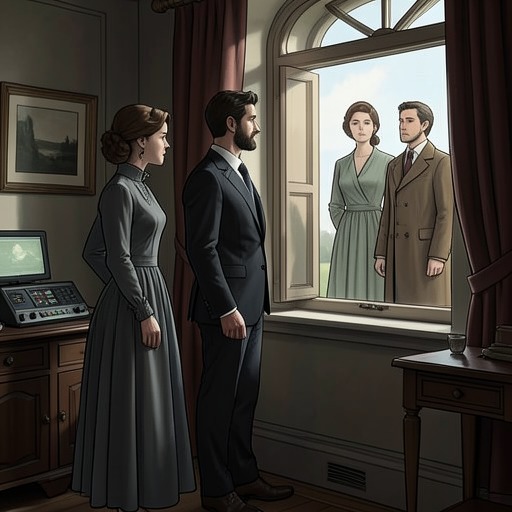
Marriage as ideal and social institution
MiddlemarchMarriage as ideal and social institution in Middlemarch is both a promise of intimate purpose and a framework governed by gender, money, class, and reputation. Its ideals are not simply false: characters seek companionship, service, and a shared life. But those aspirations take shape within unequal assumptions about what a wife should provide, who controls household resources, and how private unions affect the surrounding community. The contrast between Dorothea’s moral hopes and Lydgate’s romantic domestic expectations reveals how readily marriage can reproduce the limits it seems meant to overcome.
Ideals and Social Expectations
The novel treats marriage as a socially approved institution whose purposes may be understood differently by husband and wife. In its account of Edward Casaubon’s expectations, a well-positioned man selects a young, religious, virtuous, intelligent woman whom he supposes will be modest, appreciative, and comparatively easy to educate. He expects to make arrangements for her happiness, while also anticipating family pleasures and assistance with his scholarly work. His assumptions reflect a social model in which a wife’s capacities matter chiefly as support for her husband’s aims. Casaubon believes he has found more than a suitable bride in Dorothea: he imagines her as a helpmate who can relieve him of the need for a hired secretary. He does not comparably consider whether he can make her happy.
That asymmetry is sharpened by the narrator’s attention to Casaubon’s own loneliness and inward limitations. He has little experience of joy and is preoccupied with his unfinished scholarly project; marriage, like religion and learning, threatens to become another outward requirement he feels bound to fulfill properly. His unhappiness is not presented as proof that the institution itself is meaningless. Rather, his sense of duty and propriety repeatedly outweighs the mutual pleasure and imaginative fellowship Dorothea had hoped marriage would bring. The distance between his expectations of a wife and his ability to meet her inward needs exposes the unequal terms on which the union was imagined.
Dorothea’s Wifely Vocation and Confinement
Dorothea enters married life expecting devotion to become an active vocation. At Lowick, however, the work she anticipated does not readily appear. The narrator describes a world in which things are done for her and no one asks for her help, leaving her to sustain inwardly a connection with the wider life she longs to serve. The promise that marriage would provide guidance and worthy occupation has not freed her from what the novel calls the gentlewoman’s oppressive liberty: she has choice over her time, but little meaningful work through which to exercise it.
Her early married days bring a further mismatch between ideal and practice. The active wifely devotion she expected to strengthen her husband and elevate her own life may never take the form she had imagined, yet she continues to hope that duty will acquire a new meaning. That persistence matters: Dorothea does not approach marriage merely as a route to personal gratification. She has invested it with ethical purpose, believing that a shared life can give her energies direction. The bleakness of Lowick’s routines and surroundings makes the gap between that aspiration and her actual position visible, while her attempt to find meaning in duty shows the ideal surviving under pressure rather than disappearing at once.
Romance, Gender, and Household Economy
Lydgate and Rosamond’s courtship offers a different version of marital idealism. Their attachment grows through small, largely unspoken exchanges, while their engagement becomes generally understood in Middlemarch before a formal announcement. Mr. Vincy hesitates to examine Lydgate’s finances or to impose a decisive objection: he is reluctant to raise money questions, somewhat awed by Lydgate, pleased that his daughter is wanted, and wary of opposing her. As the courtship continues in the family drawing room, his inaction allows the engagement to take firmer shape. Private romance thus develops inside a family and social setting whose financial concerns are recognized but not squarely addressed.
The lovers also bring different assumptions to their imagined household. Lydgate supposes that Rosamond will admire his intellectual work, create order at home and in the accounts, and make their life romantic without obstructing his ambitions. His picture of marriage depends on a narrowly defined ideal of womanhood: the wife is to be accomplished and docile, but not intellectually or practically independent beyond what supports the husband. Rosamond, meanwhile, is accustomed to a household in which the best is ordered as a matter of course. Neither expectation adequately prepares the couple for the costs of setting up their home.
The material consequences become stark when their domestic expenditure exceeds their means. Furnishing and other initial expenses run several hundred pounds beyond Lydgate’s available capital; household costs, including horses and social entertaining, approach a thousand pounds in a year, while his medical practice yields far less than expected, much of its income remaining unpaid. Rosamond’s standard of good housekeeping is to order the best, while Lydgate assumes that if something is to be done it should be done properly. He does not challenge invitations or the expenses of professional sociability, even though he visits poor households and adjusts their diets to their limited means. The contrast exposes a failure of self-application: the economy Lydgate understands in his patients’ lives does not govern his own home. Marriage here is not only an emotional bond but a household economy shaped by consumption, professional hopes, and assumptions about who should manage domestic life.
Kinship, Class, and the Wider Network
Marriage also links families and circulates social standing, money, and obligation. The Vincy family’s position in Middlemarch rests on generations of manufacturing, a well-established household, and intermarriage with genteel neighbors. Walter Vincy’s sister has married Nicholas Bulstrode, while his wife’s sister was the second wife of wealthy Peter Featherstone. These connections help explain why the Vincys and their relations occupy a central place in local society, and why marriage can carry consequences far beyond the couple.
The contrast between the Vincys and the Garths shows how class distinctions shape intimacy. Fred’s affection for the Garth family goes back to childhood: the children played together, and at six he made Mary his imagined bride with a ring cut from an umbrella. Yet the families’ adult relations were marked by social condescension. After Caleb Garth’s building business failed, he worked to repay his creditors in full, but the Vincys’ genteel visiting did not follow esteem alone; suitable furnishings and a complete dinner service mattered. Mrs. Vincy’s anxiety that Fred might become attached to Mary is tied to the Garths’ modest circumstances and Mary’s position as a working young woman. Fred therefore keeps his visits to the Garth household quiet at home. The marriage ideal is entangled with judgments about respectability and the economic conditions that make some families seem suitable and others not.
Inheritance and family loyalty further widen the institution’s reach. When Peter Featherstone is ill, his blood relatives gather around Stone Court, each suspecting others of trying to influence or exploit the estate. The general feeling that everyone must watch everyone else turns kinship into mutual surveillance, with the family’s hopes attached to uncertain wills. Marriage and family connection may suggest affection and continuity, but the prospect of property makes those relations strategic and distrustful. In Middlemarch, the household is never sealed off from the town: its arrangements and expectations are shaped by networks of kin, money, status, and rumor.
Meaning and Limits
Across these relationships, marriage is shown as a promise that can inspire serious moral aspiration while remaining embedded in unequal social arrangements. Dorothea hopes for a life of service and shared purpose, but her early marriage gives her little outward work and leaves her struggling to keep that purpose alive. Lydgate imagines a wife who will sustain both his professional ambitions and domestic comfort, yet his own unexamined spending helps turn the household into a source of debt. Fred’s childhood attachment to Mary persists within a social world that ranks families by money, manners, and the visible signs of gentility.
The novel’s emphasis on these mismatches resists reducing marriage either to private romance or to a purely financial contract. Intimacy unfolds through gestures and expectation, but its possibilities are constrained by gender roles, available work, family resources, and local judgment. Marriage can connect lives and awaken devotion; it can also assign one partner the task of supporting the other’s ambitions, or make domestic ideals conceal economic dependence. Its significance lies in this double character: an institution invested with personal hopes, yet continually shaped by the social relations in which those hopes must be lived.