Gossip and public reputation
MiddlemarchGossip and public reputation in Middlemarch form a social mechanism through which fragments of information become judgments about character. The scandal involving Nicholas Bulstrode and Tertius Lydgate demonstrates its reach: a story about Bulstrode’s past spreads from conversation to conversation, while Lydgate’s sudden ability to repay his debts is joined to it as suspicious circumstance. The town does not need conclusive proof to damage either man’s standing; uncertainty itself becomes material for confident accusation.
From Passing Remark to Public Story
The mechanism is visible first in the casual scrutiny of Lydgate’s life. Harry Toller remarks that the young doctor has been living expensively and wonders whether his northern relations support him. Chichely adds that, if they do not, Lydgate ought not to have married a woman admired by the town. The comments mix financial speculation with resentment over his marriage, making reputation vulnerable to personal feeling as well as evidence. What appears to be ordinary conversation already treats private circumstances as public property.
A more consequential rumor begins when Bulstrode rides past the Green Dragon. Several people name him quietly, and Bambridge uses the moment to announce that he has heard a story about how Bulstrode acquired his fortune. The gathering grows as Frank Hawley presses him for details. Bambridge’s account includes the revelations about Bulstrode’s past and Will Ladislaw’s family connection, but it also draws on information about Raffles’s death and Lydgate’s attendance. The story is not simply transmitted: it is enlarged by the listeners’ questions and by the significance they attach to each new detail.
The Distortion of Evidence in Circulation
Hawley investigates, sending a clerk to Stone Court under the pretext of asking about hay and then questioning Caleb Garth. Garth admits only that he has stopped acting for Bulstrode; Hawley infers that Raffles told him the secret and that this disclosure caused him to resign. When Hawley repeats his inference to Toller, it passes onward as if Garth had supplied it directly. In a few retellings, a deduction acquires the authority of testimony, and Garth is mistakenly made to appear the principal source of the allegations.
The narrative distinguishes what can be established from what people are prepared to believe. Hawley finds no legal handle in the revelations or in the circumstances of Raffles’s death. He and Camden Farebrother discuss the matter, and Farebrother resists turning his antipathy toward Bulstrode into a conclusion of guilt. Yet Farebrother sees a further possible connection: Bulstrode’s fear of Raffles may bear on his generosity to Lydgate. He does not accept that the loan was consciously a bribe, but recognizes that the association could harm Lydgate’s reputation. His caution marks the gap between suspicion and proof even as he foresees how readily the town will close it.
Lydgate’s Loan and the Scandal’s Reach
The sudden change in Lydgate’s finances supplies the rumor with a second strand. He has escaped an execution in his house and paid his Middlemarch debts; the news spreads alongside the story of Bulstrode and Raffles. Townspeople connect the money to Bulstrode’s apparent wish to suppress the scandal. The source of the loan becomes widely guessed, and then confirmed through a bank clerk and through Harriet Bulstrode, who mentions it to Mrs. Plymdale. Information moves by intimate social routes as well as by deliberate investigation.
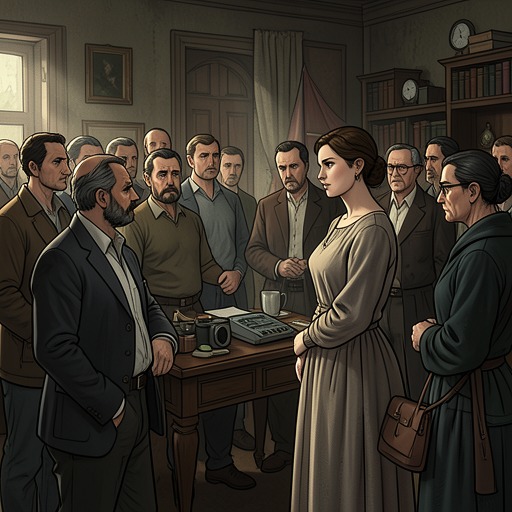
The combination is damaging even though the medical facts do not establish that Lydgate acted improperly in Raffles’s illness or death. Hawley assembles a private gathering that includes physicians and asks them to consider the particulars surrounding the death certificate, which attributes the death to delirium tremens. The doctors find no positive medical ground for suspicion. But the absence of medical proof does not dispel moral suspicion: Bulstrode had an apparent motive to be rid of Raffles, and had helped Lydgate at a moment when Lydgate needed money. Existing resentment toward Lydgate—as a young doctor thought to be making himself useful to Bulstrode and challenging older practitioners—makes the loan seem suspect. The party disperses with the impression that the affair looks bad, not with evidence of guilt.
Conjecture, Reputation, and Town Life
The narrator emphasizes that mystery can exert more influence over public opinion than established fact. People prefer to imagine how events fit together, and conjecture soon grows more confident than knowledge, accommodating incompatible explanations at once. Even the more definite revelations about Bulstrode’s former life are absorbed into a general atmosphere of mystery, ready to be reshaped in conversation. The distinction between a true disclosure, an inference, and a fantasy becomes difficult to preserve once each circulates as part of the same scandal.
The rumor also reorganizes the town’s routines. The scandal gives dinners and tea visits a new urgency; invitations are issued and accepted because people want to discuss it. Public conviviality, from the Green Dragon to Dollop’s, gains an excitement that political debate over the Reform Bill cannot match. At the Tankard in Slaughter Lane, Mrs. Dollop asserts an imagined version of Bulstrode’s inward wickedness with such confidence that a customer confuses it with something said by the Duke of Wellington. Her story shows gossip becoming less a report of events than a performance of moral certainty, supplied with vivid details and repeated until its origin scarcely matters.
Gossip in Middlemarch thus exerts power without the procedures of law or the discipline of medical inquiry. It converts association into accusation, lets inference masquerade as testimony, and makes reputation answerable to the town’s appetite for a coherent story. Bulstrode’s past and Lydgate’s loan are not treated as separate matters once they can be joined; the connection itself becomes a public verdict. The episodes show how a community can damage its members not only through what it knows, but through what it confidently imagines from what it only partly knows.