Railway expansion and rural change
MiddlemarchRailway expansion and rural change in Middlemarch turn a new transport system into a test of how progress is understood, resisted, and imposed. The projected line through Lowick parish connects landowners, laborers, estate management, and railway agents in a conflict over property and authority; the violence against surveyors gives that conflict a local and personal cost. The novel neither treats the railway as harmless nor accepts rumor as an adequate account of it: through contrasting responses, it makes visible the gap between promised public benefit and the fears of people who expect to bear the disruption.
A new line through an old landscape
The railway enters the affairs of Lowick through work Caleb Garth undertakes for Dorothea Brooke, managing three farms and the many tenements attached to Lowick Manor. A projected line is to cross the parish where cattle have grazed without disturbance. Garth’s estate work and the railway’s claims therefore meet in the valuation of land: he expects railway business to grow and is inclined to obtain the best possible terms for Dorothea. What might appear on a national scale as the spread of a transport system arrives here as a route through particular fields held by particular owners.
The prospect also links technological change to a wider reordering of local society. The novel describes railway construction as part of a gradual movement that shifts the boundaries of social connection, bringing municipal town and rural parish into closer relation. But connection is not experienced as simple improvement. The new system unsettles existing uses of land and established expectations about who may enter it, while the compensation available to proprietors does not erase the change to the landscape or the concerns of those who work there.
Land, uncertainty, and local opinion
Railways become a subject of intense discussion in the district, on a level with the Reform Bill and fears of cholera. Women and landholders are particularly wary: some regard steam travel as dangerous, while proprietors, though divided in their reasoning, agree that companies should pay heavily for the land they need. For people unfamiliar with the technology, suspicion fills the space left by uncertainty. Mr. Solomon Featherstone and Mrs. Waule imagine the Big Pasture cut into unusable pieces before they can credit the prospect of accommodation bridges or substantial payments.
In Frick, opposition takes a different but related form. There, the rumor of Reform has brought no clear promise of better wages or cheaper necessities, and railways likewise inspire distrust because their benefits seem unspecified while their disruption is easy to imagine. Solomon encourages that suspicion in conversations with local workers, suggesting that surveyors may have designs beyond the route they claim to be measuring and warning that traffic will harm both land and poor people. His influence works through insinuation rather than evidence, giving existing anxieties a target and a story.
The episode also draws attention to the unequal scale on which change is judged. A landowner may bargain over compensation, but an agricultural laborer may see canals and other public improvements as having left poor people no better fed or paid. Timothy Cooper voices that durable skepticism even after Caleb argues for the railway. His view does not make him an advocate of violence: he says the laborers were foolish to interfere. Yet his distrust of assurances about general benefit reflects an experience Caleb cannot simply refute by describing the system as progress.
Assault on the surveyors and Garth’s response
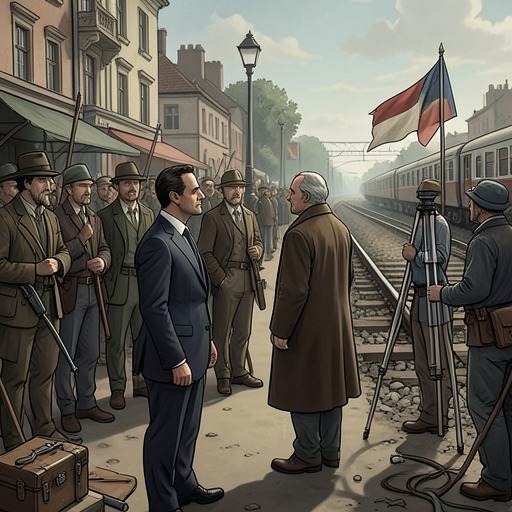
The circulating fears become action when a group of laborers confronts four railway agents who are using a spirit-level to survey the ground. Caleb Garth and his assistant hurry toward them; the assistant, a seventeen-year-old, is knocked down, and the agents are driven back. Fred Vincy, riding nearby, reaches the scene after the confrontation has begun. He intervenes to disrupt the pursuit and cover the agents’ retreat, then threatens the laborers with prosecution. The collision thus draws Fred into a public dispute at a moment when he is privately uncertain about his future: his father expects him to enter the Church, while Mary Garth has made clear that she will not marry him on that path.
Caleb addresses the laborers by distinguishing their grievance from the false account that has mobilized it. The law permits the railway men to come onto the land, he explains, and the laborers could face arrest if they attack them. He also tells them that the railway is a good thing, while conceding that it may cause harm in particular places. That qualification matters: Caleb does not deny local costs, and the narrator emphasizes the difficulty of reasoning with people whose distrust has been formed by what they have experienced. Timothy answers that earlier improvements have not brought the poor meat, wages, or security; Caleb has no easy argument that can make those benefits present to him.
Progress and its uneven promise
The railway conflict belongs to a novel-wide attention to the way broad historical movements enter ordinary lives through property, work, public opinion, and personal choice. In Lowick, the line is at once an infrastructure project, a dispute over access and compensation, and a source of rumor capable of turning distrust into collective action. The surveyors’ legal authority does not ensure local consent, and the promise of wider traffic does not convince those who expect to be left behind.
At the same time, the railway is not presented solely through resistance. Caleb’s estate work anticipates new business, and his practical judgment recognizes both the system’s inevitability and its capacity for harm in particular places. By placing his qualified support beside Frick’s suspicion and the laborers’ encounter with the agents, the narrative resists a simple choice between backwardness and progress. Change arrives unevenly: it creates new connections and work, but also threatens familiar land uses, tests the distribution of power, and forces people with unequal resources to decide what they can defend.