Marriage and mutual obligation
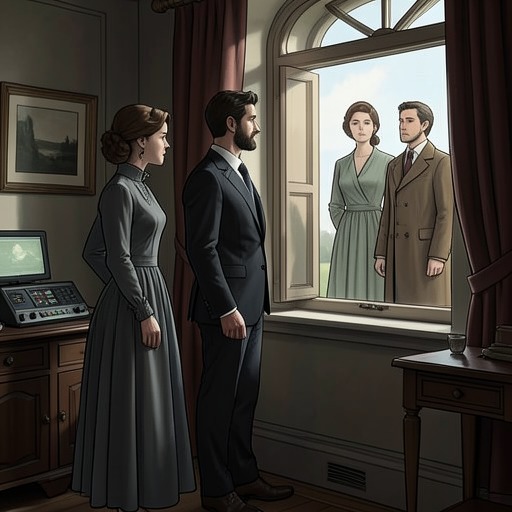
MiddlemarchMarriage and mutual obligation in Middlemarch is more than a private promise: it joins emotional responsibility to household economy, professional ambition, domestic labor, and the limits imposed on individual choice. The novel contrasts marriages imagined as instruments of a husband’s fulfillment with the harder work of mutual understanding. In Lydgate and Rosamond’s courtship, each projects a desired role onto the other; when debt and public disgrace later expose the cost of those assumptions, silence deepens their crisis. Dorothea’s intervention offers a different account of the bond, grounded in candor, sympathy, and the effort to take responsibility for another person’s distress.
Marriage as an Unequal Arrangement
The account of Edward Casaubon’s decision to marry exposes how social convention can define obligation chiefly from a man’s point of view. He expects to choose a young, religious, virtuous, intelligent wife of his own rank, make financial settlements for her, and receive domestic pleasures in return. He also imagines that she may help with his scholarly work, allowing him to avoid hiring a secretary. He reads Dorothea’s acceptance as confirmation that he has found the wife he needs, while scarcely considering whether he can make her happy. The imbalance is not simply a difference in personality: the marriage is framed as an arrangement in which her qualities and labor are evaluated for their usefulness to his life.
The narrator’s account makes that convention visible by distinguishing what society requires of a prospective wife from what it asks of a prospective husband. Casaubon expects an appreciative and unambitious companion, and assumes that such a wife will regard his mind as powerful. The possibility that he should examine his own capacity to bring happiness to a young woman barely enters his view. Marriage therefore carries mutual duties in principle, but social expectations can distribute those duties unequally before the spouses have begun their life together.
Idealized Roles and the Household Economy
Lydgate’s courtship of Rosamond shows how a mutually attractive marriage can still begin in incompatible expectations. He imagines an accomplished wife who will admire his intellectual work, create order at home and in the accounts, and help make domestic life seem romantic. His confidence that marriage will further rather than obstruct his vocation rests on an ideal of feminine support, not on a tested understanding of how the couple will make decisions together. The expensive dinner service he buys after becoming engaged gives that expectation a material form: the future household is being furnished according to his conviction that things should be done properly, before the couple has faced what that standard will cost.
Rosamond’s own expectations are shaped by the household she knows. She treats ordering the best as good housekeeping, while Lydgate assumes that the expenses of setting up a home, keeping horses, and maintaining a suitable table will not amount to much. Their expenditure eventually exceeds their income: initial furnishing costs run four to five hundred pounds beyond his capital, while annual household expenses approach a thousand pounds and his practice brings in far less than expected. The facts matter to their marriage because neither spouse’s idea of domestic life is financially neutral. Their habits turn an imagined standard of comfort into debt, and that debt later narrows Lydgate’s professional and personal choices.
The arrangement also assigns different forms of responsibility within the home. Lydgate imagines himself pursuing significant work while Rosamond maintains domestic order and accounts; Rosamond, meanwhile, understands comfort and good housekeeping through the standard of abundance she has grown up with. Neither expectation has been worked out as a shared plan. The resulting strain illustrates how marital ideals become practical pressures through spending, household management, and the assumption that one spouse will adapt to the other’s ambitions.
Debt, Silence, and the Failure of Mutual Trust
When Lydgate’s debt becomes pressing and his reputation is damaged by the Bulstrode scandal, the couple’s difficulty is no longer only financial. Rosamond does not know what Lydgate has done or whether he is innocent, and resents that he has not told her everything. He, already overwhelmed by public suspicion, reads her silence as evidence that she believes him guilty. Each experiences the crisis as something the other has failed to meet: she asks why he has not cleared himself, while he struggles to speak openly about what has happened and what he needs from her.
Lydgate recognizes that his reserve is part of the problem, but that recognition does not immediately dissolve his resentment. He understands that he must bend himself toward Rosamond’s nature and give more where he believes her sympathy falls short. He also hopes to explain that their trouble has grown from his desperate want of money, set out practical economies, and persuade her that they should live with less in order to remain independent. The proposed response makes the connection between ethical and economic obligation plain: asking for trust also means asking his wife to share the consequences of a changed household life.
Their marriage has become a bond that governs decisions neither can treat as individual. Lydgate tells Dorothea that he cannot take a step without considering Rosamond’s happiness, and that what he might choose alone has become impossible because he cannot bear to make her miserable. He says that she wishes to leave Middlemarch and that the troubles there have wearied her; he has lost the spirit to continue his life in the town. At the same time, he admits that the crisis has reached Rosamond confusedly, that they have not been able to speak about it, and that he is unsure whether she fears he has acted basely. He accepts that he should have been more open, even as he describes his own suffering.
Sympathy as a Marital Practice
Dorothea responds to Lydgate’s account by offering to visit Rosamond, not to decide the facts for her but to express confidence in his character and offer sympathy. Her own unhappy marriage gives her a keen sense of how a spouse’s illness and distress can obstruct another person’s plans, and of the difficulty of living in constant fear of hurting someone to whom one is bound. She understands that marriage makes private choices consequential for another life; she does not treat that dependence as an excuse to withdraw from care.
In speaking with Rosamond, Dorothea explains that Lydgate blamed himself for not speaking and had refused an opportunity that would have kept him at the hospital because it would require him to remain in Middlemarch, a prospect he believed painful to his wife. This disclosure changes the meaning of his silence for Rosamond: she had thought he was angry with her, whereas Dorothea makes clear that he has been blaming himself and taking her wishes into account. Dorothea does not rebuke Rosamond from a position of moral certainty. She speaks hesitantly, conscious of her own vulnerability, and recalls that she too is weak and that such feelings may take hold of people before they know how to master them.
The exchange turns mutual obligation into an act of attention. Dorothea puts her hands on Rosamond’s and tries to communicate fellowship rather than accusation; as her own grief rises, her words falter. Rosamond, who had approached her with apprehension, is moved by a form of feeling she had not expected from her. Their shared emotion breaks down the pride separating them, and Rosamond responds with an embrace. The episode does not erase the couple’s financial or reputational difficulties, but it makes possible a more sympathetic understanding between husband and wife by allowing one woman to interpret the other’s distress without reducing it to blame.
Significance
Across these marriages, the novel distinguishes obligation from mere authority or dependence. Casaubon assumes that a wife should contribute to his comfort and scholarly purpose; Lydgate and Rosamond begin with idealized assumptions about vocation, domestic order, and expenditure; when their plans fail, the marriage’s demands become concrete in the choices each must make about money, residence, and work. The contrast suggests that good intentions alone cannot make such arrangements reciprocal. A spouse must also attend to the other’s actual needs, speak honestly, and acknowledge how household decisions distribute costs and freedom.
Dorothea’s intervention offers no simple formula for resolving that imbalance. Its force lies in her attempt to imagine the experience of both spouses, including the pain created by what has not been said. Marriage binds lives together, but that closeness can become a source of loneliness when one partner’s distress is treated as private or when silence is mistaken for a verdict. The novel’s account of mutual obligation therefore rests not on the claim that spouses must always agree, but on the harder practice of candor, consideration, and sympathy when each person’s choices have consequences for the other.