The Pequod's crew
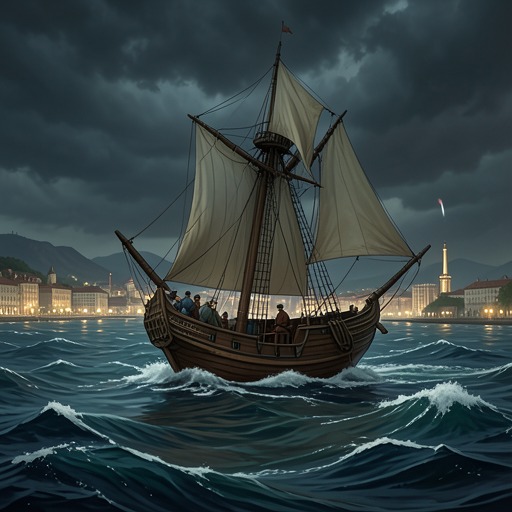
Moby-DickThe Pequod's crew is the human body of the Pequod: a heterogeneous company of harpooneers, officers, and sailors bound together by dangerous labor, maritime discipline, shared profit, and the enclosed life of a long Southern whaling voyage. Their decisive narrative significance lies in the way Captain Ahab converts this working community into a single weapon aimed at Moby Dick. The crew does not merely accompany Ahab's revenge; through ritual, hierarchy, fear, and collective excitement, it becomes the social mechanism that makes his private obsession appear to possess the force of common destiny.
Composition and Working Community
The crew is presented as a mixed company of “mongrel renegades, and castaways, and cannibals,” a description that emphasizes both its international breadth and its distance from the settled social world ashore. The ship gathers men who would not ordinarily form a community and subjects them to common luck, common vigilance, intrepidity, and hard work. Unlike merchant sailors who may depend on fixed wages, whalemen share in the uncertain profits of the voyage, so their livelihood is tied to the success of the whole enterprise. The length and danger of Southern whaling voyages intensify this dependence: the men live for extended periods without ordinary contact with land, and their ship carries its own provisions, weapons, and necessities across the world's oceans.
The wider defense of whaling also enlarges the crew's historical identity. Whaling is described as an occupation despised by landsmen, associated with butchery and physical defilement, yet its ships are credited with exploring uncharted seas, opening relations with previously inaccessible harbors, carrying missionaries, aiding settlements, and contributing to the commercial and political transformation of the Pacific world. In this account, the crew's labor belongs to a global maritime system rather than to an obscure local trade. The men work within a vocation that claims to have connected Europe, America, Australia, Polynesia, and the Pacific coast of South America, even as the narrative's heroic language risks obscuring the violence and unequal power embedded in that expansion.
Hierarchy, Ritual, and Obedience
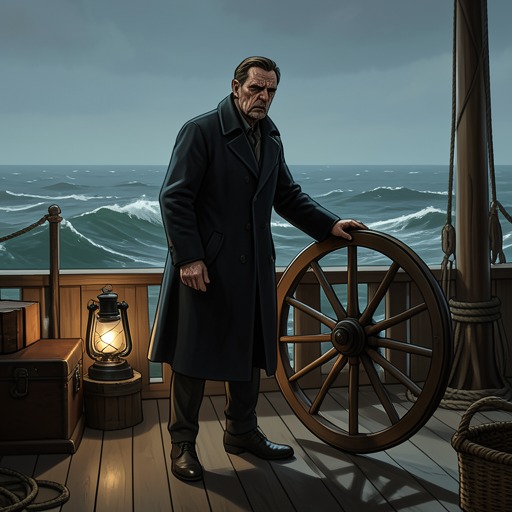
The Pequod's crew operates under a formal hierarchy that remains powerful even when the men display informality elsewhere. Captain Ahab is not given to the empty grandeur adopted by some shipmasters, and he demands chiefly “implicit, instantaneous obedience,” yet he observes the established forms and usages of the sea. Those forms become more than etiquette. They provide the external structure through which his private authority can become practical supremacy, allowing what the narrative calls the sultanism of his mind to assume the shape of an irresistible dictatorship.
The contrast between the open deck and the cabin reveals how deeply the hierarchy governs conduct. Officers may behave boldly toward their commander in the air of the deck, but at dinner they become deferential and humble before Ahab at the head of the table. The crew's silence, attention, and physical gestures turn the meal into a ceremony of power: Ahab presides over the ivory-inlaid table, carves the chief dish, and directs a portion toward Starbuck, who receives it almost as alms. The scene shows authority working through ordinary habits rather than through continuous punishment. Maritime custom makes submission feel natural, even when the men retain private reservations.
Ahab later summons the entire ship's company aft, ordering the mast-heads down and confronting the men as a mass. Their faces are curious and apprehensive while he paces before them, but the assembly soon becomes a military and theatrical ritual. He asks what sailors do when they see a whale, and a score of voices answer that they sing out for it. The familiar response is then redirected toward his own purpose. Harpooneers bring their weapons, the mates stand with lances, and the rest of the crew form a circle around the capstan. The implements of labor become ceremonial objects, and the crew's ordinary whaling identity is recast as participation in a war.
Ahab fills the sockets of the harpoons with liquor and presents them as murderous chalices. The crew drinks together and swears to hunt Moby Dick to his death. The oath is therefore not simply a speech by the captain; it is a bodily act performed by the company, joining weapons, alcohol, voices, and synchronized movement. Starbuck pales and shivers, but the ceremony has already made dissent difficult. The crew's collective vow gives Ahab's revenge the appearance of a shared mission while binding each participant to its consequences.
From Company to Collective Will
At first, the crew does not possess one mind. It contains differences of courage, fear, judgment, and temperament, and its officers embody contrasting responses to Ahab. Starbuck's moral resistance and practical caution, Stubb's reckless jollity, and Flask's mediocrity represent distinct forms of limitation rather than a unified political opposition. Yet the crew's heterogeneity does not protect it from Ahab. Instead, the ship's organization allows separate weaknesses to converge around his will.
The developing chase intensifies this convergence. When Moby Dick is sighted, the crew's earlier fears and forebodings are driven from view by awe of Ahab and by the excitement of the pursuit. The perils of the previous day, the suspense of the night, and the boat's reckless plunge toward its target make the men feel that an invisible force is carrying them forward. The wind filling the sails becomes a figure for the agency that enslaves them to the race. Their participation is therefore neither simple free consent nor mere external coercion: fear, excitement, discipline, and fascination combine until the men experience Ahab's objective as their own.
The narrative gives this transformation its most powerful image by declaring that they are one man, not thirty. The crew's individual qualities are compared to the different materials of the ship—oak, maple, pine, iron, pitch, and hemp—joined into one hull and directed by a central keel. Ahab becomes that keel and the one lord who points the vessel toward its fatal goal. The metaphor captures both the strength and the danger of organized solidarity. Cooperation makes collective action possible, but once the common direction is controlled by a single destructive purpose, the same unity becomes a mechanism of self-destruction.
Conflict, Resistance, and Complicity
The crew's submission is never entirely free of resistance. Starbuck repeatedly recognizes that Ahab's pursuit threatens the lives of everyone aboard. At one point, standing outside Ahab's cabin and seeing the loaded muskets, Starbuck remembers that the captain once pointed one at him. He considers whether Ahab should be disarmed or set aside before he can drag the ship's company to ruin, and he understands that obedience to Ahab may make the captain a wilful murderer of more than thirty men. Yet Starbuck cannot convert this recognition into action. Reasoning, remonstrance, and entreaty have failed, while Ahab's commands remain the practical law of the ship.
Ahab also identifies and exploits the crew's psychological dependence. After the chase has already damaged the boats and renewed the danger to his own body, Starbuck protests that the murderous fish should not be pursued until the last man is lost. Ahab answers that his action has been immutably decreed and presents himself as the lieutenant of the Fates. He orders the men to obey, declaring that although his body has been cut down and supported by a broken lance, his soul still moves on many legs and his purpose remains taut like a hawser. The language turns personal determination into cosmic necessity, making resistance seem not merely disobedient but futile before destiny.
The crew's complicity is consequently tragic rather than simple. They are frightened, but their fear is submerged by collective excitement; they are commanded, but they also cheer; they are drawn into Ahab's hatred until Moby Dick appears to them as an insufferable common foe. The narrative withholds any complete explanation of how this happens, suggesting that the deepest motives of a group cannot be fully mapped by a single observer. Their shared obsession is produced by social pressure and ceremony, but also by the mysterious human impulse to surrender separate judgment to a force that promises direction.
Fate and Destruction
The crew's transformation reaches its end during the final chase. When the whale appears, the men are driven forward as one body, their individual differences welded into the ship's movement. The chase has become a total environment: the wind, the sails, the masts, the boats, and the men all seem organized around the object that may destroy them. The crew searches through the blue expanse for the very being that can annihilate it, while Ahab's commands continue to define courage as continued pursuit.
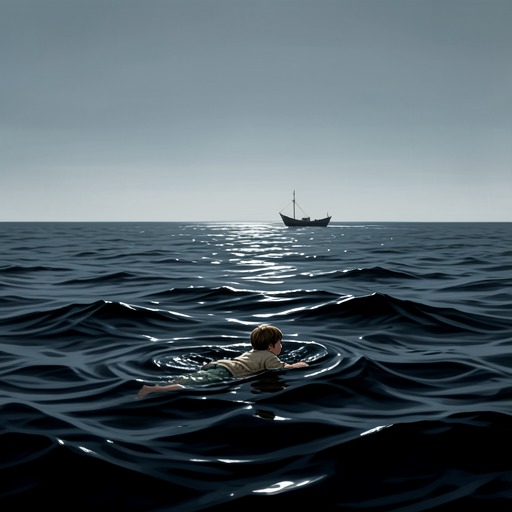
The final destruction exposes the cost of that collective identity. After Ahab is caught by the whale-line and shot from the boat, the boat's crew turns and sees the Pequod fading into the distance, its masts alone remaining above the water. The ship, the men, their oars, and their weapons are drawn into a vortex that carries away every fragment of the organized world they had inhabited. The harpooneers remain at their sinking lookouts, fixed to their perches by infatuation, fidelity, or fate, as though even at the end their identities remain attached to the duty and hierarchy that doomed them.
The sinking flag gives the catastrophe a final emblem. As the Pequod goes down, Tashtego continues nailing the flag to the descending spar; a sky-hawk is caught between hammer and wood and is carried beneath the waves with the ship. The image joins the crew's labor to the vessel's destruction: a practical act of fastening becomes the last gesture of a doomed collective order. The Pequod's crew is thus remembered not as a stable brotherhood that survives its ordeal, but as a community whose courage, discipline, and solidarity are seized by Ahab's revenge and carried to the bottom with it.