Douglas, Arizona
NomadlandDouglas, Arizona, is a border town whose industrial decline and inexpensive rural land make it a place of both constraint and possibility. For Linda May, a five-acre parcel outside town offered a way to build an Earthship and exchange seasonal migration for a home of her own. The same setting also exposed the hazards behind that dream: isolation, flash floods, extreme heat, and a border economy marked by smuggling.
Border town and industrial history
Douglas was founded in 1901 as a smelting center for ore from nearby copper mines. The town prospered around the industry, but its economic foundation came with a severe environmental cost. By the 1980s, the local Douglas Reduction Works smelter, owned by Phelps Dodge Corporation, had become the largest sulfur dioxide emitter in American manufacturing, releasing about 950 tons of the pollutant each day. The resulting air pollution was so dense that one doctor stopped encouraging patients to exercise, concerned about the effects of breathing heavily.
The Environmental Protection Agency ordered Phelps Dodge Corporation to install emissions controls at a cost of half a billion dollars. Instead, the company shut the smelter. In January 1987, workers poured its final batch of copper, ending a period of industrial pollution but also eliminating 347 jobs and $10 million in payroll—estimated at about a quarter of the local economy. The closure made the costs of environmental regulation and industrial dependence visible at once: the air cleared, while livelihoods disappeared.
Douglas continued to contract. Its only hospital closed in the summer of 2015, eliminating another seventy jobs, and the metropolitan area that includes Douglas and Sierra Vista was identified as the fourth-fastest-shrinking city in the United States. Between 2010 and 2015, Douglas lost population more sharply than the Flint, Michigan, and Youngstown, Ohio, metropolitan areas. The empty or deteriorating buildings along G Avenue give the town’s former prosperity a physical presence: the Brophy Building’s boarded storefronts retain their ornamental neoclassical details, while the once-grand Grand Theatre, which closed in 1958, remains dormant after its roof collapsed and restoration proved prohibitively expensive.
A landscape of memory and reuse
The Gadsden Hotel preserves a different image of Douglas’s past. Its cavernous lobby, Italianate columns, marble staircase, and forty-two-foot Tiffany glass mural evoke a period of civic ambition. The mural depicts desert ground, mountains, sky, and flowering yuccas in colored glass; its cultivated landscape offered a striking counterpoint to the raw land Linda hoped to inhabit outside town. The hotel’s polished interior and the abandoned commercial buildings nearby place prosperity and decline within a short walk of each other.
Decline did not make Douglas seem useless to everyone. For a low-budget experimental homesteader, falling prices could turn economic contraction into an opening. The town had also begun attracting a small number of newcomers and creative ventures, including Manhattan transplant Robert Uribe, who opened a coffee shop and later became mayor, and Berkeley filmmaker Harrod Blank, who was building Art Car World. Blank’s collection included a hearse with stained-glass windows and a car covered with 1,045 plastic horses. Such projects did not reverse the town’s decline, but they made Douglas a place where new uses could coexist with remnants of its industrial and commercial past.
Linda May’s land and homesteading plan
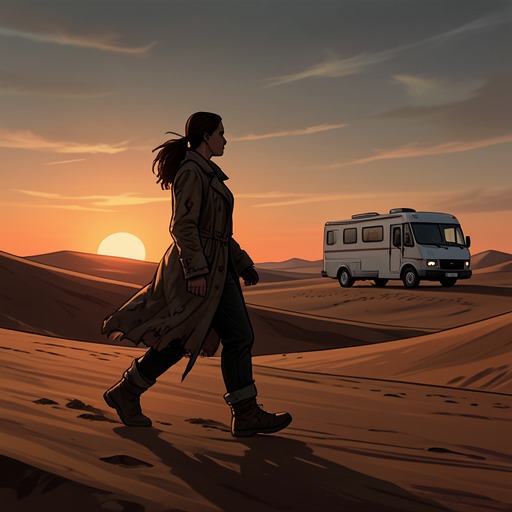
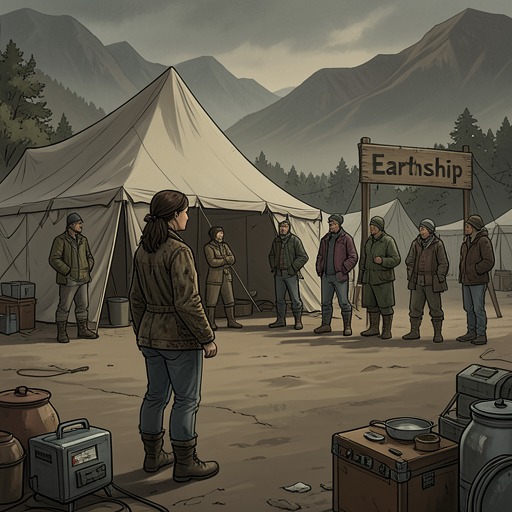
Linda found the parcel through a Craigslist advertisement: five acres near Douglas, on the western edge of the Chihuahuan Desert and about nine miles north of the Mexican border. She had scouted the region before and once thought it too remote. Later, concerned that she might not remain healthy and strong enough indefinitely to build her own home, she decided that waiting carried its own risk. The land was in a rural district where homesteaders on four or more acres were exempt from county building codes, a circumstance that made the area one of the kinds of places Earthship inventor Michael Reynolds described as pockets of freedom for experimental construction.
The parcel’s physical conditions shaped the plan. At an elevation of 4,200 feet, it offered the prospect of less punishing summer heat than lower desert locations, and camp-hosting work in the surrounding mountains might provide seasonal income. The advertisement described vacant, unimproved land with legal access but no electricity, well, or septic system. Mesquite had overgrown the bordering roads, and one route crossed a dry gulch vulnerable to flash flooding during thunderstorms. The land was not a ready-made refuge: its affordability came with the need to build basic infrastructure and contend with a demanding environment.
The seller’s terms made the purchase possible in small increments: $2,500 in total, with $200 down and $200 monthly payments, without interest. For Linda, finances had long seemed like the obstacle to her stalled Earthship project, but the installment plan converted that obstacle into a manageable sequence of payments. She also imagined inviting fellow nomads to help with construction, offering a tire as the price of staying on her land. The proposal linked the private ambition of building a home to the mutual assistance of the traveling community she expected to keep visiting.
Border geography and the risks of remoteness
The homestead lay in the Sulphur Springs Valley, an arid expanse extending nearly a hundred miles through southeastern Arizona and into northern Mexico. Linda’s site was at the foot of the Porilla Mountains, with camp-hosting opportunities farther north in the Chiricahua Mountains, within Coronado National Forest. The approach passed through sparsely settled scrubland, where ranch houses could appear abandoned and long stretches of road offered few signs of habitation. The landscape was not simply empty scenery; its distances and limited services were part of the practical conditions of living there.
The border brought additional uncertainty. Linda had read that Douglas faced a drug-smuggling problem, though she was unsure how current her information was. The area’s history included a 1990 tunnel used to move cocaine beneath the border, and border agents continued to find drugs concealed in vehicles or carried across by couriers. On the road near Linda’s property, a ranch manager described a quieter but still threatening dimension of that geography: he kept fifty Brangus cattle and had lived on the land for twenty-six years, yet drug mules sometimes crossed his property with heavy backpacks, and he had been shot at twice. His account made the danger concrete without suggesting that every encounter in the area involved violence.
Public space, mobility, and narrative significance
Douglas’s significance extends beyond Linda’s individual purchase. The book sets her search for land against the precarious arrangements through which many vehicle-dwellers find places to stay. Some Walmart stores permit overnight parking, while others restrict it or have withdrawn the privilege after conflicts and encampments. An AllStays app maps stores in the United States and Canada and uses color-coded markers to indicate where travelers may be turned away or towed. These parking lots offer temporary shelter, but access depends on store policies and local rules rather than a secure right to remain.
Public desert land around Quartzsite, Arizona, offers another model. Managed by the Bureau of Land Management, free camping areas allow stays of up to two weeks, after which visitors must move at least twenty-five miles or pay to stay in the La Posa Long Term Visitor Area. More than forty thousand RVers were estimated to spend the winter months in the desert near Quartzsite. At the same time, laws restricting sleeping in cars and the enforcement of limits on long-term forest camping show how quickly a place that appears open can become regulated against residential use. Against that background, Douglas’s rural parcel offers Linda something different from a temporary parking place: a legally accessible piece of land where she can attempt to establish a lasting home.
Yet the parcel’s promise is not the same as security. Its permissive building conditions and low price coexist with absent utilities, flood-prone access, and the hazards of a sparsely populated border region. Douglas thus gathers the book’s central tensions into one location: economic collapse can make land affordable, but affordability does not erase risk; open landscapes can enable independence, but rules and resources determine who can actually stay. Linda’s plan turns that tension into a concrete project, while the town’s empty buildings and surrounding desert leave its outcome uncertain.