San Bernardino Mountains
NomadlandThe San Bernardino Mountains in California appear in the book as a working landscape and a recurring field site, rather than simply as scenery. Linda May camp-hosted in the mountains, and the author later traveled with her to Hanna Flat Campground to document that work. The mountain campsites also return in a winter passage, when snow settles over Hanna Flat and the campground stands unoccupied.
Camp-Hosting and Field Reporting
Linda May’s time camp-hosting in the San Bernardino Mountains forms part of the practical background to her plans for a different kind of home. While working in the mountains, she considered how to move a stalled Earthship project forward despite its financial obstacles. The book connects that period of seasonal work with her effort to imagine a more self-directed future, without suggesting that camp-hosting itself resolved the problem.
The mountains became a direct reporting location in May 2015, when the author traveled with Linda May to Hanna Flat Campground in the San Bernardino National Forest to record her experience working there. This visit was part of a broader investigation of workampers: people whose seasonal employment and mobile living arrangements make work sites, campsites, and temporary homes inseparable parts of daily life. Hanna Flat thus appears both as Linda May’s workplace and as a place through which the author observed that way of life.
A Seasonal Landscape
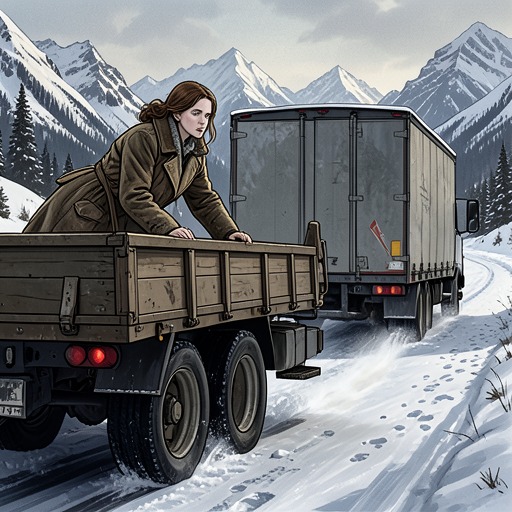
Hanna Flat returns in the book’s early-winter panorama. Snow swirls through the Jeffrey pines and settles on the campground’s unoccupied sites, while other locations associated with seasonal work and travel are likewise shown in winter quiet. The image places the mountains within a larger annual cycle: camps that served as workplaces and temporary homes during one season can become empty when the weather changes and mobile residents move elsewhere.
That contrast gives the San Bernardino Mountains a role beyond backdrop. Their campsites register the changing conditions under which seasonal workers live and work, and the reporting at Hanna Flat anchors the book’s account of workamping in a specific place. The mountains are presented through both human use and seasonal absence: a site of Linda May’s labor and, later, a snow-covered measure of the mobility that shapes the lives documented there.