Mission Viejo
NomadlandMission Viejo is where Linda May’s return to mobile life begins not with open road, but with a couch beside her daughter’s front door. After months living in a crowded family home, without her Jeep and unable to resume work because of an injury, she leaves on May 6 for a campground-host position at Hanna Flat Campground. In the book, the city is a temporary base where family care, economic strain, and the loss of independence converge—and the point from which Linda’s world begins to open again.
A crowded refuge
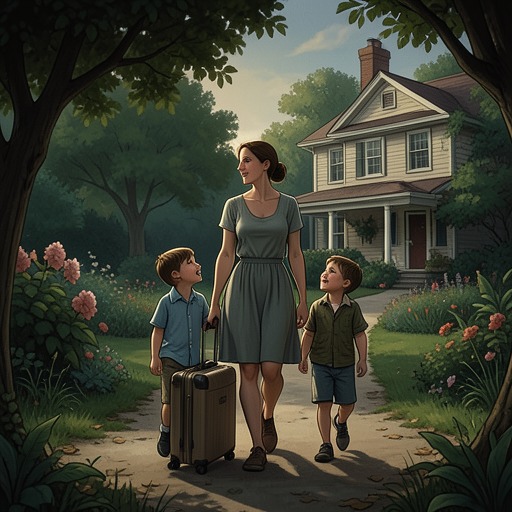
Mission Viejo lies about fifty miles southeast of Los Angeles. Linda had been staying there in a house rented by her daughter, Audra, and son-in-law, Collin, alongside three teenage grandchildren. The family’s limited space made their housing pressures visible in its rooms: Julian slept in a doorless dining area off the kitchen, while in their previous apartment one of his sisters had used a walk-in closet as a bedroom. Linda’s place was the couch near the front door.
The arrangement offered shelter, but not the privacy or autonomy she associated with having a home of her own. The couch felt like an island, and every family outing that did not include Linda began with everyone passing her on their way out. She worried that this made them feel guilty, even as she missed being able to decide for herself where to go and what to do. Her affection for her family did not make dependence easy; she wanted to leave without turning that wish into an accusation against them.
The household was also coping with serious health problems. Gabbi had been weak and intermittently confined to bed for more than three years before testing positive for Sjogren’s syndrome. Julian was managing type 1 diabetes, Audra had arthritis, and Collin’s severe migraines and vertigo had forced him out of his office job. These difficulties stretched the family emotionally and financially. Linda’s need for support therefore sat alongside a household already carrying substantial demands, sharpening the tension between accepting care and recovering her independence.
When mobility stopped
For months, Linda had wanted to return to the road and begin work as a campground host, but her Jeep was in a repair shop and she was short of money. A seasonal warehouse job through Amazon CamperForce was not a straightforward alternative: she had done the work the previous year and developed a repetitive-motion injury that left her unable to return to that job. Her monthly Social Security benefit was $524, which had to last until her first payday. When she turned sixty-five a few weeks later, the benefit would fall to $424 after Medicare premiums were deducted.
The vehicle she hoped to make her home was itself a transition. Linda had previously traveled between jobs in a twenty-eight-foot 1994 El Dorado motorhome that consumed considerable fuel and was beginning to deteriorate. The smaller Squeeze Inn trailer appealed as a way to downsize, although it needed repairs after being left in the salt air on the Oregon coast. While staying with her family, Linda worked on it when she could. She mixed eggshells ground in a blender into an abrasive cleaner to remove a rust streak from its fiberglass exterior.
She also converted the trailer’s rear dinette into a bed. After taking out its table, she made a cardboard pattern for the benches, then salvaged a nearly new queen-size pillow-top mattress discarded by neighbors. She removed its springs, cut and reshaped the padding and outer fabric to fit, and sewed the cover back together. The finished mattress measured seventy-two by thirty-six inches, a narrow sleeping space designed to accommodate Linda and her dog, Coco. These practical alterations gave her a way to prepare for life on the road even while she remained stuck in Mission Viejo.
The road out
On the morning of May 6, Linda and her family exchanged hugs before she set off with Coco. She first stopped at an automotive shop to fill the Jeep’s mismatched, cracked, and balding tires; the vehicle had no spare. At a Shell station she bought gas and cigarettes, reflecting on how much prices had changed since she was young. The tank cost $3.79 a gallon, far from the quarter-per-gallon gas she remembered.
The departure briefly stalled when Linda returned to find the Jeep locked with the keys inside. Coco stood at the driver’s door, and Linda guessed the dog had stepped on the latch. With the window open a few inches, the book’s narrator used a long-handled barbecue lighter to reach in and release the lock. The small mishap did not end the journey; once the door was open, Linda continued toward the Squeeze Inn, which was being stored outside Perris.
From there, the route crossed the Santa Ana Mountains by way of Ortega Highway, a winding road known for heavy commuter traffic and dangerous conditions. At midday the traffic was light. Linda passed trailer parks along the western edge of Lake Elsinore and continued toward the mountains. That evening she drove the Squeeze Inn along a rough dirt track to Hanna Flat Campground, where she would work as a host for four months. The elevation—about seven thousand feet—put her more than a mile above Mission Viejo, a concrete measure of how far the day’s journey had carried her from the family couch.
A point of departure in a mobile life
The book places Linda’s move within a wider account of nomadic travel. Seasonal workers often leave when jobs end, carrying their homes from one opportunity or warmer place to another. That mobility depends on more than a willingness to drive: vehicles require money and maintenance, work supplies income, and travelers need places where they can stop. Linda’s departure makes those dependencies personal. Her Jeep’s condition, her limited benefit, her injury, and the months she spent without a car all constrained her movement; repairing the vehicle and reaching a new job reopened it.
The broader account also shows how fragile a stopping place can be. Walmart permits overnight parking in some locations, but city bans and store restrictions make access uneven; public desert camping is subject to time limits, and campers may be moved along. Laws against sleeping in cars and enforcement on public land add further pressure to people without conventional housing. The book describes travelers who leave seasonal jobs as winter approaches, pulling into parking lots or truck stops to rest before returning to the highway. Mission Viejo is not presented as a nomad’s destination so much as a pause in that larger circuit: a family home that provides shelter, but cannot restore the independence Linda seeks.
That distinction gives the city its narrative importance. Linda leaves because she has a job to begin and a trailer prepared for living; she also leaves a household whose needs make reliance on relatives difficult for everyone. Her four months at Hanna Flat Campground turn the hope of departure into a working arrangement, not an escape from material limits. Mission Viejo remains the place where her mobility was interrupted—and where, with a repaired plan and a full tank, it starts again.