Red Hook, Brooklyn
NomadlandRed Hook, Brooklyn, is presented as an urban landscape where vehicles used as homes can disappear among the ordinary machinery of work. On a winter night, its industrial backstreets offer cover to mobile dwellings, revealing a hidden city while also exposing the precariousness of finding a place to stop without being noticed.
Industrial Setting and Cover
The account visits Red Hook on the night after the season’s first snowfall, describing it as one of Brooklyn’s last stretches of industrial waterfront. Its dim backstreets are lined with contractors’ vans, delivery fleets, food trucks, and utility trailers. For people camping in vehicles, this working landscape offers a way to blend in: a home on wheels can look like one more vehicle belonging to the industrial district.
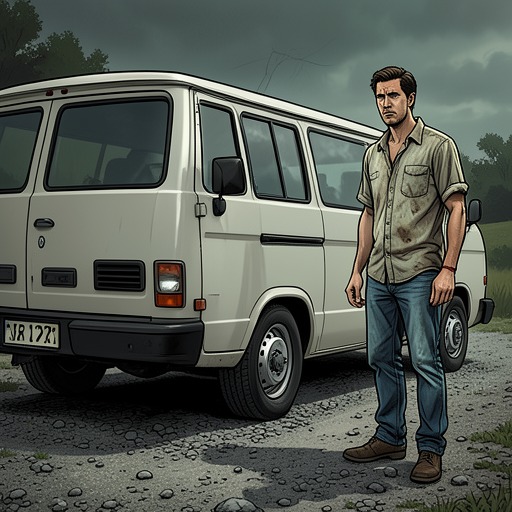
The vehicles the narrator notices vary widely. An old travel trailer has the shape of a tinned ham; a Chevy Astro van has a privacy curtain, plastic sheeting over its cabin windows, and American flags. A converted transit shuttle has tinted glass, red hubcaps, and a propane furnace mounted above its rear bumper to provide heat when its engine is off. Other camper vans sit with their blinds drawn. Together they suggest not a single encampment but scattered shelters embedded in the ordinary streetscape.
Dwellings Hidden in Plain Sight
The most conspicuous dwelling is also carefully screened: a short yellow school bus with sheet metal covering its windows. Four aligned solar panels sit at the edge of the roof, barely visible from street level. A drape hangs behind the windshield, whose condensation provides another sign that the bus is occupied. It faces the East River, with an unobstructed view of the Statue of Liberty. Its position pairs a private, concealed interior with a broad public view, while its altered windows protect that interior from passing eyes.
The neighborhood’s vehicles make visible what the book elsewhere describes as an invisible city of mobile shelters, hidden in plain sight. That invisibility is not simply a matter of living out of sight in remote country. In Red Hook, it is produced by resemblance: dwellings settle among work vehicles, and curtains, covered windows, and tinted glass limit what outsiders can see. The result is a form of urban presence that can be widespread yet remain easy to overlook.
Mobility, Parking, and the Right to Stay
Red Hook’s scene belongs to a larger geography of movement and temporary stopping. Seasonal travelers cross the country in search of work, warmth, or company, resting in places such as truck stops, Walmart parking lots, and quiet suburban streets before returning to the highway. Their mobility depends on more than a vehicle: they must also maintain an official domicile for registration, licensing, taxes, voting, and other obligations, even when they have no fixed home in the ordinary sense. Some use mail-forwarding services and establish residency in states with fewer administrative burdens; in South Dakota, the described process can require only a motel night and registration with a forwarding service.
A parking place may provide overnight shelter, but permission is uneven. Walmart has traditionally allowed many RV travelers to stay overnight, yet some stores prohibit the practice or have withdrawn it after visitors overstayed or established semi-permanent camps. An AllStays locator app marks stores in the United States and Canada, using red icons for places where travelers may be rousted or towed and yellow icons for locations with user reports. In cities, laws can make sleeping in cars illegal: by the end of 2014, 81 cities in a survey of 187 major cities banned sleeping in vehicles, up from 37 in 2011. These pressures clarify what the Red Hook vehicles imply: finding shelter is also a continual negotiation over where a person may remain.
Public lands impose their own conditions. Around Quartzsite, the Bureau of Land Management allows free camping for up to two weeks before campers must move at least twenty-five miles or pay to stay in the La Posa Long Term Visitor Area. In Coconino National Forest, rangers have questioned van and RV campers about their addresses, and people judged to be making residential use of the forest can be ticketed and evicted. These examples are not rules specific to Red Hook; they show how the apparently simple act of parking becomes subject to changing permissions, costs, and scrutiny across the places nomads travel.
The Encounter and Its Limits
The narrator recognizes the vehicles as dwellings and feels the impulse to knock on the school bus door. Memories of stealth parking interrupt that impulse: covered windows and approaching footsteps recall what it feels like to hide inside a vehicle. The narrator walks away rather than disturb the occupants. Red Hook thus appears not as an encounter with named residents, but as a place where the observer’s recognition of shelter is tempered by an awareness of its occupants’ need for privacy.
That decision gives the location its narrative significance. Red Hook offers evidence of mobile life in the city, yet the same precautions that make such life possible also keep it inaccessible to a passerby. The vehicles are present in the open, among the fleets and trailers of an industrial waterfront, while their inhabitants remain behind curtains, sheeting, and metal-covered windows. The scene makes the hidden city legible without claiming to know the people living within it.