Drayton Yard
NomadlandDrayton Yard is a large sugar beet storage and processing facility in North Dakota near the Canadian border, where the autumn harvest turns agricultural urgency into round-the-clock industrial work. Its scale, machinery, and temporary workforce make it both a crucial link in the Red River Valley’s beet supply chain and a testing ground for the book’s account of seasonal labor and life lived on the move.
Location and seasonal setting
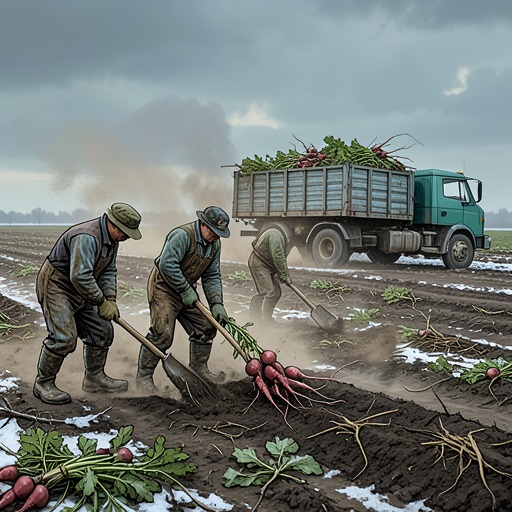
Drayton Yard receives beets grown across the Red River Valley. The harvest depends on a narrow window: in the first two weeks of October, farmers race to lift the crop before the ground freezes, while cool temperatures help keep the beets from rotting. The book describes the effort as a campaign that begins at midnight on October 1. Trucks carrying beets travel continuously from the fields to storage sites, and the volume can strain local roads and the workers who keep the operation moving.
The Yard is part of a much larger receiving network. At peak harvest, American Crystal Sugar Company’s more than three dozen receiving stations handle about 50,000 truckloads a day. The account also notes concerns raised locally about inexperienced farm workers hauling heavy loads without the commercial driver’s licenses generally required of truckers. That detail places the Yard within a system whose speed and scale have consequences beyond the facility itself.
The narrator arrives during the last week of September, after applying to work the harvest through Express Employment Professionals. Seasonal jobs like this attract itinerant workers who travel with their homes, allowing the employer to recruit from beyond a region where local employment is nearly full. Drayton Yard is thus not simply an industrial destination: for a short, intense period, it becomes a workplace for people who have come from elsewhere to earn wages before moving on.
The receiving operation
The narrator is assigned to the ground crew at Piler Number One, inside a refrigerated structure known as the shed. It is an enormous, open-ended building with a concrete floor. A pre-harvest pile of about 20,000 tons of beets already rises inside when the crew begins work; the orientation trainer says this season’s crop is larger than the previous year’s, with some beets reaching the size of basketballs. The indoor assignment offers protection from rain and snow, but comes with greater noise and exhaust than many outdoor stations.
At the Yard, trucks are weighed at the scale house before lining up at a piler. Each truck is directed beside the machine, where a hopper receives its load. Conveyors carry the beets through a tumbler that removes excess dirt, which falls back into the truck, and then up a long boom to the growing storage pile. The piler moves backward on its treads as the heap expands. By the end of the harvest, the pile is expected to stretch roughly the length of two Boeing 747s parked end to end and to be about as wide as their wingspan. Forced-air ventilation keeps it near freezing while the beets wait to be taken to a refinery.
The ground crew’s work supports this machinery through constant cleanup and sampling. Workers shovel spilled beets back into hoppers, clear mud from the concrete floor, and collect samples beneath a vertical chute. When the piler must be cleaned, the machine is shut down so workers can enter and scrape material from its main chute; the crew is given a strict fifteen-minute window because downtime is expensive. Managers discourage standing idle, and a horn from the elevated control booth signals workers to speed up. The tasks are practical and repetitive, but they unfold around equipment moving large loads at high volume.
Work, pace, and risk
After two days of orientation, the narrator begins a twelve-hour shift. The work is physically taxing: repeated lifting, slippery floors, and the pace of cleanup make the shift difficult to sustain. The sample collection task also requires workers to steady bags beneath the chute as beets drop into them. These details show how the Yard’s continuous flow depends on ground crews handling the materials that the automated conveyors spill, move, or leave behind.
The account records hazards without presenting the operation as a single dramatic accident. A broken harvester’s seven-foot metal pole arrives concealed among the beets and is pulled onto the conveyor. An emergency shutdown is called before it can reach the tumbler, where it could damage the machinery and endanger workers nearby. On another day, a coworker slips on the concrete and has to report the accident. The incidents expose the narrow margin between routine work and disruption in an environment where machinery, heavy loads, and fast-moving crews occupy the same space.
The narrator’s first shift ends with substantial pain and fatigue, and the promised access to bathing facilities is unavailable because that part of the campground is still being built. A recruitment sign on the drive back advertises an “UNBEETABLE EXPERIENCE,” a cheerful slogan at odds with the labor described inside the Yard. The narrator, who is thirty-seven and considers themself in reasonably good shape, is surprised by the toll of the work, especially knowing that retirement-aged workers are employed at other stations.
The Yard in the narrative
Drayton Yard brings together workers of different ages and circumstances. At the nearby campground, the narrator meets Dan, a sixty-nine-year-old former truck driver who has medical problems and asks the foreman to leave the night shift because he needs daylight to get around. Dan’s wife, Alice, lives with him in their motorhome but cannot work because of ALS. Other neighbors include older workers, people in their fifties, younger employees, and a couple living in a pickup truck. Their proximity makes the temporary workforce visible as a varied community rather than an interchangeable labor pool.
The narrator considers staying through the campaign out of a sense of responsibility toward the people met there, but recognizes that the experience will not make them a long-term workamper: unlike the other workers, they will return home to write. After telling the foreman they will not come back, they later learn that most coworkers at Piler Number One have also quit, and hear that a worker at another station has broken her wrist. The departures show how quickly the Yard’s staffing can unravel when the labor proves difficult to sustain.
The narrator leaves Drayton Yard at night, passing trucks traveling in the opposite direction toward the facility. The refinery sign for American Crystal Sugar Company glows through rising steam in the rearview mirror. A hotel in Grand Forks offers a hot shower after the unfinished campground facilities and the long shift. The departure closes this episode but not the larger inquiry: Drayton Yard has given the narrator direct evidence of the work’s demands, while the steady stream of trucks suggests a harvest operation that continues regardless of any one worker’s decision to leave.