Empire, Nevada
NomadlandEmpire, Nevada, was a company town built around gypsum mining and wallboard production on the edge of the Black Rock Desert. For generations, United States Gypsum Company linked work, housing, and local services in a settlement where factory wages could support a family and expenses stayed low. Its abrupt closure in 2010 reversed that arrangement all at once: employees were told they would lose not only their jobs but also their homes, and the town itself was emptied and sealed. What remained was a ghost town, and an unusually clear record of how a community organized around stable industrial employment could disappear when its company no longer needed it.
Company Town and Industrial Setting
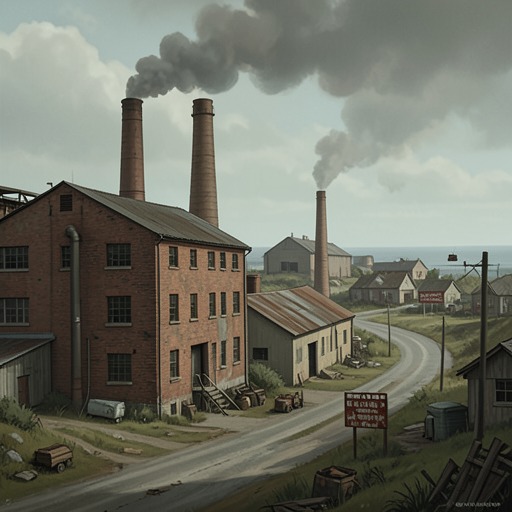
Empire stood in northwestern Nevada, six miles north of the gypsum mine known locally as the gyp, at the foot of the Selenite mountain range. Miners blasted ore from five terraced pits with ANFO, an ammonium-nitrate-and-fuel-oil explosive. Haul trucks carried loads of roughly sixty tons to the drywall plant at the edge of town. There, workers pulverized the gypsum, heated it to 500 degrees in large kettles, and made the wallboard used in homes across the American West. The industrial chain connected a remote settlement to the construction economy far beyond it.
The town’s roots reached back before the factory village residents knew. Laborers established a tent colony on the site in 1923, and the mine’s claim had first been established by Pacific Portland Cement Company in 1910. By the time of its closure, Empire was described as one of the last traditional company towns in the United States, wholly owned by United States Gypsum Company. At its peak, more than 750 people lived there; by 2010, the population had fallen to fewer than half that number.
Everyday Life and Local Character
The residential core consisted of single-story cottages along four main streets planted with cottonwoods, elms, and silver poplars. Company-subsidized rents were as low as $110 for an apartment and $250 for a house. Mechanics at the drywall plant could earn up to $22 an hour, while equipment operators earned somewhat less; a day or two of work could cover a month’s rent. United States Gypsum Company also paid for television, sewer, trash, and internet service. With reliable income and limited household costs, the precariousness of living paycheck to paycheck seemed comparatively distant.
Isolation shaped the town’s social life as much as its economics. Residents knew one another, left front doors unlocked, and sometimes left keys in parked cars. With few other places to go, they held block parties and potlucks, gathered to play Bunco, and went into the high desert to hunt deer, antelope, and chukar. Residents also maintained conspicuously green lawns in an arid landscape. From above, Empire appeared as a patch of green against the brown desert, a cultivated community set apart from the wilderness around it. That closeness had a less welcome side: a factory foreman joked that neighbors watched one another whether they wanted them to or not.
Closure and the Loss of Home
On December 2, 2010, workers gathered in the community hall for a mandatory morning meeting. The plant manager, Mike Spihlman, announced that Empire would close and that everyone had until June 20 to leave. The room fell silent before workers began to cry. Spihlman later recalled having to tell ninety-two people that they had lost both their jobs and their houses. Employees were sent home for the rest of the day to face a winter morning and explain the news to their families.
The closure followed a prolonged slump in the housing market, which had weakened demand for wallboard. United States Gypsum Company had lost $284 million by the end of the third quarter of 2010. Its chief executive, William C. Foote, cited weak market conditions and exceptionally low shipping volumes; beneath the corporate language was the practical fact that the market no longer needed enough of what Empire produced. The recession had damaged many communities, but here the company’s decision meant the end of the town itself.
Departure and Abandonment
The workers’ paths after the announcement diverged. More than a dozen former employees found jobs with Barrick Gold Corporation at nearby mines, as Nevada’s rising gold prices brought new hiring. Others had fewer prospects. Former supply-chain manager Dan Moran had sent out résumés without receiving an offer and considered cutting firewood for a living. Monica Baker, who had returned to Empire from Oahu with two young children expecting factory work, had to reconsider that future. Concerned about the toxic leach ponds associated with mining, she looked instead toward retail work in Fernley, Nevada. Her possible move reflected a broader shift away from manufacturing and toward service-sector employment.
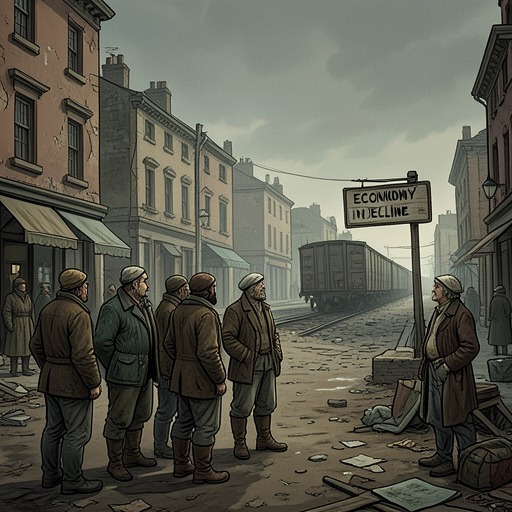
The exodus continued through June. After the last families left, chained gates, security cameras, and no-trespassing signs closed off the town. Its cottages, public pool, two churches, post office, and nine-hole golf course were left to decay; even the postal code, 89405, was removed. The company brought in two dozen goats to keep the weeds down. Inside the factory office, unfinished cups of coffee remained on desks and calendars still showed the shutdown date. The contrast between an orderly workplace and its sudden abandonment made the loss legible in small, interrupted details.
A Town Preserved as an Image
Empire’s most striking afterlife was not in its locked streets but in an old online view of them. As of 2017, Google Maps Street View still allowed visitors to drop an avatar on Circle Drive and see parked cars, lawn furniture, and residents watering their yards. The imagery had not been updated since 2009, so it showed Empire before the closure: a lived-in town held still at the moment just before its disappearance.
That frozen view stands against the physical fate of the settlement. Where Street View preserved the routines of a functioning community, the actual town was fenced off, emptied, and left to weather. The difference also sharpens Empire’s significance in the book’s account of work and housing: its residents had experienced a local version of stability because a single employer supplied both livelihoods and homes, but that security depended on the continued operation of the factory. When production ended, the town’s tightly connected institutions and domestic life went with it.