Red River Valley
NomadlandThe Red River Valley is a major sugar-beet growing region whose annual harvest depends on a brief, weather-sensitive season and a stream of workers and trucks. More than half of the country’s sugar-beet fields lie there, making the valley both an agricultural center and a destination for itinerant laborers who travel with their own homes.
Agricultural Setting
The valley stretches across western Minnesota and eastern North Dakota and contains about 680,000 acres of planted sugar beets. Sugar beets account for 55 percent of the United States’ manufactured sugar yield; the remainder comes from sugarcane. The region is home to American Crystal Sugar Company, the nation’s largest beet-sugar company.
The valley’s labor market is an unusual one: employment is nearly full, making it difficult for local employers to find enough workers for the harvest. When the Bakken oil fields were booming, that recruitment challenge was even greater. American Crystal therefore seeks itinerant workers who can come from far away and bring their own housing, tying the region’s crop cycle to a wider population of mobile workers.
Seasonal Work and Recruitment
The beet harvest begins in autumn, when American Crystal Sugar Company brings hundreds of recreational-vehicle dwellers to Montana, North Dakota, and Minnesota. The work is weather-dependent and can run day and night in twelve-hour shifts. Harvest workers receive a starting wage of $12 an hour plus overtime, as well as a parking space for their vehicles.
Recruitment for this labor is part of the wider workamping economy: jobseekers can encounter seasonal opportunities at gatherings for vehicle dwellers, then apply through staffing agencies. An application to Express Employment Professionals, which hires workers on behalf of American Crystal, led the book’s narrator to the region to observe the work firsthand. The arrangement makes mobility a practical resource for employers facing a local labor shortage, while giving travelers a temporary job and a place to park.
The Harvest Campaign
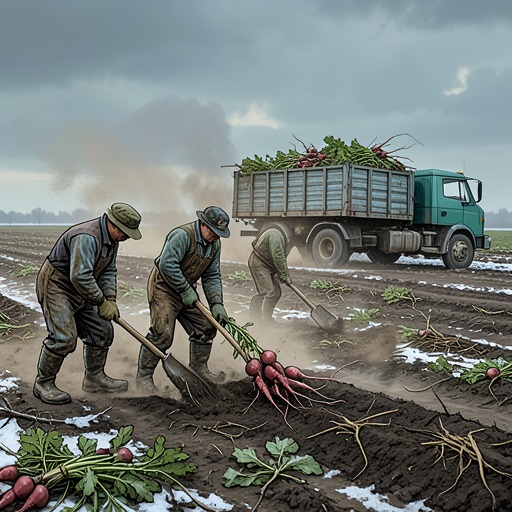
For beet producers across the valley, the first two weeks of October are a race against the weather. The opening of the campaign comes at midnight on October 1. Farmers work to lift the beets before the ground freezes, while hoping cool temperatures will keep the crop from rotting. The compressed schedule turns harvesting into a regional logistics effort rather than a sequence of isolated farm tasks.
Semitrailers carrying several tons of beets move along local highways around the clock toward storage facilities. Loads can rise above the trucks’ brims, and spilled beets litter the roadsides. The traffic can snarl, and accidents occur. Some local residents attribute crashes to state rules allowing inexperienced farmworkers to haul multi-ton produce loads without the commercial driver’s licenses generally required of truckers.
Processing and Regional Significance
Drayton Yard, a large beet-storage and processing facility in North Dakota near the Canadian border, illustrates the scale of the harvest. The narrator arrived there in the last week of September and was assigned twelve-hour shifts on the ground crew at Piler Number One, inside a vast refrigerated shed. Before the main harvest, a pre-pile of roughly 20,000 tons of beets already rose toward the ceiling; workers were also seeing beets as large as basketballs.
Many receiving stations operate outdoors, but the shed offered protection from rain and snow at the cost of greater noise and fumes. At the peak of the campaign, American Crystal’s more than three dozen receiving stations can handle about 50,000 truckloads a day. The valley’s seasonal work thus joins agricultural urgency to industrial storage and heavy transport. Its dependence on itinerant workers also reveals how a region with little local unemployment can draw on the mobility of people whose livelihoods are organized around temporary jobs, vehicle housing, and the changing demands of the harvest.