Quartzsite, Arizona
NomadlandQuartzsite, Arizona, is both a winter destination for tens of thousands of vehicle-dwelling travelers and a meeting ground where a dispersed community becomes visible. The desert beyond town offers space to camp, but access depends on fees, time limits, and the ability to move on. Each winter, the Rubber Tramp Rendezvous brings nomads together to share practical knowledge and form relationships that can support them long after the gathering ends.
Desert setting and seasonal migration
The seasonal migration to Quartzsite draws people from across the country. In winter, travelers arrive in large numbers, settle near the town, and reunite around evening campfires. Their movement is part of a wider pattern: seasonal workers and other nomads follow jobs, weather, and companionship, then take to the highway again when winter or employment shifts. The book presents Quartzsite as a recurring destination within that mobile life, not as a permanent home for everyone who gathers there.
Many visitors camp on federal public land outside town rather than pay for an RV park. They use solar panels or generators for electricity and carry their own water, trading campground amenities for a place to stay. More than forty thousand RV travelers are estimated to live in the desert nearby from December through February. The scale of the encampment makes a landscape of temporary individual camps into a large seasonal settlement, though its residents remain widely dispersed across the terrain.
Public land and the conditions of staying
The Bureau of Land Management administers the open desert camping area. Some sites are free, but stays are limited to two weeks. Campers who reach that limit must move at least twenty-five miles to another patch of federal desert or relocate to the La Posa Long Term Visitor Area, just south of Quartzsite. That area covers more than eleven thousand acres and charges $40 for two weeks or $180 for as long as seven months. Its brightly colored permit stickers, bearing a roadrunner and a snowflake, also identify returning campers to one another.
These arrangements make mobility a practical requirement as well as an ideal. A traveler who cannot afford a longer stay, drive elsewhere, or meet the rules may have fewer choices than the language of open space suggests. In the Coconino National Forest, rangers questioned vehicle campers about their home addresses, and a Quartzsite camping sticker could be taken as evidence of permanent nomadic residence. People judged to be making residential use of the forest could be ticketed and evicted. Quartzsite thus figures in a tension between access to public land and official efforts to distinguish temporary recreation from living in a vehicle.
Nomads also need a fixed legal domicile, despite moving continually. That address is used for responsibilities including vehicle registration, driver's licenses, taxes, voting, and insurance. Some travelers choose states with fewer administrative burdens and use mail-forwarding services. South Dakota's process, as described in the book, could require only one night at a local motel and registration with a mail-forwarding service before a person presented the receipts to the state. The contrast is central to the geography of nomadic life: a person may travel widely, but paperwork still anchors them somewhere on paper.
The Rubber Tramp Rendezvous
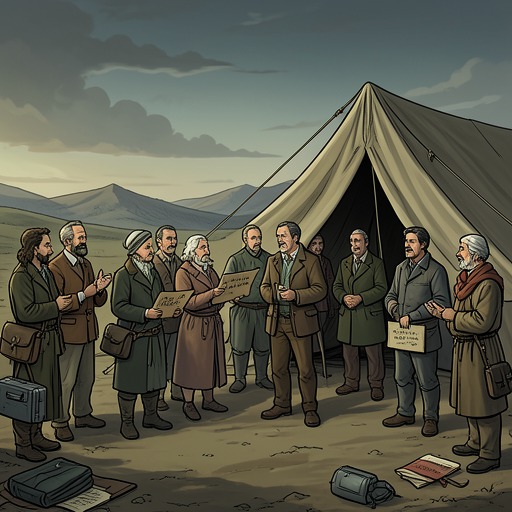
In 2011, Bob Wells organized the first Rubber Tramp Rendezvous on public desert land near Quartzsite. The free, two-week gathering takes place in January. Its model recalls the annual meetings of nineteenth-century mountain men: people who spent much of the year apart would reunite to trade and share knowledge. Here the purpose is to exchange stories and skills, make friends, and help newcomers learn how to live on the road. Some aspiring nomads attend in tents or borrowed vehicles before setting out themselves. News of the event initially spread largely by word of mouth.
The gathering grew quickly. When the narrator first attended in 2013, about sixty mobile dwellings were present; by 2017, the estimate had reached five hundred. Bob Wells's public talk on boondocking and the event's practical instruction make the desert gathering a classroom as well as a reunion. Its growth reflects the expansion of an online network into face-to-face community, while its free admission and informal exchanges preserve a low-cost character.
The Rendezvous works through shared labor and donated resources rather than a single organizer supplying every service. Participants offered haircuts, basic vehicle repairs, carpentry, and informal lessons; people with larger solar systems shared excess power. Charlene Swankie demonstrated a solar oven by baking food for the group. At sunrise, another attendee made coffee for anyone who came by, and communal dinners let people contribute ingredients to shared pots. Bob Wells also established a free pile where travelers could leave useful possessions and take what they needed. These exchanges give the gathering a practical function: skills, food, power, and equipment circulate among people whose budgets and living space are often limited.
Mutual aid and connections
The support formed around Quartzsite is not confined to scheduled events. During a cold spell, Kat and Mike Valentino ran out of fuel while trying to keep their van warm. Vincent Mosemann drove them into town to fill a fuel container; they returned with additional food obtained from the local food bank, including apples, sausages, and salad greens. The episode joins public services and informal assistance: travelers depended on help from a companion, then brought back food that could be shared.
Charlene Swankie also made newcomers feel included. She led a group of vehicles to nearby petroglyphs, and when one member became stuck in a ditch, she used her own van and a nylon strap to pull the vehicle free. For some participants, the relationships established in camp came to function as chosen family. When Linda May later became too ill to cook while staying near Ehrenberg, fellow nomads brought her food. That later act of care shows how a community formed in seasonal gatherings could persist after people moved on from Quartzsite.
The gathering accommodates different needs for company. Some participants park at the edge of the camping area or attend only briefly; others value the opportunity to meet friends and learn from one another. Its social life is therefore not a demand that every traveler become communal. Rather, its importance lies in making connection available to people who otherwise spend much of the year separated by distance.
Significance and limits
Quartzsite offers a striking contrast to places where income increasingly sorts people into separate neighborhoods. On public desert land, a person arriving by bicycle and someone in an expensive custom motorhome can camp as neighbors, united by their wish to use the same public space. Yet the apparent openness has boundaries: permits, stay limits, fuel costs, fixed-address requirements, and enforcement all affect who can remain and for how long. The town's seasonal community is both an experiment in shared access and a reminder that mobility depends on infrastructure and legal permission.
The location also gathers economic uncertainty into view. At one visit, Peter Fox, a former San Francisco taxi-industry worker displaced by competition from ride-hailing, had moved into a van and hoped to find workamping. He described the difference between being on a trip and recognizing that this was now his life. His presence at the Rendezvous connects Quartzsite's hopeful communal image to the economic pressures that bring some people onto the road.
As a recurring winter destination, Quartzsite provides more than a place to park. It gives travelers a point of return, a setting for sharing practical resources, and a temporary social center within a life organized around movement. But neither the desert nor the community abolishes precarity. The travelers still need work, a legal address, money for fuel, and somewhere they are allowed to stop. Quartzsite's significance lies in holding these realities together: freedom of movement and the rules that restrict it, solitude and chosen kinship, scarce resources and the mutual aid that makes continued travel possible.