Fernley, Nevada
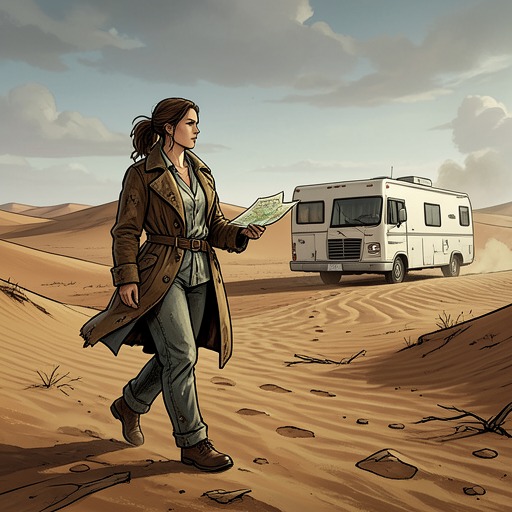
NomadlandFernley, Nevada, became one of the book’s clearest portraits of a new kind of company town: not a settled community built around secure employment, but a seasonal gathering of mobile workers who brought their homes to a temporary Amazon job. Around the warehouse, older travelers and other financially precarious workers parked in crowded RV parks, endured demanding shifts, and formed small networks of practical support. Linda May’s move there made the seasonal labor system part of her own migration, while the site also gave the narrator a close view of workamping as survival rather than recreation.
A seasonal settlement around the warehouse
In autumn, itinerant workers began filling mobile-home parks around Fernley. Some traveled hundreds of miles for temporary warehouse work paying $11.50 an hour plus overtime. Many were in their sixties or seventies, at or beyond the age conventionally associated with retirement. Their trailers, vans, and RVs were not necessarily built to withstand subzero weather, but workers planned to remain through early winter, while Amazon’s holiday shipping demand was high.
The settlement had no single boundary. By the narrator’s visit in the week before Halloween in 2013, workers had crowded into parking areas as far as thirty-five miles from the warehouse, including an RV lot at the Grand Sierra Resort and Casino in Reno. Parks had filled months earlier, and some had long waiting lists. The most sought-after option, Desert Rose RV Park, offered the shortest commute. Its gravel ground was bounded by Highway 50 and crossed by high-voltage wires that crackled overhead.
The lots held the marks of people trying to make a temporary parking spot feel personal. Residents put out doormats and patio furniture, hung wind chimes and bird feeders from cottonwoods, and raised flags. Homemade yard art and Halloween decorations appeared beside the trailers. These gestures did not erase the workers’ circumstances, but they gave the spaces a lived-in character. People also built modest forms of mutual assistance: they organized carpools to save on gas and exchanged tips about inexpensive restaurants. A favored day-off breakfast at the Pioneer Crossing Casino in Fernley cost $2.70 after the senior discount.
CamperForce and the work that brought people there
The workers had come for CamperForce, Amazon’s seasonal labor program for nomads recruited to meet the extraordinary shipping demand of the three or four months before Christmas. Amazon called its warehouses fulfillment centers. In Fernley, CamperForce workers joined thousands of conventional temporary employees during peak season, but their distinctive feature was that they arrived with their own housing. When the holiday rush ended, the company no longer needed them; workers were dismissed and drove away in what managers called the taillight parade.
The work was physically exacting. Shifts lasted ten hours or longer. Some employees walked more than fifteen miles across concrete floors while scanning, sorting, and boxing merchandise, repeatedly stooping, squatting, reaching, and climbing stairs. New arrivals went through work hardening, an acclimation period involving half-day shifts; those who had arrived earlier were already struggling to keep pace. The seasonal arrangement suited an employer needing labor in a particular place for a limited period, while leaving workers to absorb the demands of the work and the costs and hazards of living in their vehicles.
CamperForce began as an experiment during the housing crash. Amazon had struggled to staff its far-flung warehouses for Christmas and tried different recruitment schemes, including transporting workers from several hours away. In 2008, Express Employment Professionals brought RVers to the pre-Christmas rush at the warehouse in Coffeyville, Kansas. After a successful trial, Amazon gave the program the CamperForce name and logo, expanded it to Fernley and Campbellsville, Kentucky, and began hiring workers directly rather than through temp agencies. Later, small groups of experienced workers trained employees at newly opened facilities. In early 2017, Amazon advertised positions in other locations, while the Fernley facility had shut down and been replaced by a new Reno location that did not hire CamperForce employees.
Linda May and Don Wheeler in the Fernley orbit
Linda May reached the Fernley area in September after leaving her camp-hosting job near Yosemite as smoke from the Rim Fire thickened. She had applied for only one other workamping position before joining CamperForce, and the move placed her within the same seasonal labor stream she had not known about earlier in the summer. The RV parks near the warehouse were bustling and full. At orientation, Amazon trainers told workers the company was considering buying nearby land to build its own trailer park.
Linda had no reservation. Much of her summer had been spent without cell or internet service, so she had not arranged a space in advance. Twenty-three miles southeast of the warehouse, in Fallon, she found Sage Valley RV Park, a fenced gravel lot off Highway 50 among cottonwoods and near cow pastures. It too was full of CamperForce workers, but a sympathetic manager made room for her. Her arrival shows how a job’s location shaped more than a commute: workers had to find a place to live in a region where temporary residents had already filled the available parks.
Don Wheeler, whom the narrator first corresponded with at length, was another CamperForce worker in Fernley’s orbit. At sixty-nine, he was divorced and staying at Desert Rose RV Park. He had once retired to a Spanish Colonial Revival house in Berkeley, California, after a career as a software executive; the 2008 market crash wiped out his savings, and his former wife kept the house. He also had to sell the red-and-white Mini Cooper S he had modified and raced. His new home was a 1990 Airstream he called Ellie, where he lived with Rizzo, a fifteen-pound Jack Russell terrier. A plastic hula girl stood on the dashboard, and race-car posters leaned against the drawn blinds. Against a former life costing about $100,000 a year, he had learned to get by on as little as $75 a week. For the 2013 holiday season, he expected five overnight shifts each week, sometimes twelve hours long, receiving and scanning freight until shortly before dawn.
From recreation to precarious work
The Fernley encampments unsettled the narrator’s initial assumption that RV travelers were mainly retirees enjoying leisure after long careers. The people at Desert Rose included new nomads whose immediate concern was adjusting to warehouse work, not sightseeing. Although the recreational vehicle remained their home, the seasonal job turned it into a condition of employment: workers brought shelter with them because the work was temporary and their circumstances often offered few alternatives.
The broader CamperForce workforce included people whose savings or retirement accounts had been depleted, workers laid off in the recession, small-business owners whose ventures had failed, and people coping with divorce, illness, or injury. Some younger workers carried student debt or had degrees that had not led to reliable jobs. Their reasons for arriving differed, but the temporary settlement drew together people exposed to financial shocks and an insecure labor market. Fernley’s proximity to chain stores also represented the kind of service-sector work toward which displaced manufacturing workers were being pushed. After Empire, Nevada, began dying as a company town, former supply-chain manager Dan Moran told the narrator that he had sent out resumes without success and might end up cutting firewood. Monica Baker, who had returned to Empire with young children expecting factory work, considered trying to find a job at Walmart or Lowe’s in Fernley instead.
The book’s reporting shifts Fernley from backdrop to field site. The narrator initially encountered workamping through interviews and short visits, and found that media accounts often emphasized travel and friendship while avoiding the hardship behind the lifestyle. Spending many weeks with workers across five states did not by itself provide the closeness needed to understand their lives. The narrator eventually chose to live in a self-contained van and make longer reporting trips, having found that a tent left the researcher sleeping miles from gatherings and limited access to backcountry camps. Fernley was one of the places that had first made the mobile workers’ labor visible: a seasonal town that appeared when Amazon needed staff and dispersed when the season ended.
A temporary company town
The comparison with Empire clarifies what made Fernley distinctive. Empire had offered factory employment and middle-class stability before its shutdown; its homes and civic institutions were left behind as the town emptied. The seasonal settlement around Fernley’s warehouse offered no comparable promise of permanence. Workers arrived in their own vehicles, performed temporary labor, and left when demand fell. Their home parks were company-town-like in their dependence on a single employer’s seasonal needs, but the employer did not have to maintain a settled workforce or a lasting town.
Fernley’s importance in the narrative also has a limit built into it. The warehouse and RV parks enabled workers to gather, but the arrangement remained temporary and physically demanding, and the later closure of the Fernley facility removed the local CamperForce jobs. The site therefore holds together two opposing facts: the work made survival possible for people with few dependable options, while the short-term structure treated their presence as disposable. What remained was not a permanent Amazon community but the remembered pattern of a seasonal town, assembled from parked homes, exhausting shifts, and the brief practical ties formed among people who had come there to work.