Ehrenberg
NomadlandEhrenberg, Arizona, is more than a stop along the nomads’ route: it is a seasonal gathering place where the freedom of dispersed camping meets the practical needs and vulnerabilities of life without conventional housing. Its quiet, little-regarded campgrounds contrast with the sociability of the Rubber Tramp Rendezvous, while recurring migrations, vehicle troubles, and shared errands make the area a revealing waypoint in the book’s account of mobile life.
Setting and Camping
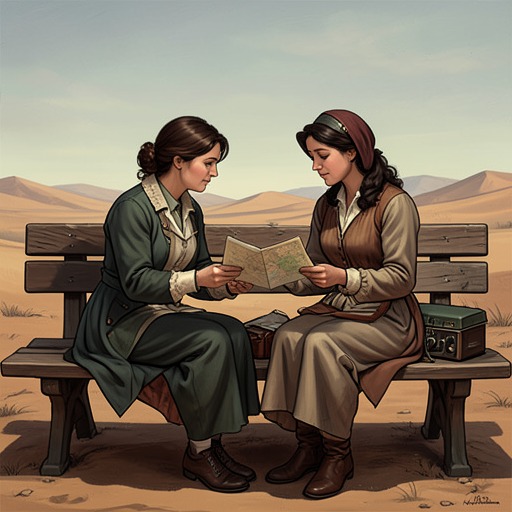
The camp described outside Ehrenberg lies west of Quartzsite, reached by following Interstate 10 toward the Colorado River and turning off near a Flying J truck stop, just short of the California border. Beyond a frontage road and a Dead End sign, the landscape opens into gravel and sparse vegetation. Compared with the desert around Quartzsite, it seems almost barren. Ancient, weather-beaten RVs sit back from the unpaved entrance; flat tires and general disrepair suggest that some have been there for years, with their inhabitants staying year-round.
The site is technically subject to the Bureau of Land Management’s fourteen-day camping limit, but the rule and the area itself receive little attention from visitors or patrols. Its conspicuous lack of charm discourages most campers, leaving room for those who prefer solitude. The rigs stand farther apart than at the Rubber Tramp Rendezvous, and the camp’s dispersed, changeable population resists any official or readily visible count. During one visit, the number seemed to hover around fifteen, but people came and went regularly. The narrator reports that, across dozens of visits, no ranger appeared and no one told him of being asked to leave.
A Seasonal Way Station
Ehrenberg becomes a destination as the Rubber Tramp Rendezvous ends and its temporary community breaks apart. When Bob Wells took down the official sign, Silvianne Delmars packed up the leftovers from the free pile for a local thrift shop, including a large straw sombrero nobody wanted. Linda May made coffee, showed the narrator a newly installed solenoid that let her charge her RV’s house power from her car battery while driving, and prepared to move on. After word came that Bob Wells had left for Ehrenberg, she hurried to break camp and said goodbye to Jen and Ash, who planned to travel through the Southwest before their next jobs.
Others followed Bob Wells to the area, where the camp’s quieter rhythm allowed some to recover from the Rendezvous’s concentrated social life. A few still met for morning coffee. Linda May and LaVonne Ellis grew close enough to plan to work together: Linda May’s next job, camp hosting at Sherwin Creek Campground in Mammoth Lakes, would begin in spring, while LaVonne Ellis considered applying for work through recruiters at the Rendezvous. The relationship took shape amid practical decisions about employment and travel, not simply shared time in camp.
The stay was also bounded by the desert’s changing seasons. Bob Wells generally remained in Ehrenberg until the heat arrived and the rattlesnakes woke, then moved to higher elevations around Cottonwood and Flagstaff. The broader group likewise migrated from Ehrenberg to Prescott National Forest near Cottonwood, roughly three thousand feet higher and about ten degrees cooler. There, campers spread across open hillsides and sheltered wooded patches. This movement makes Ehrenberg one node in a recurring circuit: a place to gather after winter, then leave when rising temperatures make another landscape more livable.
Community, Separation, and Practical Strains
The camps around Ehrenberg offered companionship without guaranteeing permanence. After a morning coffee gathering, the narrator found Silvianne Delmars reading in her rig with her cat, Layla. LaVonne Ellis, meanwhile, was more relaxed than she had been at the Rendezvous. She reflected on the emotional force of the word homelessness: some people might classify her as homeless, but she considered herself sheltered. At the same time, she worried that separating herself from the category could reinforce the stigma directed at people with low incomes.
The intimacy of camp life could be as ordinary as heating dishwater, and its difficulties just as concrete. Linda May explained that she lacked enough power to pump water from the storage tank beneath her couch to the sink. Someone in Nevada had sold her an engine-starting battery rather than the deep-cycle battery needed for her RV’s house power, so she heated water in a tea kettle instead of using the on-demand hot water she expected to have. She was glad to be in Ehrenberg, but had errands to complete before her next job, including searching for land and emptying a storage unit. Before long, she left.
Her departure sharpened the cost of mobility for LaVonne Ellis. After Linda May moved on, LaVonne Ellis wrote that another friend had left and that the sadness of people coming and going was an inevitable consequence of nomadic living. The encampment enabled friendships to form, but offered no assurance that they could remain in the same place. Its community was built through temporary proximity and repeatedly tested by departure.
Refuge and Narrative Significance
Ehrenberg also appears as a place where vehicle failure can turn mobility into immobilization. After her maroon GMC Safari, LaVanne, broke down, LaVonne Ellis was stranded in the area without money for repairs and still owed several thousand dollars on the van. She spent nearly a month and a half living in the dead vehicle as temperatures rose and the surrounding group thinned. A repair shop quoted $3,000 for an engine fix, beyond what she could afford. A nearly new Chevy Express on a used-car lot became the alternative: she accepted financing despite uncertainty about its terms and named the vehicle LaVanne Two. In her account, the purchase was a way to avoid becoming homeless, not a discretionary upgrade.
The place also became a point of return after an unsettling visit elsewhere. Linda May and LaVonne Ellis went to Slab City, slept there before seeing the site in daylight, and learned from a friend that they had parked where people used meth. Linda May worried about her home and Jeep, which they had left behind, and they hurried back to check. Finding her belongings intact did not dispel the unease; they left and rejoined the Rubber Tramp community in Ehrenberg. Once there, they planned to stay in the area and split the cost of a mailbox, another practical arrangement made easier by their friendship.
Through these recurring arrivals and departures, Ehrenberg anchors the book’s account of nomadic life in specific material conditions: where a vehicle can remain unnoticed, where friends gather for coffee, where work plans are discussed, and where an unaffordable repair can threaten a person’s shelter. Its apparent emptiness is not an absence of social life. Rather, the wide spacing between rigs and the steady movement through camp make community visible as something assembled, dispersed, and assembled again.