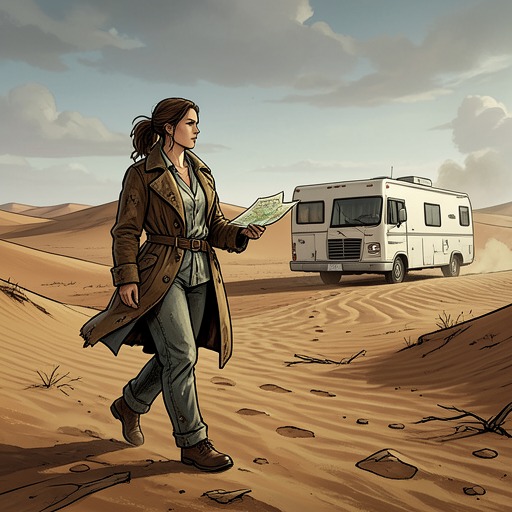
Junction Campground
NomadlandJunction Campground was the first workamping post of Linda May’s new mobile life: a small, first-come, first-served campground where a modest paid job could also provide a place to live. In June 2013, shortly after turning sixty-three, Linda arrived in her El Dorado RV to work as a camp host. The campground gave her a foothold in the Sierra, but not a permanent home; within months, a major wildfire and the seasonal rhythm of work would move her on.
Setting and camp-host work
Junction Campground lies two miles from the eastern entrance to Yosemite National Park. Linda began there as an employee of California Land Management, working thirty hours a week for $8.50 an hour. Even if she had secured forty-hour weeks throughout the year and taken no vacation, her annual earnings at that rate would have been $17,680, without benefits. The location offered a striking change from the retail and service jobs she had held, but its appeal did not erase the financial limits of the work.
The campground had thirteen sites, filled in order of arrival rather than by reservation. That arrangement kept paperwork and advance bookings to a minimum; the routine included cleaning two outhouse toilets. The job also reduced Linda’s housing costs. Her site had no utility hookups, so her supervisor lent her a generator and arranged for a water truck to replenish the RV’s fifty-five-gallon tank each Tuesday. With rent removed from the equation, her main living expenses were groceries, generator diesel, and propane for the stove. Camp hosting thus joined employment and shelter in one arrangement, while leaving Linda responsible for supplying the utilities her site lacked.
For part of her stay, Linda also agreed to take responsibility for nearby Tioga Lake. The two assignments extended her work beyond a single campground, while remaining part of a seasonal job rooted in the region’s visitor traffic. When two older RV travelers, Billy and Helene Outlaw, said they wanted camp-hosting work, Linda introduced them to her supervisors. They soon took over her duties at Tioga Lake, a practical connection between workers seeking mobile employment and the managers who needed staff.
Visitors, coworkers, and the work’s limits
The job gave Linda regular contact with vacationers, a social dimension she enjoyed. One visitor who stood out was Mr. Brown, a solitary sixty-nine-year-old climber. For fifteen years he had climbed routes in Yosemite and replaced corroded fixed anchors that climbers relied on to secure their safety ropes. Linda admired his persistence and the work he did for others, while also worrying that he could fall. Their exchange made the campground a meeting point between seasonal workers and people whose activities depended on sustained, often self-directed labor in the surrounding landscape.
Not every worker fitted the position. One of Linda’s coworkers, a former border patrolman, insisted on carrying a firearm during his daily rounds. Linda explained that a camp host at a National Forest could not carry a gun in that role, and the employer let him go. The episode exposed a boundary within the apparently informal work: camp hosting might offer a different pace from a checkout line, but it still came with workplace rules and conditions that could determine who stayed employed.
A seasonal refuge within a mobile system
Linda’s experience at Junction belonged to a wider pattern in which work, parking, and housing were tied together. Nomadic workers could travel between seasonal jobs and rest stops, but movement depended on practical arrangements: a place to park, fuel, water, and a legal address. Although there is no clear count of full-time American nomads, the law requires them to maintain an official domicile for matters such as vehicle registration, licenses, taxes, and voting. South Dakota offered one relatively easy route: a night in a local motel and registration with a mail-forwarding service could establish residency. Such formalities underline the difference between living on the move and being free of fixed administrative obligations.
The locations available to travelers also offered different terms of shelter. Public desert land near Quartzsite, for example, allowed free stays of up to two weeks before campers had to move at least twenty-five miles or pay to stay in the La Posa Long Term Visitor Area. In other places, long-term vehicle dwelling could draw scrutiny: rangers in Coconino National Forest questioned campers about their home addresses and could ticket or evict those judged to be making residential use of the forest. Against that broader landscape of rules and limited stays, Junction’s paid camp-host position offered a defined place to live for the duration of a job, but not lasting security.
The Rim Fire and departure
Linda’s summer at Junction went smoothly until mid-August, when a small illegal campfire in the remote Clavey River Canyon of Stanislaus National Forest ignited the Rim Fire. Investigators believed a solitary bow hunter had used twigs and pine needles to heat soup and burn backpack garbage; embers reached dry brush, starting a blaze about fifty miles west of Junction. Over the following two months, the fire burned an area more than seventeen times the size of Manhattan. By September, smoke was thickening the air at Linda’s campground, and it was time for her to leave.
She said goodbye and drove north to Fernley for her next workamping job, with Amazon’s CamperForce. The transition was characteristic of the life Junction had helped make possible: a campground post supplied temporary paid work and a place to stay, then ended as the season and circumstances changed. The site’s significance lies in that combination of opportunity and impermanence. It gave Linda a practical alternative to a conventional rental and a chance to meet visitors and fellow workers, yet neither the job nor the landscape could guarantee that she could remain.