Brooklyn, New York
NomadlandBrooklyn, New York becomes a revealing urban landscape for vehicle dwelling: mobile homes sit among ordinary parked vehicles, visible in detail yet easily missed as a dispersed, hidden-in-plain-sight city. The book’s return to Brooklyn, New York after three years of reporting turns familiar streets into evidence of how nomadic life can persist inside a dense city, dependent on concealment, parking, and the chance to stay unnoticed.
An invisible city
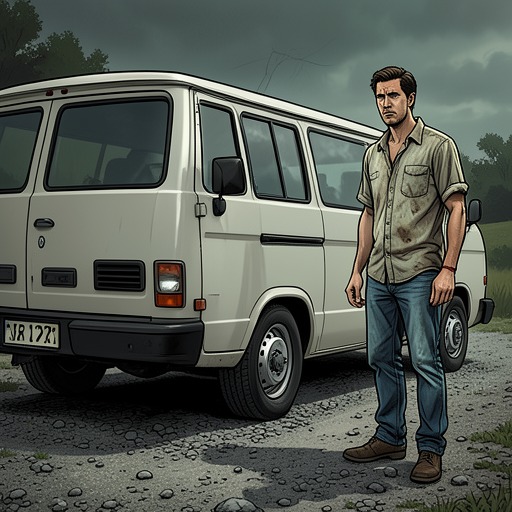
After returning home, the narrator finds that the story of nomads has followed them. On an unmetered side street near an apartment in Boerum Hill, a silver high-top Ford camper van is marked by a nazar hanging from its rearview mirror. Its dark tinted windows and drawn blinds obscure the interior. Nearby, across from a commercial truck lot in Bed-Stuy, an old motorhome is adapted for privacy and sleep: a curtain closes off the cab, foil insulation blocks the sleeping loft’s windows, and trash bags and duct tape cover an empty rear window socket. These are not passing curiosities but signs that vehicles can function as shelters within the city’s everyday parking spaces.
Other vehicles gather at the edges of Prospect Park and beside low warehouses in Gowanus and Crown Heights, where there are fewer neighbors likely to complain. The range of locations suggests a dispersed pattern rather than a single encampment. Camper vans and occasional recreational vehicles occupy the margins of parks and industrial districts, using places where their presence can blend into the surrounding streetscape. The text calls this an invisible city, hidden in plain sight: a shelter network legible through close observation but not necessarily recognized as a community by passersby.
Red Hook and the work of concealment
The account’s most detailed survey takes place in Red Hook, Brooklyn, described as one of the remaining industrial waterfront stretches in the borough. On the night after the season’s first snowfall, its backstreets are lined with contractors’ vans, delivery fleets, food trucks, and utility trailers. Those work vehicles provide cover for urban campers. Among them are an old travel trailer, a Chevy Astro van with a privacy curtain and plastic sheeting over its cabin windows, and a converted transit shuttle with tinted glass, red hubcaps, and a propane furnace mounted above the rear bumper for use when the engine is off. Newer camper vans, their blinds drawn, complete the street’s mix of vehicles.
A yellow school bus stands out as the most elaborate dwelling. Sheet metal covers its windows, while four aligned solar panels sit in frames at the roof’s edge. A drape hangs behind the windshield, and condensation on the inside of the glass offers another clue that someone is living there. The bus faces the East River, with a view of the Statue of Liberty. Its solar equipment and furnace suggest the practical work involved in making a vehicle livable; its covered windows show the parallel need to keep that life private. The narrator considers knocking, then remembers the vulnerability of stealth parking and the quickened heartbeat associated with a stranger approaching covered windows. The decision not to intrude preserves the distance between seeing a dwelling and being entitled to enter it.
Mobility, parking, and the right to stay
These Brooklyn, New York scenes belong to a wider system in which mobility depends on access to places to stop. Across the country, nomads travel between seasonal jobs and warmer destinations, then rest in places such as Walmart parking lots, quiet suburban streets, and truck stops. Yet the apparent availability of a parking space does not guarantee permission to remain. Walmart allows overnight parking in many locations, but some cities ban it, and some stores have withdrawn the practice after visitors overstayed or established semipermanent camps. A parking-locator app distinguishes stores where travelers may be rousted or towed from those with more permissive reports. The national pattern clarifies the stakes of urban parking without establishing that any particular Brooklyn, New York location follows the same policy.
The difficulty of counting nomadic residents also reflects this dependence on fixed systems. Full-time travelers must maintain an official domicile for such tasks as vehicle registration, licensing, taxes, and voting, even when they have no settled home in the ordinary sense. Their paper address can remain stable while their physical location changes. At the same time, housing pressure and laws governing public space can make sleeping in a vehicle vulnerable to enforcement. A national survey cited in the book found that, by the end of 2014, 81 cities prohibited sleeping in cars, up from 37 in 2011; the wider growth of restrictions coincided with gentrification and rising housing costs. The account does not claim a specific legal outcome for the Brooklyn, New York vehicles it describes. Instead, the broader climate makes their privacy measures and discreet choice of parking places intelligible as responses to an unstable right to shelter.
Narrative significance
Brooklyn, New York shifts the focus from the open road and public desert to the urban curb. In the desert, temporary camping can be organized through designated federal lands and permits; in the borough’s industrial streets, shelter is threaded into working landscapes and ordinary parking. The vehicles’ coverings, insulation, furnace, and solar panels make domestic life materially present, while their placement among fleets and work vans helps conceal it. The scenes therefore complicate the distinction between a parked vehicle and a home: the same street infrastructure can offer rest while leaving residents exposed to complaint, regulation, or unwanted attention. By recognizing the vehicles without turning their occupants into spectacle, the narrative presents Brooklyn, New York as both a refuge of opportunity and a landscape where the ability to stay remains uncertain.