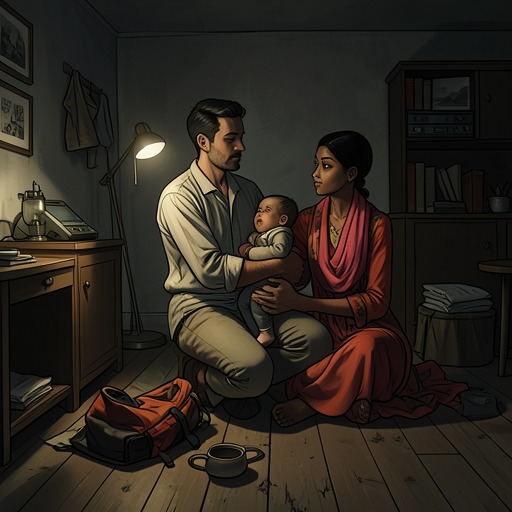
Damiri
PeacemakerDamiri is Tabini’s wife and aiji-consort, Cajeiri’s mother, and a woman whose Ajuri and Atageini connections make private family ties inseparable from political questions of succession and security. Her father Komaji’s assassination brings that entanglement into sharp focus: she must reckon with the loss while confronting uncertainty over her clan, her marriage, and the danger surrounding her children. She is not a formal participant in the inheritance decision, but her maternal responsibilities and independent political position remain central to its consequences.
Identity and Family Background
As a young woman, Damiri was disaffected from her Ajuri father and angry with her circumstances. During the Winter Festivity in Shejidan, she left a family outing and presented herself to her influential uncle, Lord Tatiseigi, asking to be taken in by the Atageini clan. Tatiseigi sent a conciliatory letter to the Ajuri lord, describing her departure as a crisis of man’chi and offering to keep her until she tired of life in her mother’s clan. That explanation was not false, but it did not tell the whole story: Tatiseigi was childless, needed an heir, and saw in Damiri a promising member of his own bloodline. He hoped she might attach her man’chi to him rather than to Komaji. The account establishes her early life as a family negotiation in which affection, clan belonging, and the need for an heir overlapped.
Damiri’s position later gives those early ties renewed significance. She remains linked to Ajuri through her father and to Atageini through Lord Tatiseigi, while her marriage to Tabini connects her to the ruling household. She is a possible candidate for the Ajuri lordship after her father’s death, but Tabini regards that possibility as dangerous and later forbids her from taking the office. Her political importance is therefore not simply a matter of rank: it arises from competing expectations attached to her several family affiliations.
Marriage, Security, and Political Pressure
Tabini maintains his marriage to Damiri even when political and security considerations might have suggested dissolving it. The strain becomes acute when Ajuri is implicated in events surrounding the Padi Valley and the Assassins’ Guild. Tabini has removed Damiri’s staff from the apartment, leaving senior security there in the hands of Ilisidi’s people. Bren worries that this arrangement and the clan crisis could feed suspicion between husband and wife, but the evidence does not show Tabini ending the marriage or treating Damiri as complicit in the conspiracy.
The uncertainty surrounding her family becomes explicit after Komaji’s assassination. When Damiri arrives at the Bujavid, she is in the last days of pregnancy and has only recently been told that her father has been killed on a journey that may have brought him near her son at Tirnamardi. She learns that Cajeiri and his guests have returned safely and are staying with Lord Tatiseigi. The news also places her uncle at the center of the immediate political situation: Lord Aseida is under arrest, and Asien’dalun has suffered damage. Damiri receives these developments with raised eyebrows rather than visible pleasure. Lord Tatiseigi is both her uncle and Cajeiri’s link to her, but she dislikes his well-known conservatism and had returned to the Ajuri clan rather than remain under his influence.
Damiri recognizes that the assassination leaves Ajuri without a lord and that Kadagidi will also need new leadership. She anticipates further trouble in the north. Her political observation carries personal stakes: she herself is among the candidates for the Ajuri lordship, while Tabini does not want her to occupy that frequently vacated position. Later, Tabini insists that the decision is his alone and rejects speculation about who will take the office. Damiri’s candidacy thus remains a real possibility in the political discussion, but not an outcome she chooses or receives.
Grief and the Question of Her Father’s Death
Damiri asks Bren directly whether Lord Tatiseigi or Ilisidi was involved in her father’s assassination. Bren assures her that neither was involved and explains that both had known Komaji was moving toward Lord Tatiseigi’s estate without ordering anyone to stop him. They had been uncertain about Komaji’s intentions; one possibility was that he meant to seek refuge with Tatiseigi because of a threat within Ajuri. Bren also says that Komaji and Tatiseigi were not on good terms, though Tatiseigi could be moderate even toward an enemy. The answer addresses Damiri’s suspicion without resolving who actually killed her father.
At Cajeiri’s Investiture, Damiri returns to the question more bluntly. She asks Bren who killed Komaji. He says that neither he, Ilisidi, nor Lord Tatiseigi did so, and offers his own explicitly unsupported opinion: Komaji was probably going to Tirnamardi, and Shishogi, his great-uncle, was the person most likely to have prevented him from arriving. Damiri presses Bren to explain what he knows. He describes Shishogi’s support for a Kadagidi with southern ties, the subversion of the Assassins’ Guild, the resulting disorder between regions, and efforts to pursue Tabini and seize Cajeiri. Bren further explains that information had been withheld from Tabini’s bodyguards and from his own aishid, putting the household at risk and nearly costing Cajeiri his life. These are Bren’s account and assessment, not a confirmed identification of Komaji’s murderer.
Bren connects the conspiracy to the succession questions Damiri faces. Komaji had only recently become lord of Ajuri after the death of his uncle, and there may have been questions about that replacement that Tabini knew. Bren says the Guild’s leadership had knowingly exposed Tabini’s household to political danger, and that the investigation had led back to the Guild in Shejidan. Shishogi is dead, but Bren warns that not all of his agents may be. He explains that Tabini’s prohibition against Damiri taking the Ajuri lordship, his concern about her clan’s man’chi, and his earlier decisions to keep her father and his bodyguard out of the Bujavid were connected to the danger. He also emphasizes that Tabini has rejected suggestions of dissolving the marriage for political convenience and has not treated Damiri as complicit in her great-uncle’s actions.
Motherhood and Cajeiri’s Investiture
Damiri’s relationship with Cajeiri is shown through restrained gestures as well as political decisions. During his stay with his older human guests, she asks whether they are all older than he is. Later, seeing Irene, she remarks on how small the child is and rests a hand above her own baby. She says she expects a daughter soon and asks Irene whether she has enjoyed her visit. Cajeiri, anxious that the encounter might turn volatile, rephrases the question for his guest; Damiri remains gentle and controlled. The scene sets his apprehension against a moment of tentative warmth, without suggesting that her political concerns have disappeared.
At the Investiture, Damiri appears in black and green, combining Ragi and Atageini colors. She looks pleased to see Cajeiri and gives him a gift. Because standing has become increasingly difficult for her, she does not rise when he bows; he bows repeatedly and thanks her without sulking. She tells him he looks grown-up and says that Tabini favors him. Her concern immediately turns to his younger sister: she asks him to promise that the girl will not be left wanting for their father’s favor. Cajeiri promises to care for her as her older brother. Damiri presses his shoulder as she asks, then relaxes her hand after he answers. The exchange makes the emotional cost of succession visible within the family: Cajeiri’s elevation carries an obligation to protect the child who may otherwise receive less attention.
Damiri has no formal role in the card-signing or in the inheritance question. At the public celebration she receives congratulations with a cup of tea, but she is legally outside the decision; the aiji-consort is not required to participate in the inheritance. That exclusion contrasts with the weight of her maternal role. Her request that Cajeiri care for his sister is not a claim to succession, but it gives the public rite a private future to answer for.
Independence and the Turn Toward Labor
Bren’s account of the conspiracy changes the terms in which he understands Damiri. He tells her that she is independent not only of Shishogi, but also of her father, aunt, cousin, and Lord Tatiseigi. In Bren’s view, she has not courted power, though power may eventually come to her; her children will face ambitious clans, and she should not reject Ilisidi or her allies but learn from them. This is unsolicited advice, and Damiri’s immediate response is shock rather than agreement. The scene gives her no quick political resolution. Instead, it leaves her confronting a history in which the men around her have interpreted her loyalties and possible inheritance as matters of state.
The conversation is interrupted when Damiri catches at Bren’s arm and says she thinks she is having the baby. Jago supports her, while Banichi directs that security be advised and that Tabini be informed; Bren asks whether Lord Tatiseigi is present. The account ends at the onset of labor, without giving the birth’s outcome. Across the episode, Damiri’s pregnancy is not incidental background: it heightens the urgency of the household’s security, frames her encounter with Cajeiri and Irene, and brings her private family future directly against the political crisis.
Narrative Significance
Damiri’s arc exposes the limits of formal authority without reducing her to a passive consort. She is excluded by law from the inheritance decision and does not direct the investigation, yet she recognizes the consequences of Komaji’s death for Ajuri and asks the questions that force the conspiracy’s implications into the open. Her early movement between Ajuri and Atageini, her marriage to Tabini, and her concern for both Cajeiri and his unborn sister show how kinship distributes political risk as well as belonging. At the Investiture, the public arrangement leaves her outside the legal act; in the private exchange with her son, she gives that act a familial obligation. Her position remains unsettled, but the account presents her as an independent person whose judgment and future cannot be safely collapsed into the ambitions of the clans around her.