Murini
PeacemakerMurini is the ruler installed after Tabini’s overthrow, but he is not the coup’s architect. The investigation into the seizure of power overturns the original account: the conspiracy began within the Assassins’ Guild, and Murini was put forward by a hidden message whose origin could no longer be traced. His rise gives an already fractured political order a face, while leaving the deeper source of the conspiracy unresolved.
Identity and Installation
For a time, the prevailing explanation was that a discontented lord from the Kadagidi clan, backed by the Marid, had assembled dissatisfied lords and bodyguards, breached Tabini’s security, taken the shuttles, and thrown the government into chaos amid declining public approval. The later inquiry rejects that account. Neither broad discontent with the economy nor dissatisfaction with Tabini’s governance had caused the overthrow, and Murini himself had not plotted it.
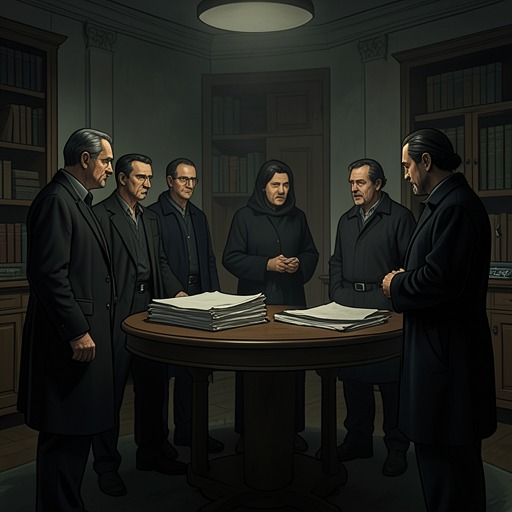
The conspirators who chose him were a committee of elder lords described as confused and disreputable. They appointed Murini in the hope that the influential, ancient Kadagidi clan would consent to govern and that his accession would lend the new government legitimacy. Yet even this account has a crucial qualification: the committee did not originate the choice. A message from somewhere within the Guild presented Murini as the candidate, and investigators could not establish where it came from. His installation therefore depended on an unseen intervention within the institution that was supposed to enforce the law.
Rule and Personal Grievances
Murini entered office with ambition, jealousies, suspicions, and private feuds, and acted as though he possessed supreme authority. The account of his rule does not give him a coherent program for remaking the government. The coup’s leadership, including Murini, appears to have been driven instead by general discontent with the changing world and a wish that humans had never existed. Once in power, however, Murini’s personal animosities became a governing force: he set about satisfying his own grievances under the illusion that he was the highest power.
The Shadow Guild under Murini did not question his orders. A separate Shadow Guild above his authority also showed little urgency about stopping his vendettas, although it restrained him from attacking two neighbors in Padi Valley: the Taibeni and Lord Tatiseigi. They were among Tabini’s most loyal supporters, and an attack on them would have undermined Murini’s claim to be defending order and rescuing the Conservatives of the aishidi’tat. This restraint was tactical, not evidence that Murini’s rule had a dependable system of lawful checks.
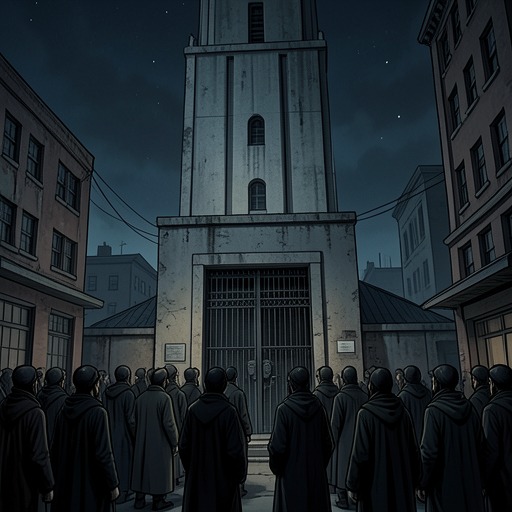
The seizure of the shuttles and other communications infrastructure formed part of the coup’s practical effort to isolate the mainland from the heavens. The conspirators took shuttles under service and the radio station, and believed their control of Mogari-nai would prevent communication with the heavens. They also believed there were no mines there. These actions belonged to the larger conspiracy; the evidence does not establish that Murini personally devised them. Their significance to his rule is that his authority depended on a coordinated seizure of communications and transport, even as the origin of his own selection remained hidden.
The Guild Conspiracy and Its Fractures
The coup’s true origin changes the meaning of Murini’s position. The Assassins’ Guild, an institution that served as a law-enforcement agency, had fractured, and one part had seized the government. Murini became the ruler placed at the head of that takeover, but the later evidence distinguishes his role from the forces that created it. He was not simply the leader of a popular revolt or the mastermind of a coalition of dissatisfied lords; his candidacy itself had been delivered from within the Guild by an unidentified source.
Even after Murini was taken down, the conflict continued. Tabini and Ilisidi initially pursued him, then found themselves confronting a splinter of the Guild they had assumed consisted of his committed supporters. The forces opposing Tabini had received forged orders bearing no name that could be shown to be genuine. Many had been lied to or misled, although that deception did not make every action they had taken innocent. The discovery persuaded Ilisidi that the remaining disorder could not all be attributed to Murini. His name had become a convenient explanation for a crisis whose institutional roots were wider than his own rule.
Flight, Collapse, and Legacy
In only two years, Murini and his supporters had turned public opinion against themselves. Across the continent, ordinary citizens began organizing in small groups to consider how to remove him. When Tabini reappeared with Ilisidi and Cajeiri at his side, reporting success in the heavens, he received widespread support. The Shadow Guild then attempted an attack on Tabini, Ilisidi, and Lord Tatiseigi; the attempt failed, though it damaged Lord Tatiseigi’s grounds and a bedroom.
After that failure, Murini and his closest staff fled toward the Marid, and his government disintegrated. Tabini’s return did not erase the damage: restoring the aijinate proved easier than repairing what Murini had done. In the year that followed, Tabini and Ilisidi investigated the remaining network, weighing whom to forgive, whom to warn, and whom to pursue. Murini was among the first they took down, but the inquiry into his accession and the forged orders showed why his removal alone could not resolve the crisis.
Murini’s importance lies in the gap between visible ruler and concealed authorship. His ambition and personal feuds shaped the conduct of his regime, while the coup that placed him there originated in a Guild fracture and an untraceable recommendation. The distinction prevents his fall from serving as a complete explanation of the upheaval: the government collapsed with his flight, but the question of who had empowered him—and how the Guild’s authority had been turned against the state—remained central to restoring lawful rule.