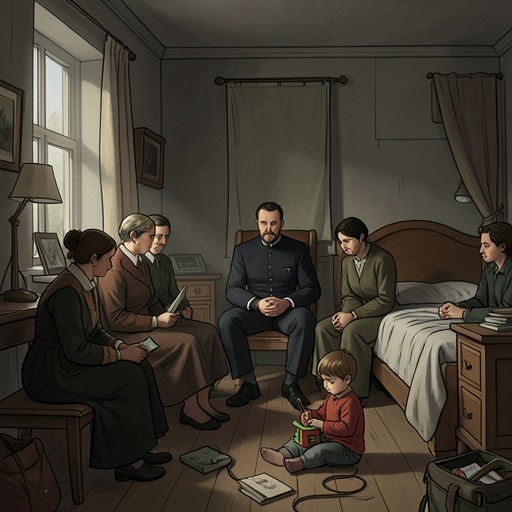
Veijico
PeacemakerVeijico is one of Cajeiri’s young bodyguards, a member of the close protective circle that accompanies him through private household routines and public uncertainty. The evidence gives Veijico no independent biography or extended account of personal motives; instead, the character emerges through specific duties: keeping watch, noticing political developments, explaining an obstacle, and reminding Cajeiri of protocol. That limited but recurring presence makes Veijico a measure of how much Cajeiri’s ordinary life is shaped by security and by the discipline expected of those around him.
Identity and Place in Cajeiri’s Guard
Cajeiri counts Veijico among his own bodyguards, alongside Antaro, Jegari, and Lucasi. When he considers the young guards in their black leather uniforms with sidearms, he finds them impressive and official, even if he had not previously thought of them as frightening. Their appearance marks a change in how he sees them: they are not simply familiar companions but visibly armed members of the protective establishment around him.
Veijico’s role is presented as practical rather than ceremonial. The young guards remain close to Cajeiri as he moves among guests, household staff, and older political figures. Their presence is sufficiently constant that Cajeiri can rely on them in moments when he must decide where to go or how to proceed, while their duties also require them to observe the boundaries set by other authorities.
Household Service and Composure
At Lord Tatiseigi’s apartment, Veijico and Lucasi are particularly skilled at appearing as though they had not been interrupted while having breakfast at the buffet. Antaro and Jegari are still learning the same maneuver. The small domestic detail shows the guard’s work embedded in the household: even an informal meal is fitted around readiness, and the young bodyguards manage their presence so that service can continue without drawing attention to the interruption.
That poise matters in a residence where propriety is treated as a serious responsibility. Cajeiri notices that the household staff and his bodyguards are doing everything correctly after the group arrives with only the clothes they are wearing, and the breakfast table is laid with toast, eggs, and sweet cakes. Veijico’s quiet competence belongs to this larger pattern of orderly care. The guard’s usefulness lies not only in visible force but in helping maintain the smooth surface of daily life around Cajeiri.
Observation and Restricted Access
Veijico also serves as a source of information. After Lord Tatiseigi has received visitors, Veijico tells Cajeiri that Jase has remained in conversation with his great-uncle far longer than most of the Conservatives, and that their discussion concerns the space station and the parents of Cajeiri’s human guests. The report gives Cajeiri a glimpse of serious political business taking place inside a private sitting room. His unease follows from the implication: Lord Tatiseigi, whom he had not expected to be involved in station affairs, is now speaking with Jase about matters affecting the guests and their families.
Later, Veijico explains a more immediate obstacle. Antaro will have difficulty getting upstairs because clearance has been refused; even Cenedi has tried and failed to obtain the codes from the Assassins’ Guild. Cajeiri believes Antaro may be able to persuade people where the others cannot, and he wants access to his room in order to retrieve a paper from his pocket. Veijico’s report makes the barrier explicit: the restriction does not come merely from one of Cajeiri’s father’s guards or from his great-grandmother’s household, but from the Guild itself. In this exchange, Veijico is both a messenger of institutional resistance and a participant in Cajeiri’s attempt to work around it.
Protocol and Family Crisis
When Cajeiri follows Antaro toward his father, Veijico stays close and reminds him that they are not receiving visitors. The reminder places ordinary protocol beside a rapidly changing family situation. Cajeiri’s father tells him that his mother has gone upstairs, may be about to give birth, and has called for her physician; Cajeiri immediately asks whether she is all right. Veijico’s proximity does not take away the uncertainty, but it keeps the young guard beside him as attention shifts from formal appearances to concern for his mother.
A later scene shows the limits of what the young bodyguard can do. Cajeiri runs out after learning that he has a sister, while his young guards rise in confusion. The major domo hurries after him, but Banichi tells the assembled guards to sit and wait, and Tano and Algini appear amused. Veijico is not singled out from the group; the episode instead places Veijico within a guard detail whose movement is governed by senior judgment. Their restraint contrasts with Cajeiri’s sudden dash: the child can act on a personal impulse, while the guards must assess whether their presence is still needed.
Characterization and Narrative Function
Veijico’s characterization accumulates through understated acts rather than a separate personal storyline. The character is attentive enough to report what Jase and Lord Tatiseigi are discussing, direct enough to explain that clearance is being denied by the Guild, and close enough to Cajeiri to remind him of protocol while accompanying him toward his father. At the same time, the breakfast scene grants Veijico a distinct competence among the young guards: the ability to resume an alert, official appearance without revealing the interruption behind it.
This quiet vigilance takes on additional weight against the dangers Cajeiri has experienced. He privately reflects on having killed people and on his uncertainty about what those acts mean, while also recalling that his bodyguards were unhappy he had to act instead of them. That reflection concerns his guard collectively, not Veijico alone, but it clarifies the protective role in which Veijico appears: the bodyguards are expected to face dangers that Cajeiri should not have to manage himself. The gap between that expectation and what has happened gives their constant presence an uneasy undertone.
Veijico therefore helps connect domestic order to political and personal vulnerability. The same guard who maintains a composed presence at breakfast can report a Guild-imposed restriction and stay near Cajeiri as news of a possible birth changes the household’s priorities. Veijico is not the decision-maker in these scenes, but the character’s attentiveness allows Cajeiri to see what is happening around him—and reminds the reader that his freedom of movement is always accompanied by protection, protocol, and limits.