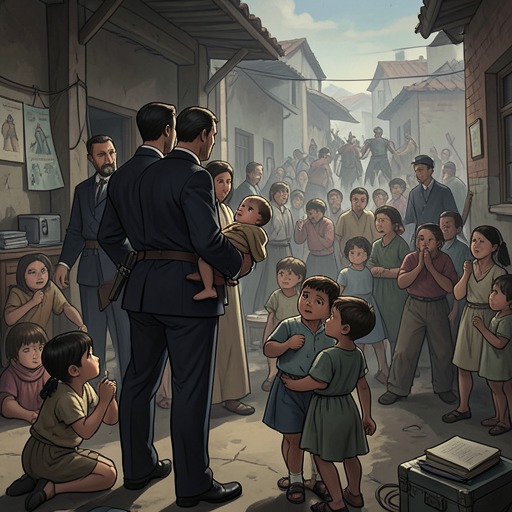
Cajeiri
PeacemakerCajeiri is the son of Tabini and Damiri, and the heir whose ninth birthday becomes a public turning point. Still a child amid political danger, he tries to understand what adults withhold, keep his human friends safe, and meet the responsibilities gathering around him. His birthday is not simply a celebration: Tabini formally proclaims him heir before witnesses, while Cajeiri’s own speech describes the kind of future he hopes to serve. The day closes with the birth of his sister, Seimiro, placing a new family bond beside his newly affirmed political identity.
Identity and Childhood Under Threat
When Cajeiri is eight, he is traveling toward Shejidan after a night of violence. His great-grandmother, Ilisidi, has arranged for a regular train to collect the party at Tirnamardi. The passenger car is brown, made largely of enameled metal, and less comfortable than his father’s red car; it has no armor. The curtains must remain down because the train is supposed to be empty, and because its occupants are not safe. People have died in the fighting, including people on the other side who shot at Bren Cameron and Jase Graham, and enemies remain at large. The Guild guards are so exhausted that most have fallen asleep, even though further fighting may follow on arrival.
Cajeiri understands that the instruction not to cheat is serious. He knows there has been violence, and that safety cannot be assumed merely because the immediate fighting has stopped. That awareness sits uneasily beside his age: he is still eight, but has already watched extraordinary political changes during that year and concludes that he must be ready for more. For him, politics means that no one can safely declare that a problem will never arise or that circumstances will remain fixed.
His concern extends beyond himself. He has to explain events to his three human guests—Gene, Artur, and Irene—without frightening them or revealing secrets that belong to Ilisidi. He recognizes that they know more than he can explain: they have seen the smoke beyond the hedges, ashes falling on the estate driveway, and bullet holes in the bus that carried them to the train. Jase Graham was close to the fighting on Kadagidi clan land, so Cajeiri expects the ship’s leaders to know facts he does not. His task is not to make the danger disappear, but to find a way to speak about it without making his friends more afraid.
Seeking Truth and Offering Protection
In Bujavid, Cajeiri asks Madam Saidin to stop keeping secrets from him. He reminds her that he is almost nine and that he and his guests were present at Tirnamardi. They know they must stay in the apartment and watch Boji carefully, but they also understand that his father is in danger. Cajeiri is troubled that the people connected to that danger are nearby in Ilisidi’s apartment, and wishes she would send them to the Bujavid guard instead.
Madam Saidin answers with details rather than a full disclosure. Ilisidi has servant passages and storerooms that can be made comfortable and secure, she explains, so the detained people need not be lodged in the apartment proper. Lord Aseida is reputed to be indolent and self-indulgent; the two Assassins are indebted to Ilisidi and are guarded. The explanation offers practical reassurance but does not remove Cajeiri’s awareness that his father and the household remain exposed to political danger.
Bren Cameron prepares for the possibility that his own plans may fail. In a contingency letter, he tells Cajeiri to place himself and his guests under Jase Graham’s protection and obey Jase’s orders. The letter promises that Tabini, Ilisidi, and Jase will protect Cajeiri and Lord Tatiseigi through wise action if something goes wrong. Bren also addresses Cajeiri’s future directly: he urges him to become an excellent and wise aiji when his time comes, and explains that he is taking the risk in hope of Cajeiri’s long life and success. The message treats the boy as both someone who must be protected now and someone expected eventually to bear responsibility for others.
Friendship and the Return to Bujavid
Cajeiri’s bond with his human friends is shaped by the difference between their worlds, but he does not treat that difference as a reason to abandon their connection. When the group’s unease makes the distance between them palpable, he reaches for the gesture from their first meeting in the ship corridors: a hand laid on his chest as he introduces himself. He says, “Cajeiri. I’m Cajeiri.” Gene answers with the same solemn gesture, names himself, and identifies Irene and Artur as human. Cajeiri answers, “Ateva,” then declares, “No change!” The brief exchange restages their first encounter and affirms that their friendship still holds, even after danger and the misunderstandings that come with being from different peoples.
The return to Bujavid is also a moment of public welcome. At dinner, Tabini brings the gathering to attention and says that Cajeiri and his guests need rest. Cajeiri follows his father’s formal cues, and the guests bow when he prompts them. Tabini welcomes them and expresses relief that his son has returned safely. The ceremony gives the children a place in the household’s public life, while reminding Cajeiri that even a family welcome has rules of rank, timing, and proper conduct.
The Ninth Birthday and the Proclamation of an Heir
The arrangements for Cajeiri’s birthday make the demands of public rank explicit. Tabini’s letter sets out a day divided among family, personal guests, and official visitors: Jase Graham will escort the human guests to Bren Cameron’s apartment, while Cajeiri and his guards go to his parents’ apartment for a private breakfast. A family luncheon follows; Lord Tatiseigi is to escort Ilisidi on a private museum tour, ending in a larger reception and formal Festivity in the Audience Hall. Cajeiri is told to explain to his friends that the arrangements do not indicate precedence, rank, or favor. The residency lift system’s capacity and the need for the hosts to arrive together determine the schedule.
Cajeiri finds the day less simple than its ceremonial plan suggests. He tells his friends that he must spend the day with his parents and then attend a large public event, where he will have to speak to hundreds of legislators in court dress, stand beside his parents, bow, and smile. His guests are to remain with Jase Graham and Bren Cameron. He demonstrates the restrained court smile he expects to wear and complains that they must all be proper throughout the evening. The performance is already part of his obligation: he must present calm courtesy even when he would rather be with his friends.
On the morning itself, Gene and Artur wake him with birthday wishes, first in a halting phrase and then in ship-speak. Cajeiri is too happy to suppress his grin, but answers them politely. Irene wakes in embarrassment, finding herself in her nightrobe while attendants are present; Cajeiri reassures her that they have layered the bedclothes and that everyone is properly covered. The small domestic awkwardness sits beside the formality awaiting him outside the guest quarters.
After breakfast, Cajeiri changes into court dress and learns that the speech he must memorize is three full paragraphs, not the few lines he had expected. The scratchy lace and the length of the address make the birthday’s public demands tangible. In the Audience Hall, Tabini announces before the gathering that Cajeiri is his son and heir, and calls on the appropriate legislative bodies to proclaim him aiji of the aishidi’tat when the time comes. He asks his kin and associates to support the claim and give Cajeiri their man’chi. Tabini’s hand remains on his son as the declaration is met first by a murmur and then by a shout. The staff strikes the floor to restore silence. Cajeiri is not merely being praised on his birthday: his succession is being named before witnesses and framed as a claim requiring public support.
Cajeiri’s Speech and the Meaning of the Day
In his own speech, Cajeiri thanks the people whose actions have shaped his life. He honors Tabini for fearing no one, Damiri for guiding him, and Ilisidi for defending him. He thanks Bren Cameron for saving his life and Lord Tatiseigi for teaching him traditions; he also credits Lord Geigi and Jase Graham with teaching him about space, the Guilds with their work, and his tutor with helping him understand how things function. The sequence makes his education more than a list of lessons: it joins personal protection, family guidance, political institutions, and knowledge of the wider world.
He describes what he has learned, from geography, clans, and their colors to rain, airplanes, comets, tides, and storms, and says he is still learning kabiu. He connects tradition and harmony with art, and art with beauty; learning why things are beautiful, he says, helps people become better, kinder, and wiser. He wants to learn, act, and meet as many people as he can during his fortunate ninth year. His closing wish is for Tabini to remain aiji for a long time and for everyone at the gathering to enjoy the occasion. Above all, he identifies the aishidi’tat as their home and says they must make it the most beautiful place there is.
After speaking, Cajeiri worries that his ideas ran together and that he may have committed an infelicitous error. The gathering’s silence leaves him fearing that he has disappointed his father or offended the assembled kabiuteri. Later, the elders address him as young aiji rather than young gentleman. He wonders whether this change in address is caused by his fortunate ninth birthday, Tabini’s proclamation, or a paper being carried through the city. No one has told him that the birthday would change everything, and he is unsure whether the new form of address means he must already behave like his father, conducting business and signing papers. His uncertainty preserves the difference between being publicly named as heir and feeling ready to occupy that position.
Seimiro and the Close of the Day
The birthday also becomes the day Cajeiri meets his newborn sister. Damiri is propped up in bed with her hair tied by a ribbon, while Tabini sits beside her. In Damiri’s arms is a white blanket that makes the scene resemble a machimi performance to Cajeiri, as if he were looking at somebody else’s family on a stage. When he comes closer, Damiri smiles and moves the blanket to show him a new, tiny face. She names the baby Seimiro and tells him that she is his sister.
The day continues past midnight with fruit drink, cake, and stories. Lord Tatiseigi returns and asks about the baby and Damiri. Cajeiri reports that both are well and that Tabini is very happy. Lord Tatiseigi congratulates him as a young aiji and calls the day fortunate: Cajeiri’s ninth year and Seimiro’s first begin on the same day. The ending joins the public and private changes without resolving Cajeiri’s questions about what his new title will require. He has been proclaimed heir, welcomed by a new form of address, and made an elder brother; the future arrives through ceremony, family, and the expectations he is only beginning to grasp.